

The complexity of modern care delivery has rendered the traditional, monolithic hospital management systems insufficient for high-acuity environments. Today’s healthcare leaders are shifting focus from static record-keeping to dynamic management, seeking solutions that bridge the gap between clinical data and operational throughput.
Successful hospital management software development now requires building an integrated ecosystem that harmonizes patient flows, resource allocation, and financial health in real time.
Operational inefficiency remains a critical barrier to care quality. A recent study by PwC highlights that "administrative costs climb toward 25% of national health spending", with a significant portion of these expenditures attributed to "administrative overhead and fragmented information infrastructure".
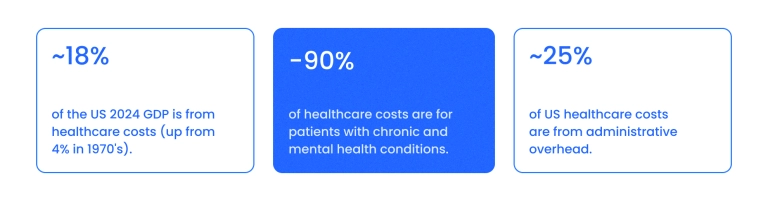
To combat this, providers are moving toward a custom healthcare software approach that prioritizes interoperability over isolated data entry.
In this guide, you will learn:
- The shift from monolithic HMS to modular Hospital Operations Platforms
- How to orchestrate workflows across EHR, LIS, and RCM entities
- The role of Agentic AI in automating clinical and back-office tasks
- Security and compliance benchmarks for the 2026 regulatory landscape
From HMS to hospital operations platform
The industry is moving away from the "all-in-one" software model toward a unified hospital operations platform that functions as an intelligent layer above existing infrastructure.
Rather than replacing core systems, this architecture integrates with legacy EHRs and RIS/PACS to create a "digital nerve center". This evolution ensures that data doesn't just sit in a database but actively drives clinical workflows and administrative efficiency across the entire enterprise.
What is a hospital operations platform, HMS, and HIS?
In modern healthcare, the terms HMS system, HIS, and Hospital Operations Platform are often used interchangeably, yet they represent distinct stages of digital maturity.
A Hospital Information System (HIS) is the foundational data layer, primarily focused on the storage and transmission of patient medical records and clinical data.
A traditional Hospital Management System (HMS) expands this by adding administrative layers like billing and scheduling.
However, modern hospital management system design is moving toward the Hospital Operations Platform. Unlike older, monolithic systems that act as static databases, a modern platform serves as an active management layer. It integrates entities, such as EHRs, pharmacy systems, and RCM, into a unified ecosystem.
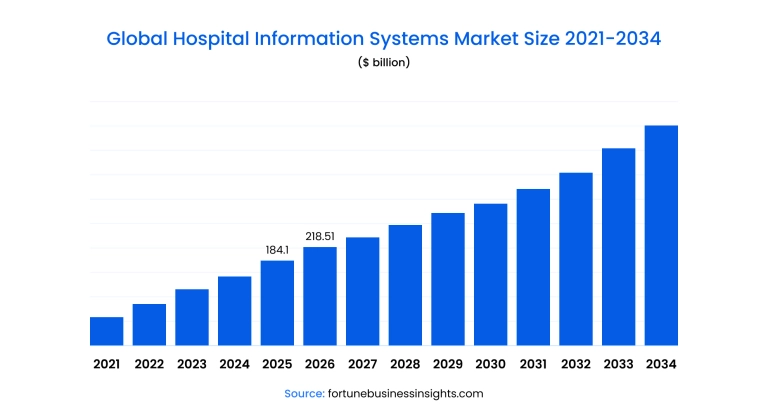
According to Fortune Business Insights, the market for these integrated systems is projected to reach 0.71 billion by 2034, driven by a transition toward "cloud-enabled and interoperable hospital platforms" that prioritize real-time data flow.
The shift from monolithic to modular architecture
The primary difference between "old" HMS and modern platforms lies in their structural flexibility. Traditional hospital management software features were often locked into rigid, all-in-one "black box" solutions that made updates difficult and expensive.
Modern platforms utilize a modular, API-first approach to ensure:
- Interoperability: Seamless data exchange between legacy HIS and new digital tools.
- Scalability: The ability to add specific modules (like AI-driven diagnostics) without rebuilding the core.
- Agility: Faster clinical workflow optimization by allowing independent updates to specific operational blocks.
This modularity transforms the software from a simple record-keeping tool into a dynamic engine that manages the complex "back office" and "clinical front door" of a 2026 healthcare facility.
Potential benefits for clinical operations and back office
Modern hospital management system development has evolved from simple administrative digitization into a comprehensive strategy for operational excellence. By moving beyond basic record-keeping, a unified platform addresses the "digital front door" and the "back office" with equal precision.
This dual focus ensures that patient engagement remains high while the administrative machinery behind the scenes operates without friction.
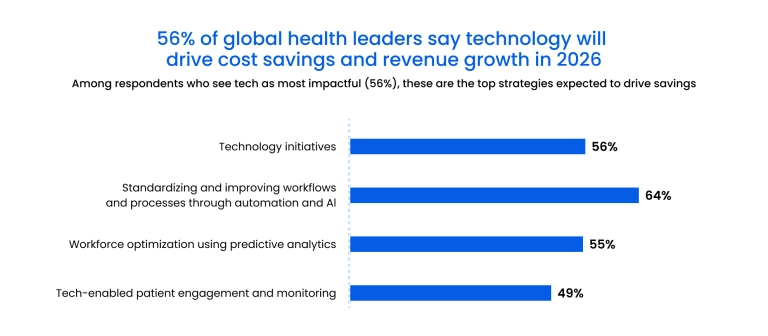
The financial and clinical impact of this shift is measurable. According to the 2026 Global Health Care Outlook by Deloitte, "64% of respondents said AI could reduce costs by standardizing and automating workflows", while nearly half of healthcare executives expect major savings from "tech-enabled patient engagement". This level of hospital management system software directly translates into reduced clinician burnout and a more responsive patient experience.
The primary goal of how to develop a hospital management system today is to remove the "invisible work" that keeps providers away from their patients. This is achieved by optimizing three core areas:
- Clinical Operations. Real-time visibility into bed management, staff rounding, and patient throughput. By integrating a healthcare CMS with the clinical layer, providers can deliver personalized patient education materials directly to the point of care.
- Digital Front Door. Seamless patient self-scheduling, automated digital intake, and omnichannel communication that reduces no-show rates and improves the pre-arrival experience.
- Back Office and Analytics. A robust hospital database management system synchronizes RCM (Revenue Cycle Management), supply chain tracking, and payroll. This ensures financial transparency and allows leadership to identify which service lines are performing optimally and which require resource reallocation.
The impact is direct: when data flows vertically and horizontally across these departments, the facility shifts from a reactive stance to a proactive, data-driven care model.
Core features of a modern hospital operations platform
A high-performing hospital management software system is no longer defined by its ability to store data, but by its ability to move it.
In 2026, the architectural standard has shifted from passive modules to an active "operations layer". This transition is driven by the urgent need to address administrative complexity. Modern design bridges the gap between clinical intent and operational execution, moving away from static records toward autonomous operation.
The anatomy of an intelligent ecosystem
To effectively scale in a high-acuity environment, hospital management system features must prioritize "action-oriented" design. This ensures the system doesn't just record data but initiates the logistical chain required to optimize care delivery.- Workflow and Process Optimization. Beyond basic scheduling, the platform utilizes to manage "bed-turnover" lag. When a discharge order is signed, the system autonomously triggers environmental services and transport, reducing idle time and improving patient throughput without manual intervention.
- Real-Time Clinical Analytics. Modern platforms function as a command center, processing live telemetry from IoMT devices. By leveraging predictive modeling, these systems can identify early signs of sepsis or patient deterioration, often up to 48 hours before a clinical crisis, allowing for proactive intervention.
- Intelligent Inventory and Pharmacy. In 2026, inventory modules function as self-governing supply chains. They track everything from surgical mesh to high-cost biologics, automatically adjusting reorder points based on real-time surgical schedules and seasonal disease trends to eliminate waste and prevent stockouts.
- Automated Finance. To combat revenue leakage, modern platforms embed AI-driven coding engines. These interface directly with payer APIs to provide real-time authorization decisions, significantly shortening the "quote-to-cash" cycle and reducing claim denials.
- Zero Trust Data Security. Protection is baked into the architecture through "Confidential Computing". This ensures that sensitive PHI remains encrypted even during active processing by AI models, meeting the strict NIST CSF 2.0 standards required for 2026 compliance.
The modern platform acts as the "connective tissue" between clinical entities and back-office systems.
By moving from a "request-response" model to an event-driven architecture, the platform ensures that data from the Lab (LIS), Radiology (RIS/PACS), and Finance (ERP) is synchronized in real time. This integration eliminates data silos, allowing C-suite leaders to view the facility's clinical and financial health through a single, unified lens.
Key modules and integrations
Modern how to make hospital management system software strategy has shifted from building a monolithic "all-in-one" product to developing a high-velocity "hospital operations layer".
This layer sits above specialized legacy systems, orchestrating data flow rather than trying to replicate every native function. In this architecture, the medical management system acts as the digital connective tissue, ensuring that clinical, administrative, and financial entities communicate without friction.
According to the market analysis from early 2026, the move toward these modular "platform-of-platforms" is the primary driver for hospital efficiency this year.
A future-ready platform functions by integrating essential modules into a single ecosystem, allowing data to trigger actions across departmental boundaries. Rather than acting as a static database, the operations layer transforms disparate systems into an active engine for hospital-wide coordination.
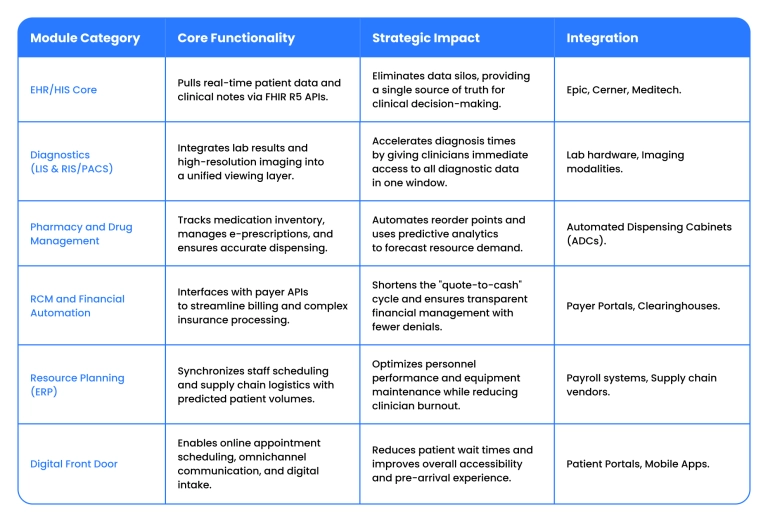
By treating these modules as interconnected nodes rather than isolated silos, a modern platform ensures that information is not just stored, but utilized to drive immediate clinical and financial actions. This "operations layer" approach allows hospitals to remain agile, swapping or upgrading individual modules without needing to overhaul the entire enterprise infrastructure.
Anchor title
The most transformative shift in 2026 is the transition from passive software to autonomous coordination.
While traditional HMS software for hospitals relied on manual data entry, the new standard is "Agentic AI". These are digital team members capable of reasoning, planning, and executing multi-step tasks across the clinical stack.
According to the 2026 Deloitte Health Care Outlook , agentic AI is the primary driver for reducing the "documentation tax" that has historically fueled clinician burnout.
The role of AI agents
To effectively develop a hospital management system today, architects must move beyond simple automation. Agentic AI functions as an asynchronous digital assistant that takes ownership of administrative friction.
Unlike a standard chatbot, an agent can manage complex conversations, send targeted reminders, and perform scheduled tasks without constant human oversight. These agents act as a persistent layer of intelligence, ensuring that no patient follow-up or administrative requirement falls through the cracks.
Event-driven triggers
The power of an agentic medical management system lies in its ability to react to real-time events. By moving to an event-driven architecture, the platform uses specific triggers to initiate action.
- Clinical Triggers: A signed discharge order or a critical lab result automatically alerts the transport, housekeeping, and pharmacy teams.
- Temporal Triggers: Time-based polling mechanisms, such as APScheduler, initiate check-ins or follow-up documentation requests at pre-defined intervals.
- Predictive Triggers: AI models identify early signs of patient deterioration, triggering an agent to notify the rapid response team and update the design of a hospital management system to prioritize the patient's care.
The transition from theory to practice is best illustrated by the implementation of agentic workflows in EHR . Binariks recently partnered with a healthcare developer to replace manual, disjointed processes with an autonomous coordination system. By deploying an event-driven "Agent Layer", the platform began handling the routine, high-stakes communication tasks that previously consumed significant staff time.
This shift to autonomous workflows fundamentally changed the daily operations of the facility. By automating repetitive documentation and follow-up flows, the solution allowed medical professionals to move away from administrative friction and focus entirely on critical patient care.
The system ensured that task completion remained consistent and records were easily traceable, proving that intelligent agents can maintain operational excellence even in high-pressure clinical environments.
Security and compliance in 2026
In 2026, the traditional security perimeter has officially dissolved. As hospitals shift toward cloud-native platforms and distributed care, the "trust but verify" model has been replaced by a mandatory Zero Trust Architecture.
Security is no longer a wrapper around the software; it is the core of hospital management software development. According to the latest NIST CSF 2.0 implementation guidelines , the addition of the "Govern" function makes cybersecurity an enterprise risk that must be overseen by senior leadership, moving it from the IT department to the C-suite.
The new regulatory baseline
The compliance landscape has shifted from periodic audits to continuous, automated oversight. Modern hospital management system features must now account for a strictly regulated environment where AI-specific statutes and high-speed recovery are the norms.
- NIST CSF 2.0 "Govern" Function. This centerpiece requires hospitals to establish and monitor a cybersecurity risk management strategy that is dynamically adjusted. It mandates a "top-down" approach where the board sets the strategy and IT executes the protection, specifically focusing on the security of the entire supply chain.
- The 72-Hour Restoration Rule. Under the 2026 HIPAA Security Rule updates, organizations are now required to demonstrate the ability to restore critical systems and ePHI within 72 hours of an incident. This makes legacy tape backups obsolete, forcing a move toward immutable, HIPAA-compliant cloud backup solutions.
- Mandatory Technical Safeguards. Previous "addressable" implementation specifications are now fully required. This includes universal Multi-Factor Authentication (MFA) for all system access, encryption of ePHI both at rest and in transit, and network segmentation to prevent lateral movement during a breach.
- AI Transparency and EU AI Act Compliance. As of August 2026, the EU AI Act requires strict transparency for high-risk AI systems in healthcare. Developers must provide documented proof of algorithmic logic, data source quality, and human-in-the-loop oversight to avoid massive non-compliance penalties.
By integrating custom healthcare software with built-in compliance engines, providers aren't just checking boxes. They are building a resilient infrastructure that protects patient safety as much as it protects data.
In 2026, a secure medical management system is one that assumes a breach is always possible and is engineered to contain, report, and recover from it in hours, not weeks.
The cost of building a hospital management system
Estimating the cost of hospital management system development depends on various factors, including the feature set, complexity, technology stack, software integrations, cooperation model, development team size, and location.
For instance, you might need a team comprising three backend developers, two frontend developers, a UI/UX designer, a QA engineer, and a project manager. Additionally, development rates vary by country.
In 2026, the budgetary focus has shifted from "all-in-one" licensing to the cost of maintaining a high-velocity "hospital operations layer". The primary financial drivers are no longer just the number of screens, but the density of the integration matrix.
Building a platform that operates data across EHR, LIS, and RCM requires sophisticated middleware and FHIR-based API development, as the system must act as the primary engine for hospital-wide coordination.
The most significant portion of a modern budget is now dedicated to interoperability and agentic AI. Rather than paying for static features, hospitals are investing in "connective tissue" that allows independent modules to communicate in real time. This modular approach ensures the medical management system remains a scalable asset that can ingest new AI tools or diagnostic modalities without a total system overhaul.
Why Binariks: Healthcare operations and AI expertise
Binariks bridges the gap between legacy hospital infrastructure and autonomous, AI-driven operations. Our hospital management software development practice is built on a single principle: the platform must act as an intelligent coordinator, not a passive database. By 2026, our engineering teams have standardized delivery of high-security, interoperable Hospital Operations Platforms that serve as a strategic layer above existing EHR, LIS, and RCM systems.
We work across greenfield builds and complex brownfield modernizations — with deep specialization in FHIR-based interoperability, Zero Trust compliance architecture, and agentic AI implementation in regulated clinical environments.
Case study: Agentic AI for clinical workflow automation
The challenge: A healthcare platform developer serving mid-sized clinics and hospitals was losing significant staff hours to manual documentation, fragmented task tracking, and inconsistent check-in processes. Medical professionals were spending large portions of their shifts on repetitive administrative work — time taken directly from patient care.
What Binariks built: We designed and delivered an event-driven agentic AI platform that automates scheduled check-ins, documentation flows, and task reminders across care teams. The architecture consists of three integrated layers:
- Agent Layer — Built on LangChain with Chain-of-Thought prompting, the agent composes contextual, clinically relevant messages tied to specific event types, with fallback support via Ollama or Together.ai for cost optimization.
- Scheduler Layer — A stateless APScheduler implementation polls a PostgreSQL database to trigger agent workflows with minimal latency, ensuring no check-in or reminder is missed.
- Microservice Infrastructure — The full solution is containerized via Docker and exposed through FastAPI endpoints, enabling horizontal scaling and future integration with hospital systems or third-party tools.
The MVP was delivered in four weeks, from scoping to production-ready deployment.
Results:
- 30% reduction in follow-up documentation time
- 2x increase in task completion compliance for scheduled check-ins
- Measurable reduction in staff administrative burden, allowing medical professionals to redirect focus to direct patient care
- Full documentation traceability through structured message storage and searchable records.
This engagement validated that LLM-based agents can operate reliably in routine hospital workflows without the overhead of complex training pipelines — and established a replicable architecture for expanded automation across care coordination and clinical communication.
Whether you are building a Hospital Operations Platform from scratch, integrating agentic workflows into an existing EHR, or modernizing a legacy HMS to meet 2026 compliance standards, Binariks provides the technical depth and regulatory expertise to execute.
Our work demonstrates that when intelligent agents are embedded into the design of a hospital management system, operational excellence becomes self-sustaining.