Streamlining Hospital Workflows: Agent-Based Automation Cuts Staff Burden by 30%


- PostgreSQL
- LangChain
- OpenAI
- Docker
- FastAPI
- SQLAlchemy
- APScheduler
SERVICES
EXPERTISES
Project Context
Solution
Outcome
About Client
The client is a healthcare platform developer focused on using AI-powered tools to improve clinical workflows.
The company serves mid-sized clinics and hospitals, helping staff simplify documentation, track tasks, and manage scheduled check-ins more consistently.
Its goal was to introduce AI agents capable of handling routine communication and administrative workflows while remaining scalable and easy to integrate with existing hospital systems.
Business challenge
Approach
To meet the client’s goal of automating check-ins and task management through intelligent, conversational agents, Binariks proposed a pragmatic and scalable architecture centered on event-driven interactions.
The solution was designed as an agent-based system, leveraging our expertise in machine learning, LLM integration, and production-grade service architecture. From the outset, our team closely aligned with the client’s technical goals, striking a balance between the rapid delivery of a functional MVP and long-term scalability and maintainability.
A dedicated engineering team worked in focused sprints to develop a working MVP, with the following components established early in the project:
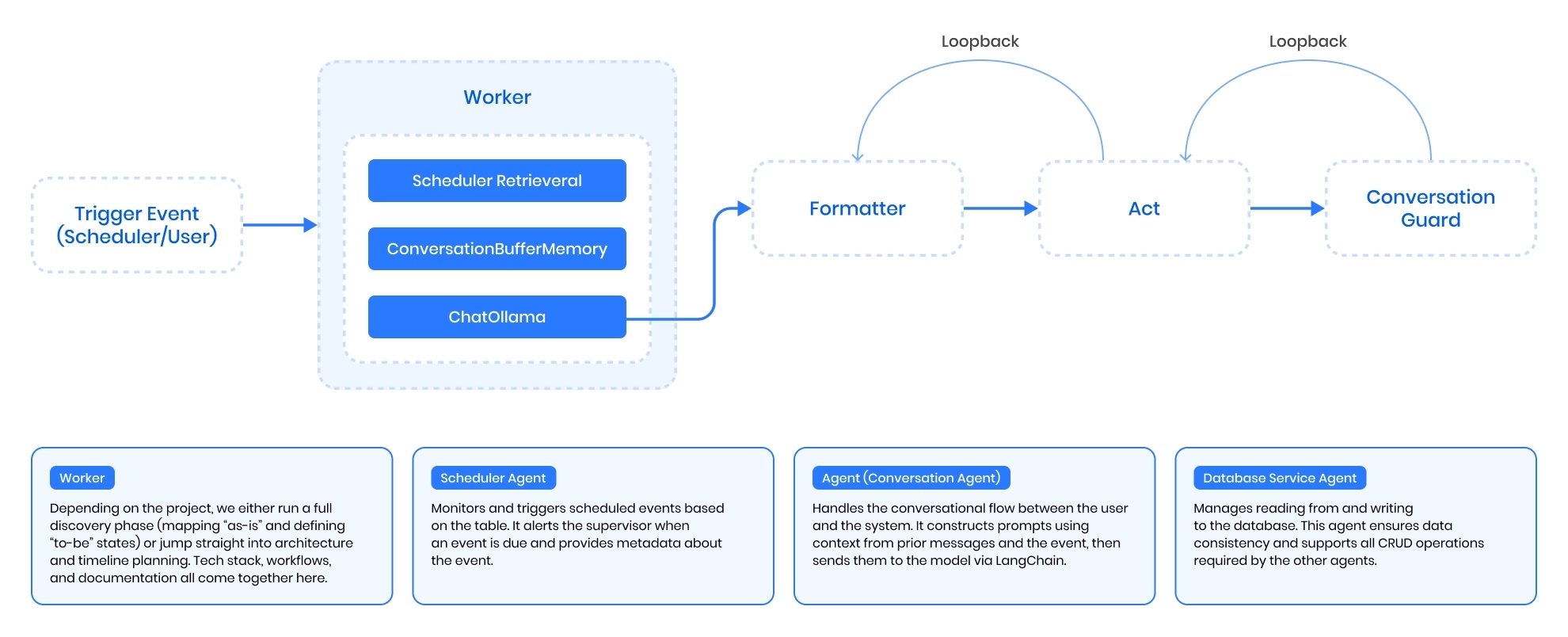
- Scheduling logic: We implemented a time-based polling mechanism using APScheduler to trigger scheduled events stored in the database.
- Agent orchestration: Each event initiates a prompt-building process. The agent composes relevant context and calls LangChain, which in turn invokes GPT to generate a response.
- Conversation handling: The system maintains conversation history and stores all updates in a PostgreSQL-backed database, which also holds user and event data.
- Microservice deployment: The full system is containerized using Docker and deployed as independent microservices, enabling future scalability and integration with hospital infrastructure.
The architecture was tailored to reflect the market demand for AI agents in healthcare while remaining lightweight and compliant with real-world deployment constraints common in mid-sized hospitals and clinics.
Implementation
Binariks implemented a lightweight, scalable system for scheduled agent-based communication tailored for healthcare environments. The architecture was driven by the need for asynchronous, intelligent task handling and structured documentation support, all without the overhead of complex training pipelines or infrastructure-heavy platforms.
The core functionality was designed and delivered as an MVP within just four weeks, demonstrating the team’s ability to execute quickly while adhering to enterprise-level quality and maintainability standards.
Architecture Overview
1. Agent layer
- Built using LangChain, the agent handles prompt construction and LLM-driven interactions
- Composes contextual messages using predefined templates tied to event types
- Supports prompt memory and response refinement through Chain-of-Thought (CoT) prompting
- Includes fallback logic for optional local inference via Ollama or Together.ai if needed for cost optimization
2. Scheduler layer
- Designed using APScheduler to poll scheduled events from a PostgreSQL database
- Triggers agent workflows at the appropriate time, ensuring timely and automated check-ins
- Stateless implementation ensures clean handoffs and minimal latency during execution
3. Database management
- PostgreSQL is used for structured storage of:Conversation historyUser profilesScheduled events
- Messages are stored as JSON objects, enabling easy traceability and format flexibility for downstream usage
4. Infrastructure & deployment
- Dockerized microservice model
- Exposed via FastAPI endpoints for asynchronous interaction
- Deployed in a modular structure to allow future integration with hospital systems or third-party tools
- Supports horizontal scaling and easy onboarding of additional agent workflows without architectural changes
5. Evaluation & iteration
- While no labeled training data or performance metrics were required, system behavior was continuously tested against real-world use cases
- Prompt templates and agent logic were iteratively refined based on internal testing and stakeholder feedback
- A human-in-the-loop approach involved domain experts reviewing outputs and guiding refinements, ensuring relevance, reliability, and user trust in real-world scenarios
- Compliance and usage metrics were tracked to assess practical effectiveness rather than model accuracy
Technology Stack & Justification
- Python: Chosen for flexibility, rich ecosystem, and ML/LLM compatibility
- LangChain: Simplified orchestration of LLM calls and memory handling
- OpenAI GPT-3.5-turbo: Used for initial deployment due to reliability and cost-effectiveness
- FastAPI: Provided async-ready, lightweight HTTP interaction
- Docker: Ensured environment isolation and deployment portability across infrastructure


Value Delivered
- 30% time saved on follow-up documentation tasks, thanks to structured, automated interactions
- 2x increase in task completion compliance for scheduled check-ins and reminders
- Reduced staff workload by automating repetitive communication and documentation flows
- Improved documentation traceability through structured message storage and searchable records
- Enabled asynchronous workflows, allowing staff to interact on their own time without disrupting patient care
- Enhanced staff productivity, allowing medical professionals to focus more on critical care instead of administrative overhead
More case studies


Web and Mobile solution for meditation
Binariks developed a mobile and web meditation app for Spanish-speaking users. We provided software development and QA services to launch a demand on the market product.
Software Development and Design Services for Food Marketplace
Binariks facilitated an American food delivery business by optimizing their web and mobile platforms, providing UI/UX services, and ensuring QA testing.
Secure Messaging Platform Based on ID Authentication
Binariks helped a Swedish technology company in developing a secure messaging platform based on the national BankID authentication.
Let's Start Your Project
We'd love to hear about the project you're working on. Simply complete the form and we'll be in touch.
What happens next?
Our expert will reach out to understand your goals and challenges
If needed, we'll sign an NDA to ensure full confidentiality
You'll receive a tailored roadmap with solution suggestions, timelines, and budget estimates