Boosting Efficiency and Reducing Infrastructure Costs by 20 Times for a Healthcare Data Analytics Company

20×

lower infrastructure costs

50% faster

data retrieval

Healthcare data analytics company case study

Project Overview

  • Country

    USA

  • Industry

    Healthcare

A Word from the Client

Jake Halpert

Jake Halpert

CEO, Healthcare Company

USA

Binariks is a highly professional organization; they’re dedicated and hardworking. They continue to be focused and strong — in fact, they’re even stronger than our US teammates in terms of excellence and dedication. Overall, we have a great team structure with the right people and personalities.

Our client is Nightingale Technology, a healthcare company specializing in data analytics tailored for primary care providers, exclusively serving Medicare patients.

They provide a structured and trusted data layer that enables providers, physicians, and insurance organizations to make informed decisions in patient care. Their platform consolidates and cleans Medicare data, positioning them as a niche leader in value-based analytics.

Business Challenge

  • The company needed to scale operations to support more primary care providers and Medicare clinics across the US.

  • Legacy infrastructure created limitations in processing and storing high-volume Medicare data securely and efficiently.

  • Internal teams faced difficulties managing complex workflows and pipelines across multiple systems and integrations.

  • The solution had to meet stringent regulatory compliance for healthcare data while remaining flexible for product innovation.

Our Solution

Approach

The primary objectives of our collaboration were centered around empowering analysts with an efficient tool to enhance the performance, accuracy, and overall quality of their Medicare data analysis and analytics services.

So, Binariks formulated a comprehensive strategy focused on leveraging advanced technologies and optimizing data management processes. The key solutions included:

  • Additional data sources: Integrated additional reliable data sources to enrich the Medicare dataset.
  • Deduplication of resources: Implemented robust deduplication processes to ensure data consistency and eliminate redundancies.
  • Cloud migration: Successfully migrated the data infrastructure to a more efficient cloud platform, addressing the intricate logic obscured within the previous cloud systems and optimizing the costs.
  • Development of notification network: Created a well-triggered notification network to promptly alert healthcare providers of critical insights and any essential changes in specific characteristics/limits/indicators. These characteristics are assigned to the data collected from public health datasets, a particular patient's hospital admissions record, lab results, wearables data, and more. They are displayed in user-friendly dashboards to present the most comprehensive picture for further analysis.

Implementation

Our project represents an unprecedented venture into the realm of "healthcare super data," as our client calls it. The intricacies of this highly complex system required meticulous attention, considering the absence of comparable products in the current market.

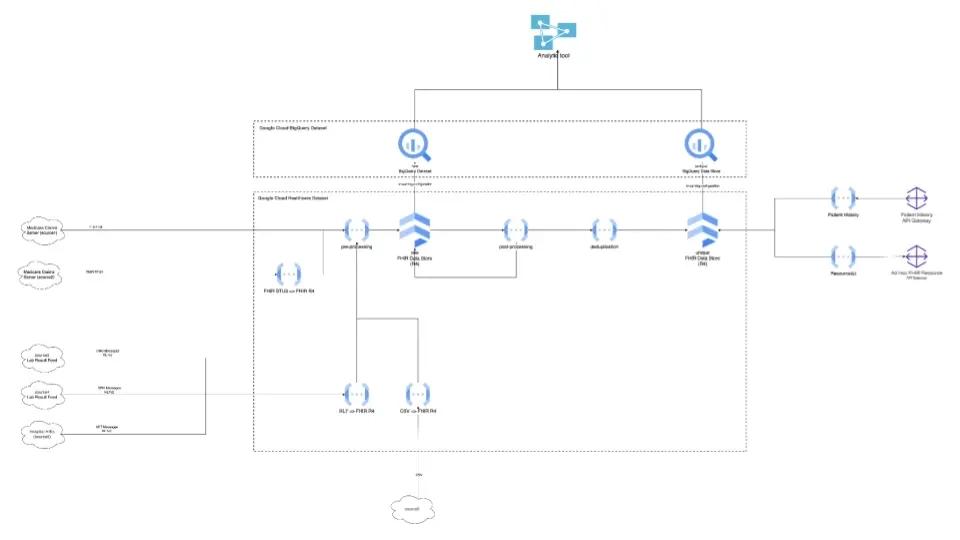
  • For instance, the data is ingested in various formats, including CSV, HL7, and different versions of FHIR, like FHIR STU3 and FHIR R4. While some sources provided completed, enriched resources, others offered less detailed data, and sometimes, this volume varied significantly, although the resource IDs in the database seemed the same. So, we had to check and validate everything case by case.
  • Also, prioritizing data accuracy, we devised a strategic plan to promptly trace and rectify discrepancies. This involved establishing robust rules on how exactly the system is supposed to handle one error or another or how to modify resources to ensure the highest quality of healthcare data.
  • A daring migration from AWS to GCP FHIR storage was a pivotal moment in our journey. We moved from the database which provides a closed database solution as a FHIR server. Instead, we chose GCP FHIR storage as the main database on which we are aimed to build our solutions, so to say, the heart of the system. The decision was made that all related services should also move to GCP for convenience and consistency. The migration process is now completed. The number of GCP services is constantly expanding and will continue to do so.
  • With information derived from seven different vendors, our task is to obtain, validate, and process diverse datasets. In general, we can leverage existing resources with sufficient information to generate entirely new data entities.

As of now, the system manages a staggering 20 million resources in production, terabytes of historical data, and handles diverse imports weekly, including real-time hospital data and monthly/quarterly data from open national databases.

The development process avoids ready-made solutions or frameworks, employing entirely custom code to meet unique requirements. Our transformative journey continues, shaping the landscape of healthcare data management.


Technologies Used

  • Node.js
  • Lambda
  • Typescript
  • Google Cloud
  • Firestore
  • JavaScript
  • AWS S3
  • CloudFormation
  • AWS IAM
  • AWS SQS
  • AWS Secret Manager
  • Google Cloud Storage
  • Big Query
  • AWS CloudWatch
  • Jest

Value Delivered

The modernized analytics platform supports broader adoption by Medicare-focused care providers. With scalable cloud architecture and improved data pipelines, it ensures compliance, faster processing, and easier integration for partners.

  • 20×

    lower infrastructure costs

  • 50% faster

    data retrieval

  • 100,000 requests

    are handled simultaneously

  • Drastic cost reductions: Moving to GCP services in 2023 resulted in substantial cost savings, eliminating, inter alia, expenses previously incurred for third-party analytics tools. Annual infrastructure expenses declined by 20 times! In addition to saving money, our decision also enhanced performance, enabling the system to handle 100.000 requests at a time with no problem. The transition resolved issues like system crashes, errors, data loss, and memory leaks, establishing a more resilient and efficient solution.
  • Expanded information volume: Our system now boasts a comprehensive seven-year patient history, providing a wealth of data for thorough analysis. Along with that, it hosts multiple resources with diverse attributes, resolving each issue individually. So, both data volume and completeness now far surpass the previous state.
  • Accelerated information retrieval: The time required for acquiring data from the source was reduced by half. Despite an augmented volume of data, our enhanced efficiency now allows for faster retrieval.
  • Diverse database integration: Utilizing various databases, including relational and nonrelational types, and different relational database models, ensuring flexibility and scalability.

Let's Start Your Project

We'd love to hear about the project you're working on. Simply complete the form and we'll be in touch.

What happens next?

01

Our expert will reach out to understand your goals and challenges

02

If needed, we'll sign an NDA to ensure full confidentiality

03

You'll receive a tailored roadmap with solution suggestions, timelines, and budget estimates