Transforming Water Filtration Management: From Outdated App to Smart IoT Solution

- Python
- React Native
- JavaScript
- GitHub Actions
SERVICES
Project Context
Solution
Outcome
About Client
Our client is a global leader in filtration solutions, serving automotive and industrial sectors.
Founded in the early 1940s in Germany, the company employs over 23,000 people worldwide and specializes in developing advanced filtration technologies, including air filter systems, intake manifolds, liquid filtration, and cabin air filters. With decades of engineering excellence, they're pioneering smart water treatment solutions for residential markets in the US and Europe.
Business challenge
The company had secured investment to launch a mobile application for their IoT-enabled water filtration systems – a critical step in their digital transformation strategy.
However, they faced a problem that many hardware manufacturers encounter when moving into smart products: their existing mobile application was failing to meet both customer expectations and internal quality standards.
The pain points were clear and costly:
- Poor user experience was damaging the product's market positioning. Customers who invested in premium filtration systems expected seamless digital control, not a frustrating app experience.
- Limited functionality meant users couldn't effectively monitor their water consumption, track filter performance, or control their devices remotely – the core value propositions of an IoT product.
- No offline capability left users helpless when internet connectivity dropped, a critical flaw for a system managing essential household water quality.
- Time pressure was mounting. With fresh investment secured and a competitive market window closing, the company needed to deliver a production-ready mobile solution fast, without compromising on quality or reliability.
The stakes were high: they needed to deliver a solution that would justify their customers' investment in smart filtration technology and meet the needs of homeowners in the US and Europe dealing with water quality concerns.
Approach
Binariks was selected after a comprehensive vendor evaluation that assessed technical expertise, reviews, and communication capabilities – ultimately chosen for proven React Native experience and IoT integration capabilities.
Building the Foundation
The engagement focused on four critical modules: water consumption statistics, filter monitoring, remote device control via Bluetooth, and offline functionality.
We deployed a strategic team: 2 React Native developers with IoT experience, 1 AWS backend developer, 1 QA, and 1 Project Manager to coordinate with the client's product owner and stakeholders.
Framework for Success
The project ran on Scrum methodology with 2-week sprints, balancing flexibility with predictable delivery. Regular refinement sessions, planning, and retrospectives kept teams aligned on priorities and challenges.
A critical early discovery shaped our strategy: existing Bluetooth Low Energy libraries couldn't maintain stable connections with the filtration devices.
Rather than compromise, we developed a custom native BLE module – adding complexity but ensuring the reliability the product demanded.
Technology choices aligned with the client's existing expertise. Python was selected because their internal team had strong Python knowledge, while Microsoft App Center and GitHub Actions were chosen based on their familiarity with these CI/CD tools, ensuring smooth handoffs and future maintainability.
Implementation
Architecture & Infrastructure
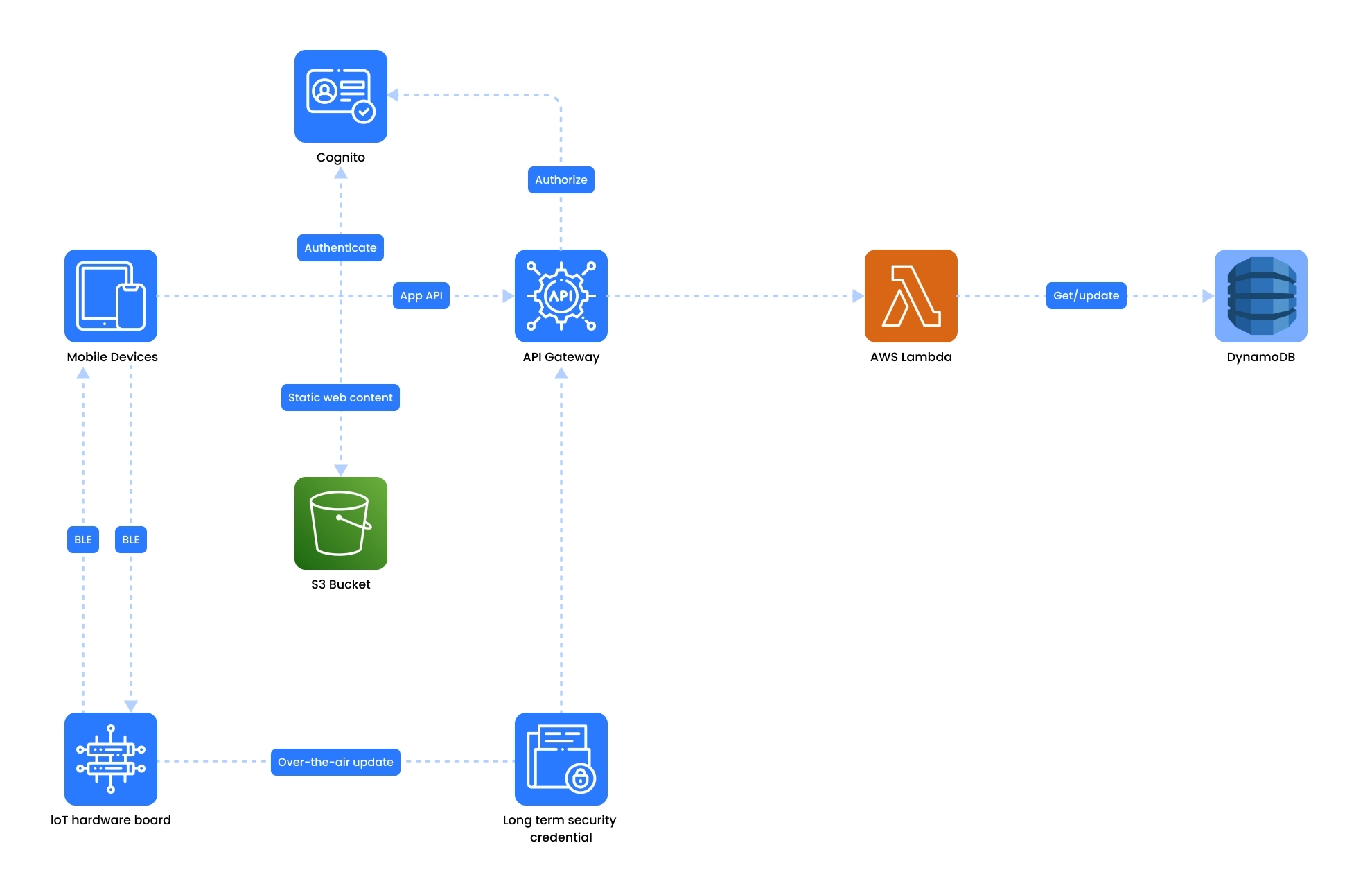
The solution was built on serverless AWS architecture for scalability and operational efficiency:
- AWS Lambda functions handle backend operations, from data processing to authentication
- Amazon DynamoDB stores user profiles, device data, and consumption statistics
- AWS Cognito manages user authentication and authorization
- Firebase powers real-time notifications and analytics
- Jira facilitated project management across distributed teams
Mobile Application
The React Native application was designed for performance and maintainability.
State management uses Redux with TypeScript for type-safe data flow—critical for managing complex IoT device states and offline synchronization.
Custom BLE module was developed to overcome stability issues in existing libraries, ensuring:
- Reliable device discovery and connection
- Stable data streaming from sensors
- Graceful handling of interruptions
- Background connection management
Offline-first architecture enables full functionality without internet:
- Local data caching for statistics
- Queue-based sync when connection restores
- Direct Bluetooth device control
- Cached manuals and product information
Core Features
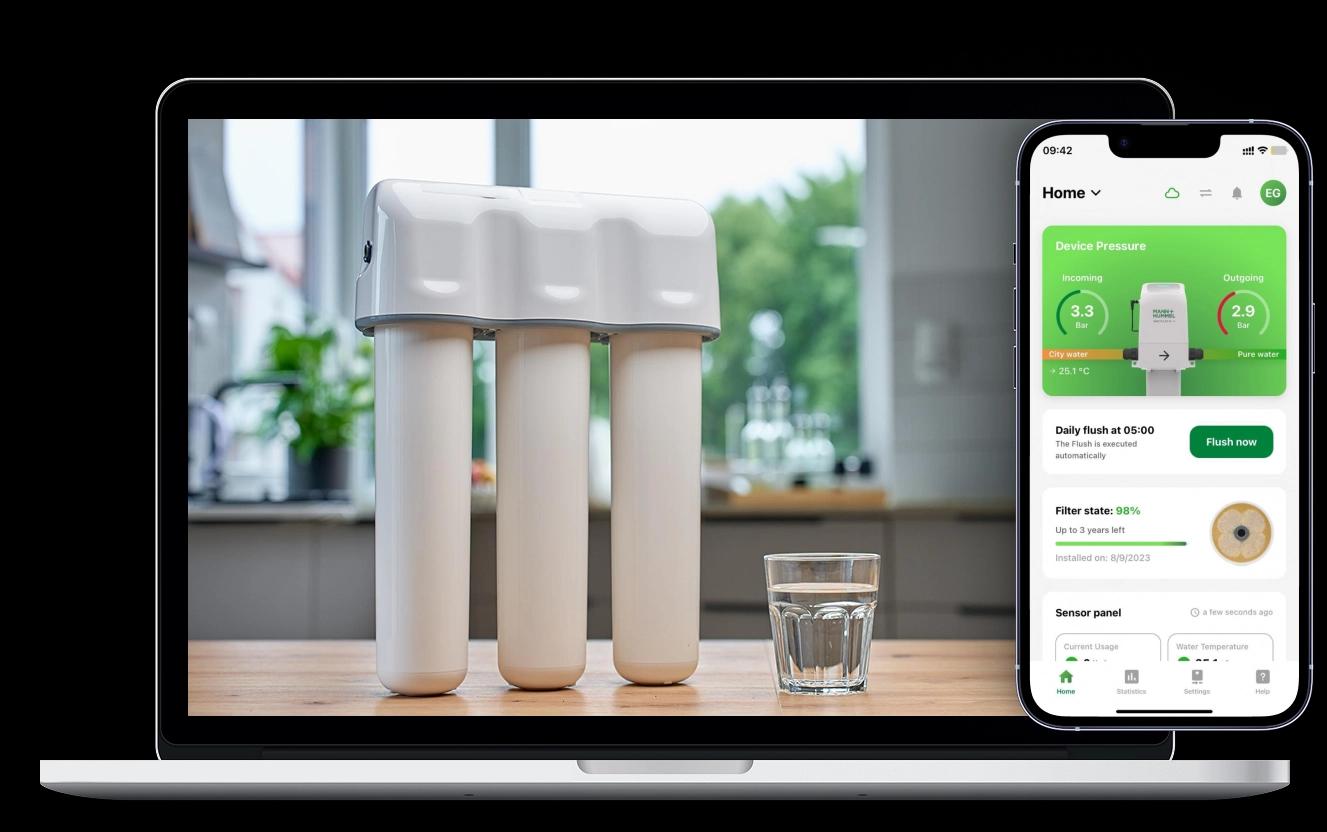
- Water consumption statistics: Built with d3.js, displays real-time and historical usage patterns with visual indicators for unusual activity that might signal leaks or filter issues.
- Filter monitoring: Tracks filter lifespan based on actual water volume processed, calculates remaining capacity, and sends proactive replacement notifications with direct links to the online store.
- Remote Control via BLE: Direct Bluetooth communication enables users to control filtration settings, run diagnostics, and receive immediate status updates—no cloud required.
- Offline mode: Device control, consumption viewing, and filter monitoring work entirely through local Bluetooth and cached data.
Quality Assurance & Deployment
CI/CD pipeline using Microsoft App Center and GitHub Actions leveraged the client's existing infrastructure knowledge. Automated testing with Jest ensures code quality throughout development.

Value Delivered
The application launched successfully in September 2023 and now serves customers across US and European markets.
Business objectives achieved:
- Water consumption statistics – Users track usage patterns with detailed analytics, identifying potential issues early
- Filter monitoring – Automated tracking eliminates guesswork about replacement timing, improving performance and peace of mind
- Remote control via Bluetooth – Seamless device management without cloud dependency provides reliability and privacy
- Offline functionality – Critical features work without internet, even in areas with unreliable connectivity
Beyond the original scope:
- Enhanced brand positioning – The polished mobile experience repositions the client as a high-tech innovator in a traditionally hardware-focused industry, strengthening competitive differentiation.
- Return on investment – The successful launch delivered measurable ROI, validating the initial investment and opening new revenue opportunities.
- Customer satisfaction uplift – Addressing previous pain points significantly improved user experience, directly impacting reviews and retention. The company reports increased satisfaction among existing customers.
- New customer acquisition – The enhanced mobile experience became a key market differentiator, attracting customers seeking smart, connected filtration solutions.
For households dealing with water quality concerns, this solution transformed frustration into confidence, providing real-time insights and control, accessible anytime, online or off.
More case studies


Web and Mobile solution for meditation
Binariks developed a mobile and web meditation app for Spanish-speaking users. We provided software development and QA services to launch a demand on the market product.
Software Development and Design Services for Food Marketplace
Binariks facilitated an American food delivery business by optimizing their web and mobile platforms, providing UI/UX services, and ensuring QA testing.
Secure Messaging Platform Based on ID Authentication
Binariks helped a Swedish technology company in developing a secure messaging platform based on the national BankID authentication.

