

The worldwide software development outsourcing market will expand by 7.7% from 2021 to 2027, bringing the sector to $937 billion in revenue in only six years (Source ). A dedicated team is one of the ways businesses can address such expansion.
While most businesses have already accepted remote work, they may now expand their teams with talent worldwide. The easiest method is to assemble a dedicated software development team within an experienced company. Well-established companies and growing startups already use a dedicated team approach to close the local talent gap.
This model not only offers access to a global talent pool but also provides greater flexibility and scalability for projects of varying complexity. By opting for a dedicated team, companies can maintain full control over the development process while leveraging specialized expertise that may not be available locally.
In fact, 70% of businesses are now looking to outsource key functions, with software development being a top priority. Additionally, companies that leverage dedicated teams can reduce development costs by up to 60% while accelerating time-to-market by 30% on average.
In this post, we'll analyze the benefits and alternatives of a dedicated team model structure and why you may want to use dedicated team services .
Key takeaways:
The dedicated team model is a powerful approach for software development projects, offering benefits like improved communication, transparency, and specialized expertise. However, it can also come with higher costs and may not be the best fit for short-term or smaller-scale projects.
Before choosing a dedicated team, project managers should take the responsible and proactive step of carefully assessing their project's specific needs and goals. Ensuring the team is composed of skilled professionals fully committed to the project and aligned with the client's expectations is crucial for success.
Establishing clear communication channels, defining roles and responsibilities, and regularly monitoring progress are essential practices. These steps help maximize the advantages of the dedicated team model, ensuring a successful project outcome while mitigating potential drawbacks.
What is a dedicated team?
A dedicated team is a type of outsourcing where you hire a remote development team with a dedicated project manager and entrust your project to them. This model involves close collaboration between the outsourced developer team and the client. It is particularly suitable for long-term projects with evolving requirements and frequent scope changes.
In the DT model, the outsourcer's development team works on a specific project full-time, reporting directly to the customer. The team's primary goal is to operate as part of the client's team to give excellent, distinctive, and project-specific solutions. The outsourcing company provides recruiting services, administrative support, and maintenance.
A few benefits of outsourcing software development to a dedicated team are:
- You can concentrate on brand promotion, R&D, or scaling strategies while your dedicated team provider handles hiring, infrastructure setup, legal paperwork, and payroll for the remote team.
- A dedicated team is focused on one project at a time, which boosts both the speed and quality of the work.
- You can change the size of a team when a workload grows bigger or smaller. An outsourcing company will hire new people when necessary and manage the recruitment.
- Outsourcing is an excellent approach when some departments want more resources, such as audits and tax season for the accounting department or a product launch for marketing when additional people are needed.
- You won't have to explain the workflow and will save money on training. Why? Outsourced experts already know how to work remotely.
- A dedicated team's price strategy is simple. Since you hired a team, each person has a set hourly fee, and you only pay for the hours performed. This is the only item you have to pay for. There are no additional costs for renting an office for a team, purchasing equipment, paying taxes, paying electrical bills, etc. Furthermore, hiring a dedicated software development team is cheaper and faster than looking for each tech specialist independently and engaging recruiters and HR managers.
To summarize, when managing dedicated teams, you receive a team of specialists who have been hand-picked to meet your unique business goals.
Dedicated team vs. extended team
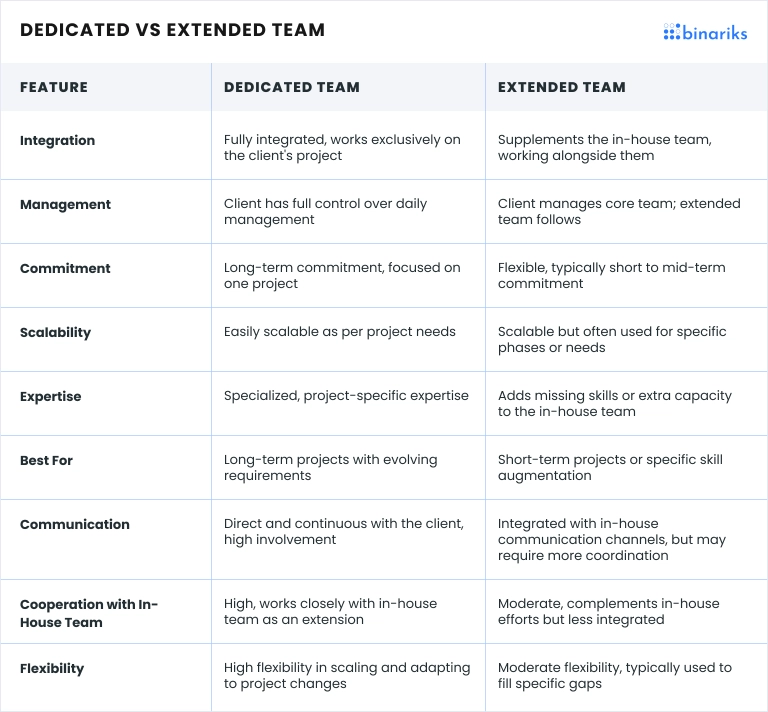
A dedicated team and an extended team structure are common models in outsourcing that are often compared or even confused. Here's a breakdown of their differences:
Dedicated team
- Composition: A dedicated team consists of specialists fully committed to one project. They work exclusively for a client over a long period. A dedicated team is also suitable for companies without an in-house development team.
- Management: The client usually controls the team, managing day-to-day operations and decisions. A project manager from the side of a dedicated team is also often present.
- Flexibility: Highly flexible in scaling the team based on the project needs.
- Expertise: Offers deep domain knowledge as the team is focused solely on one project.
- Best for: Long-term projects, where ongoing maintenance, profound product knowledge, and team continuity are priorities. Also, for complex projects that require niche specialists and full dedication.
- Advantages:
- High focus and productivity.
- Clear communication and control over development.
- Easily scalable and flexible.
- Teams with cross-functional skills and niche specialists are both available.
- You are not involved in hiring directly.
- Disadvantages:
- Can be more expensive than other models due to exclusive commitment, but the budget can be adjusted if the talent pool from multiple locations is available.
- Potential underutilization if the workload fluctuates.
Extended team
- Composition: An extended team supplements the client's in-house team by adding additional experts or specialists. They work as an extension of the existing internal team if you need to close some knowledge gaps.
- Management: The in-house team remains the core, while the extended team integrates into existing workflows and management structures.
- Flexibility: Provides flexibility in scaling up resources quickly without the need to fully onboard new in-house staff. You can hire only some specialists you're missing, and there is no need to hire an entire team.
- Expertise: Adds specific skills or expertise lacking within the in-house team.
- Best for: Projects needing additional resources or particular skills temporarily, without long-term commitments.
- Advantages:
- Fast scaling and integration with existing operations.
- Access to specialized skills without a full commitment.
- Disadvantages:
- Potential communication challenges.
- Requires effective coordination to maintain workflow consistency.
What are the 7 benefits of a dedicated development team?
If you're looking to manage a software development team , working with a dedicated team of developers can make the process much smoother. A dedicated professional company manages the process and can find you a professional team way faster than you could on your own. Here are the dedicated team advantages:
1. Cost efficiency
Using a dedicated team of developers can save you time and money by avoiding the hassle of hiring, training, and onboarding new staff. When the project wraps up, you only pay for the time you need, with no hidden fees.
2. Global talent pool
When local talent is hard to find, a dedicated team gives you access to skilled professionals worldwide without the headaches of international hiring.
3. Long-term focus
For projects that need ongoing attention, outsourcing software development to a dedicated team keeps things on track, letting your in-house team focus on other important work.
4. Specialized expertise
If your project requires skills your team doesn't have, a dedicated professional team brings the right experts on board, so you don't need to invest in long-term hires.
5. Full control and visibility
With a dedicated team, you're always in the loop. You can oversee the work directly, set priorities, and manage tasks as if they were your own employees.
6. Dedicated commitment
Your dedicated team of developers is fully focused on your project, with no distractions from other clients. They're engaged, involved in daily tasks, and participate in brainstorming to improve workflows and long-term planning.
7. Easy scaling
As your project grows, you can easily scale the team up or down without the complications of traditional hiring or layoffs.
When is a dedicated team not for me?
In some cases, outsourcing dedicated software development teams is overkill or would not work for you. If you recognize your project in this, a dedicated team is not for you:
- Short-term or one-off projects: If your project is short-term, one-time, or has a well-defined scope that can be completed quickly, hiring a dedicated team is likely overkill. A project-based model or freelance resources might be more cost-effective in such cases.
- Limited budget: A dedicated team often requires a significant upfront investment. If your budget is tight or you’re in an early stage of development, hiring a fully committed team might strain your financial resources.
- The project scope is not well-defined: A dedicated team may struggle to adapt quickly if your project scope is unclear or frequently changes. This model works best when there is a clear, stable plan in place, as it relies on consistent long-term collaboration.
- Need for specialized skills on a temporary basis: If you only need specialized skills or expertise for a specific phase of a project, an extended team or short-term contracting model may be more suitable. Dedicated teams are better for continuous, long-term involvement rather than temporary engagements.
- The existing in-house team covers all needs: If your in-house team already has the required skills and capacity to handle the project, adding a dedicated team might be redundant. In this case, extending your existing team with a few extra resources may be more efficient.
While many of these cases call for using other models, at Binariks, we know how to make a dedicated model more flexible. For example, you can work with a smaller dedicated team if on a budget or use agile technology for projects with undefined scope.
Dedicated team composition
The makeup of a dedicated IT team is adjusted based on the project's needs, such as its complexity and the skills required. A practical approach is to mix seasoned experts with newer talent to balance fresh ideas with solid experience. It's also helpful to bring in people who've worked on similar projects to avoid common mistakes and keep things moving smoothly.
Here is who the dedicated IT team consists of:
- Developers: Front- and backend developers are responsible for the server components of multi-tier systems focusing on web services, the data store, and the interface functioning of the website. Front-end developers focus on the user interface, while backend developers handle the server-side logic, databases, and APIs.
- UX/UI designers create user interfaces that ensure an intuitive and pleasant experience and manage the look and feel of the project.
- DevOps improves coordination across operations, development, and testing departments.
- QA engineers evaluate the specifications and technical design documents to guarantee fast, relevant, and meaningful feedback. They identify bugs and usability issues.
- Business analysts close the gap between IT and the business by reviewing processes, establishing needs, and delivering data-driven suggestions and reports to executives and stakeholders.
- Project managers are in charge of the success of a project, from planning to design, execution, monitoring, controlling, and closure.
Dedicated teams vs other models
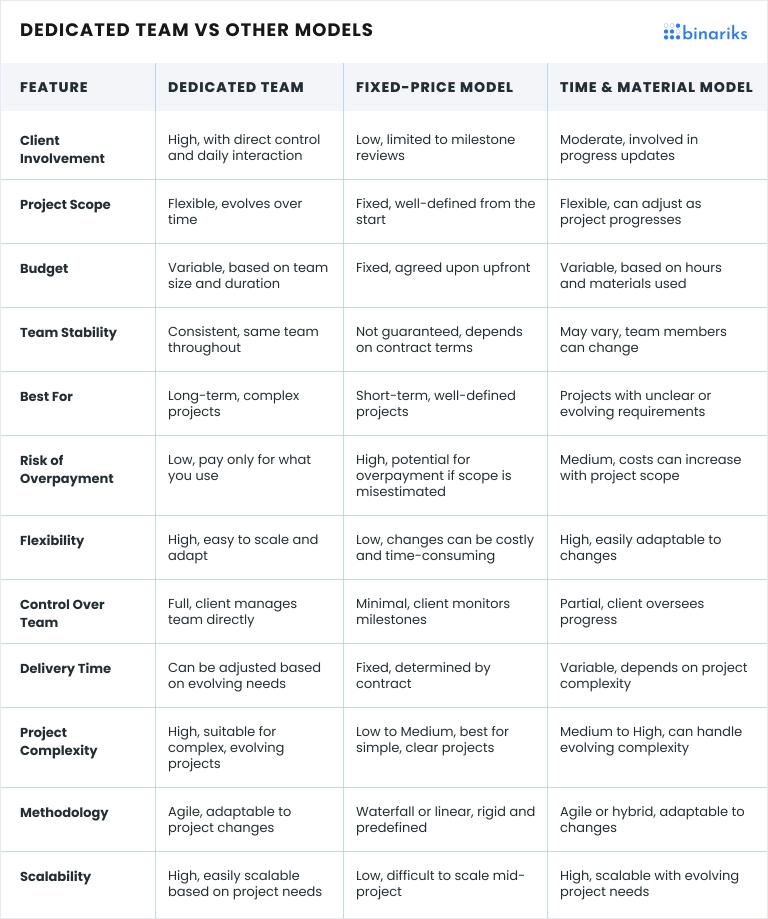
The dedicated IT team can be replaced with other popular models: time and material and fixed price models. Here is how they compare:
When considering a dedicated development team, clients actively participate, directly monitor daily operations, and collaborate closely with the team. This model allows the team to be an extension of the client's in-house team, providing flexibility and rapid response to changes. Dedicated teams are highly motivated and focused on the client's project, offering more engagement and customization than other models.
- Time and material model:
In the time and material model, clients pay based on the hours worked, making it suitable for short-term projects with a defined scope. However, this model may lead to inconsistencies in team members, budget unpredictability, and challenges in estimating total costs.
- Fixed-price model:
The fixed-price model offers cost predictability but can lead to overpaying if the project scope or duration is underestimated. Unlike fixed pricing, the dedicated team provides more flexibility and scalability so that the clients only pay for the resources they need without unnecessary overpayments.
Binariks approach
Binariks has extensive experience working with clients through a dedicated development team model. This approach is used in approximately 25% of the projects we launch. We provide tech experts who meet our clients' needs (either from the available team members or by sourcing specialists from the IT job market.
Our success stories
eMotorWerks, a leading North American EV charging hardware and software producer, needed a dedicated team to develop a cloud-based analytics dashboard on their IoT platform.
We assembled a team of 10 professionals, including frontend and backend developers, a project manager, a QA expert, and a business analyst, to deliver a solution that tracks EV charging, analyzes real-time energy prices, and optimizes charging for cost and environmental impact. Using Scrum methodology with two-week sprints, we closely collaborated with eMotorWerks, maintaining daily stand-ups and regular updates.
EatStreet, a popular US food delivery service, required additional flexibility for its technological initiatives. We provided a dedicated team to enhance their mobile and web platforms, incorporating new features and optimizing their software. Our team handled frontend, backend, UX/UI design, and QA testing, seamlessly integrating with EatStreet's EatStreet'secialists. By streamlining their software, we helped EatStreet improve their customer service quality.
For nearly a decade, Binariks has excelled in remote IT outsourcing, saving clients money and ensuring seamless project delivery. We handle all HR processes remotely, ensuring strong client connections and timely artifact delivery.
Recap
Hiring in-house developers for a single software product can be time-consuming and resource-intensive, especially when the project ends and the team is no longer needed. The dedicated team model offers an efficient alternative, allowing you to avoid these challenges while benefiting from global talent and specialized expertise.
At Binariks, we've successfully established dedicated development teams for startups, SMEs, and large enterprises. Our dedicated team engagement model is ideal for long-term and complex projects, providing a balanced price-quality ratio and expertise in technologies like .NET, iOS, Android, Java, React, and Angular.
In addition to offering cost efficiency and flexibility, our dedicated teams ensure full control and transparency, allowing you to manage your project closely while we handle the logistics, from hiring to infrastructure setup. We can also adapt the size of your team as your project evolves, ensuring you have the right resources at every stage.
Wondering if a dedicated team model is right for you? Contact us to save time and money by letting us help you extend your in-house team or build a dedicated team from scratch.
FAQ
Author

Share

