

A single clinical trial can generate millions of individual data points, and for decades the tool that captured them was a paper form, mailed to a central office, retyped by hand, and quietly riddled with transcription errors nobody caught until months later.
The electronic case report form killed that workflow, and the timing was not optional. As decentralized trials, AI-assisted data review, and direct hospital-to-trial data feeds become routine, the eCRF has grown from a digital photocopy of a paper sheet into the structured spine of the entire trial.
The market reflects it: the electronic data capture systems that house these forms are worth .08 billion in 2026 and on track to nearly double by 2031, with decentralized and hybrid trials cited as the main reason.
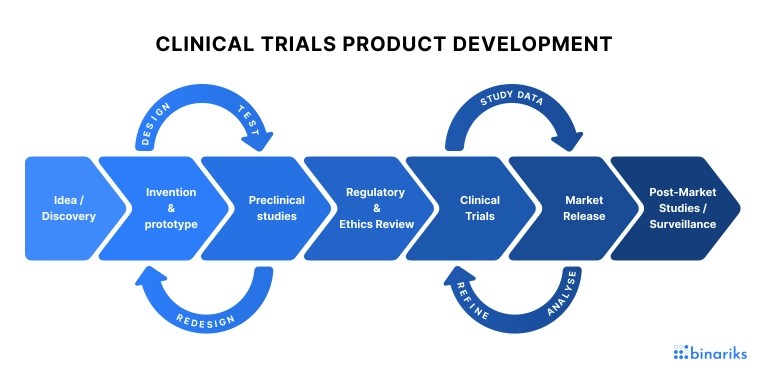
After reading this article, you will know:
- What an eCRF is, how it differs from a paper CRF, and how it relates to the EDC system around it
- How eCRF design actually works, from process and principles to the validation and audit-trail requirements regulators expect
- How EHR-to-eCRF automation removes double data entry, and what FDA guidance now expects from decentralized trials
- What real regulatory compliance looks like in practice, and how to decide whether to build, buy, or customize
What Is an eCRF?
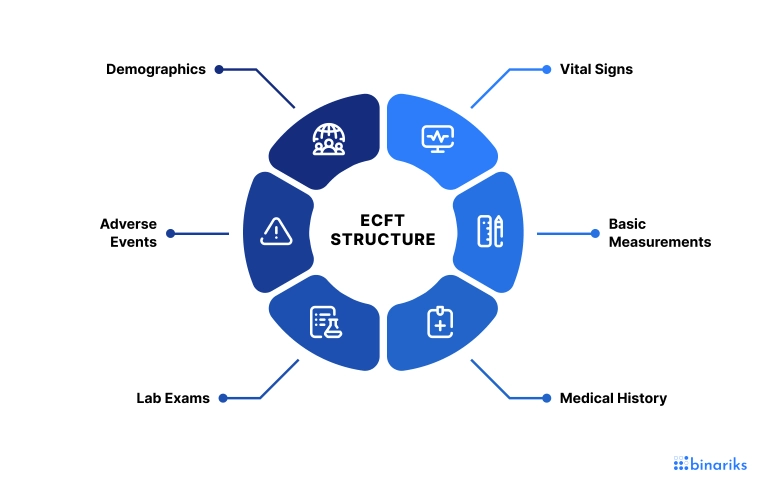
An eCRF (electronic case report form) is the digital questionnaire used to collect data on each participant in a clinical trial, according to the study protocol. It replaces the paper case report form, capturing everything from demographics and lab results to adverse events and treatment outcomes.
The FDA describes it as an auditable electronic record reported to the sponsor for each trial subject. In practice, the eCRF is where raw clinical observations become structured, analyzable data, complete with built-in validation rules and a full audit trail of every entry and change.
The eCRF sits at the centre of the clinical data lifecycle. Source data originates somewhere (a clinician's notes, a lab instrument, a patient's own report, or increasingly an electronic health record), and the eCRF is where that data lands in structured form, gets checked against validation rules, and becomes available for monitoring and analysis. Strong eCRF system design is what determines whether that data arrives clean or arrives as a mess someone has to reconcile for weeks.
According to the FDA , data elements can be entered into the eCRF manually by site staff or transmitted electronically from instruments and EHRs, with each element tied to an authorized originator for the audit trail.
Crucially, the eCRF rarely works alone. It lives inside an electronic data capture (EDC) system, which is the broader platform handling user management, validation logic, query workflows, reporting, and regulatory controls. The eCRF is the form; the EDC is the machine the form runs on. Get this relationship right and eCRF clinical trials run on a single connected data pipeline rather than a pile of disconnected spreadsheets.
One common confusion worth clearing up: eCRF vs CRF. A CRF (case report form) is the underlying concept, the defined set of data points a trial collects on each subject, and it can exist on paper or on screen. An eCRF is simply the electronic version of that form. So every eCRF is a CRF, but a CRF only becomes an eCRF once it lives in software with the validation, access control, and audit trail that electronic capture allows.
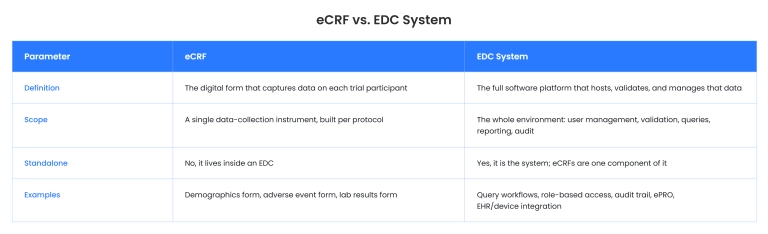
eCRF vs EDC: What's the Difference?
This is the single most common mix-up in the field, and it matters because people buy, build, and budget for the wrong thing when they confuse the two. The simplest way to hold it in your head: the eCRF is the form, and the EDC is the entire system the form runs inside.
Think of it like a paper questionnaire versus the whole office that designs it, hands it out, checks the answers, chases the missing ones, files everything, and keeps a record of who touched what. The questionnaire is the eCRF. The office is the EDC.
The distinction drives a real decision: when do you need a full EDC, and when is an eCRF enough? In practice you never truly ship an eCRF entirely on its own, because even the simplest electronic form needs somewhere to store data and someone to control access. But the weight of the eCRF systems you need scales with the trial.
A small, single-site observational study or an early feasibility study can run on a lightweight EDC with a handful of simple eCRFs and minimal workflow, where the eCRF design process is the bulk of the work and the surrounding system stays thin.
A multi-site, multi-country Phase III trial is a different animal. There you need the full EDC machine: complex validation logic, query management across dozens of sites, randomization, integrations with labs and EHRs, and audit controls that survive an FDA inspection.
The rule of thumb we use: the more sites, regulatory exposure, and integration points a trial has, the more eCRF development becomes inseparable from building or configuring a serious EDC around it. Match the system to the trial, not the other way around.
eCRF vs Paper CRF: Why the Switch Matters
The pharmaceutical industry abandoned paper because it quietly taxes a trial at every step: a coordinator writes a value by hand, ships or faxes the page to a data center, a typist keys it into a database, and any error introduced along that chain surfaces weeks later, if at all. Every handoff is a chance to lose or corrupt data. The eCRF removes most of those handoffs by capturing data once, at the source, with validation built in.
The difference is not anecdotal. A randomized controlled trial published in BMC Medical Research Methodology was, in the authors' words, "the first study to prove in direct comparison that using eCRFs instead of pCRFs increases time efficiency of data collection ", and that it improves data quality at the same time, regardless of how many items the form held or how old the patient was.
Here is how the two approaches compare across the criteria that actually decide a trial's cost and timeline:
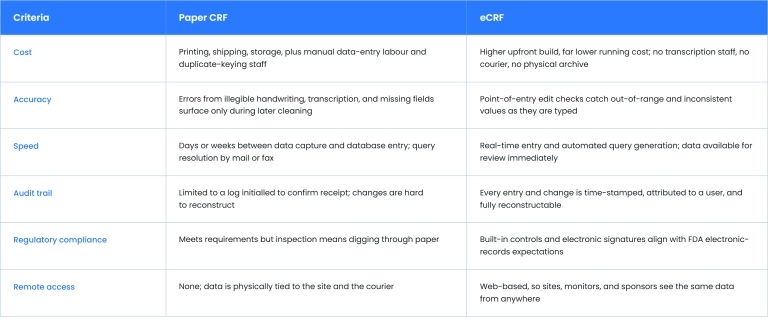
For accuracy specifically, the numbers are striking. A peer-reviewed analysis in PLOS ONE characterized the average source-to-database error rate under electronic data capture at 14.3 errors per 10,000 fields , on par with or better than the historical paper benchmark, while catching them at the point of entry rather than months later.
As the Association of Clinical Research Professionals notes, eCRFs also enable point-of-entry logic checks and automatic query generation , which shorten query-resolution turnaround and, with it, total study time.
This is also where the EDC vs eCRF distinction stops being academic. Choosing eCRF software that bakes in those edit checks, audit trails, and electronic signatures is what delivers the advantages above; a thin digital form without them is just a screen-shaped piece of paper. And because the data feeds regulatory submissions, eCRF software validation is not optional polish, it is the evidence that the system records data reliably and the audit trail holds up under inspection.
So how to move from paper CRF to eCRFs in practice? Start by mapping your existing paper forms to a structured data model, define the validation rules and edit checks each field needs, choose or build an EDC platform that fits the trial's scale and regulatory exposure, validate the system against its intended use, and migrate with a parallel-run period so nothing falls through the gap during the switch.
Done in that order, the transition protects data integrity instead of risking it. The data-mapping and integration work that makes the switch hold up is what our healthcare interoperability practice is built around.
eCRF Design: Process, Principles & Best Practices
Designing a functional electronic case report form is not a simple UI layout job. It is the core architecture of clinical data integrity. When we build these systems, we treat the eCRF as a software interface that must translate a complex medical protocol into foolproof entry fields. Get the design wrong, and site coordinators will find workarounds to clear validation errors. Get it right, and clean data flows straight into your database with zero friction.
Industry data highlights exactly how severe this operational friction has become: a Tufts Center for the Study of Drug Development Impact Report reveals that 70% of global investigative site staff believe trials have become significantly harder to manage over the last five years, making upfront automated data architecture design an essential mitigation strategy rather than an afterthought.
eCRF Design Process Step-by-Step
The timeline from a finalized protocol to a validated, live eCRF design process follows a strict, sequential engineering pipeline. It cannot be rushed: fixing a structural data-model error after a trial launches requires massive effort and system downtime.
- Protocol analysis and data mapping: The data management team extracts every required variable from the study protocol. These variables are mapped against standardized data models to ensure they align directly with specific protocol objectives.
- Specification drafting: The team writes detailed data collection specifications. This document defines every single field, variable name, field type (such as drop-down or radio buttons), and the explicit boundaries for acceptable data.
- Screen build and logic programming: Developers build the actual screens and program the point-of-entry validation rules. This is where conditional logic is established, ensuring that if a participant is marked as male, pregnancy-related forms are programmatically hidden.
- User Acceptance Testing (UAT): The system undergoes rigorous testing against the specification document. Data managers intentionally input flawed data to confirm that edit checks fire correctly before the eCRF software validation process is signed off and promoted to production.
eCRF System Design Principles
A robust eCRF system design balances two competing forces: the rigid data structures required by regulators and the messy reality of clinical site workflows. To ensure compliance without destroying site productivity, three foundational engineering principles must guide the architecture:
- First, build for maximum data traceability. Every data point must possess a transparent, unalterable lineage from its point of origin to the final clinical study report. This means any manual entry or automated data ingestion must trigger an immutable eCRF audit trail that captures the exact time, date, user ID, and both the old and new values.
- Second, enforce data standardization from day one. Instead of inventing custom data structures for every trial, use established standards like CDASH. This consistency speeds up regulatory submissions because the data structure is already familiar to reviewers.
- Third, design with technical scalability in mind. The data model must be prepared for decentralized clinical trials eCRF frameworks, where data continuously streams from wearable sensors, patient-facing smartphone apps, and remote laboratory databases.
eCRF Design Best Practices
The difference between a successful trial and an administrative nightmare comes down to execution details on the screen. In our experience building clinical trial software, clean design directly reduces protocol deviations.
Keep forms uncluttered and logical. Group data elements by the natural flow of a clinical visit rather than splitting related clinical observations across separate tabs. If a nurse is measuring vital signs, systolic blood pressure, diastolic blood pressure, and heart rate should sit on the exact same screen.
Enforce strict data entry controls. Avoid free-text fields wherever possible because they are the single greatest source of messy data. Use structured radio buttons and standardized dropdowns instead. Furthermore, ensure your design is optimized for automated data capture. Incorporating eHR to eCRF integration/automation pipelines directly pulls labs and medical histories from hospital records, eliminating double data entry.
We have seen how implementing these cohesive workflows can significantly lower operational overhead, which is why optimizing your broader digital ecosystem is the best path to trial efficiency.
eCRF Components
Building an architecture that stands up to regulatory scrutiny requires a modular approach to data structures. Every eCRF components matrix must be engineered to capture specific medical metrics while maintaining absolute compliance with global digital clinical trial standards. It is not just about placing input boxes on a web page; it is about mapping distinct clinical variables to strict data types so that regulatory auditors can verify every submission.
This modular strategy ensures that software configurations remain audit-ready and natively aligned with the technical data integrity requirements of 21 CFR part 11 eCRF frameworks.
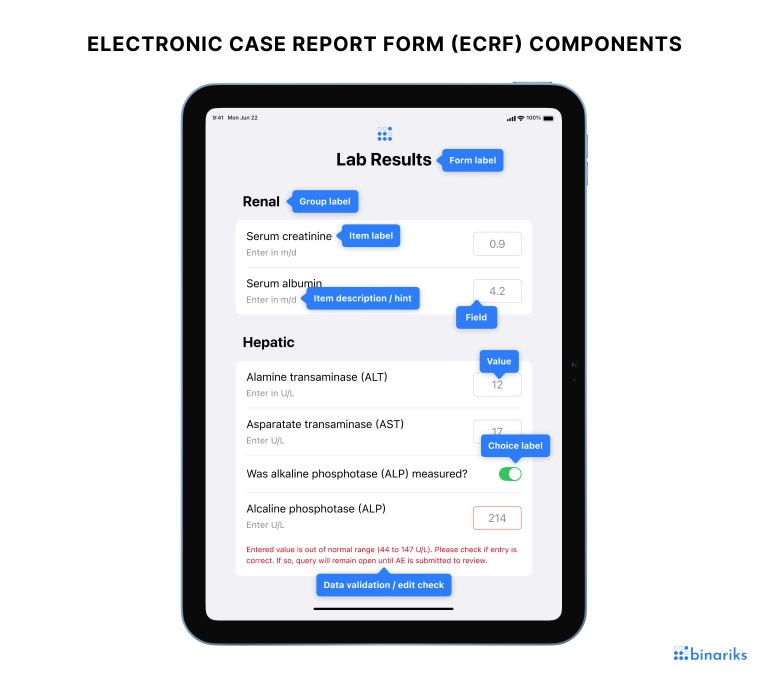
Let's take a look at the eCRF components and what function they serve:
| Component | Description |
| Form label | The name or title of the specific case report form |
| Group label | A label used to group several related items (sub-categories) within a form |
| Item label | A label used to identify data fields within a form and to prompt a user to enter data within a particular field |
| Item hint | Supplementary text about the item (or placeholder text) that gives a user a hint about the data they need to provide |
| Field | The area where data is entered into the form. It can be either in the form of a standard input field, or checkboxes, radio buttons, etc., but corresponding to an individual item. |
| Value | The actual data entered into the field by a user or automatically generated/calculated by the form itself |
| Choice label | Labels or options available to a user in a dropdown menu or radio button group |
| Data validation/edit check | Automatic checks that ensure data entered into the form conforms to predefined rules and constraints, such as data type, range, or consistency with other fields |
Once these baseline components are defined, the engineering team organizes them into a hierarchical, time-bound structure that mirrors the actual clinical protocol.
Forms do not exist in isolation. They are grouped into logic-driven folders called matrix designs or visit schedules. For instance, the system links the screening form, informed consent checkbox, and baseline demographics component into a single mandatory screening visit matrix.
When a site coordinator opens a participant's file, the system dynamically populates the specific eCRF components required for that precise chronological window, whether it is a Week 2 follow-up or a Month 6 terminal evaluation. This relational architecture ensures that data flows linearly, keeping the entire lifecycle in absolute alignment with modern ich-gcp e6(r3) eCRF standard quality management workflows.
By mapping these technical pieces directly to patient milestones, we help clinical operations teams eliminate protocol deviations at the point of data entry, which is why engineering structured data pipelines within your healthcare software ecosystem is the most reliable way to achieve cross-system compliance and speed up regulatory submissions.
eCRF Software Validation and Audit Trails
Regulatory bodies thoroughly scrutinize the journey of every single data point. A flawless data architecture loses all value if the software platform cannot provide documented proof of its reliability.
Developing these resilient, tamper-proof environments requires deep infrastructure expertise, which is why engineering robust cloud solutions for healthcare remains an essential baseline for modern clinical architectures. For developers and sponsors, this means rigorous testing of every line of logic and absolute transparency for any system change.
What is eCRF Software Validation?
Validating case report form software is a formal, documented process proving that the system consistently operates in strict accordance with its intended purpose. During an audit, regulators require a clear paper trail spanning from user requirement specifications (URS) to final testing execution reports.
The main objective is verifying that point-of-entry verification scripts fire exactly as intended. If a system must block an impossible heart rate entry or automatically calculate a participant's body mass index, validation proves these algorithms operate without error.
When we implement cdash eCRF design standards, the validation process confirms that every field structure maps perfectly to standard regulatory submission models. This step minimizes the risk of system failures during a live trial, where database fixes can cost thousands of dollars and threaten data collection continuity.
Audit Trails in eCRF Systems
An audit trail is the fundamental security layer that logs the entire lifecycle of a dataset. Any action, from the initial entry of a vital sign to a subsequent correction by a site coordinator, is recorded automatically in the background without any option to override or delete the history.
Each log entry must capture the precise timestamp, user ID, old value, new value, and an official reason for the modification. This provides the end-to-end eCRF traceability that an FDA or EMA inspector demands when tracing a data point back to its primary source. Without this underlying operational granularity, proving data authenticity is completely impossible.
EHR-to-eCRF Integration and Automation
Manually moving clinical measurements from Electronic Health Records (EHR) to an electronic case report form remains one of the heaviest operational drains in modern clinical research. This duplicate data entry forces highly trained site coordinators to act as manual transcribers.
The result is an inevitable trail of transcription errors, formatting discrepancies, and prolonged data verification delays that stall clinical timelines. Replacing this fragmented process requires shifting away from manual, paper-inspired workflows toward programmatic, direct data ingestion.
An automated solution replaces human data entry with direct system-to-system data streaming. This architecture relies on modern application programming interfaces (APIs) built on the HL7 FHIR (Fast Healthcare Interoperability Resources) data standard.
By establishing a secure, automated data pipe between a hospital's source EHR environment and the clinical trial data capture platform, critical clinical parameters populate target fields instantly. Vital signs, laboratory panels, and concomitant medications travel across systems securely.
Transitioning to this automated approach requires a deep understanding of medical software structures, which is why engineering robust interoperability solutions for healthcare directly into your software platform is the most reliable way to eliminate data entry silos.
Removing manual transcription dramatically alters the primary performance metrics of an active trial:
- Error reduction: Point-to-point digital transmission completely eliminates manual copy-paste mistakes, typos, and accidental omissions.
- Data timeliness: Information streams to data managers in near real-time, allowing clinical monitors to identify safety signals or protocol deviations immediately.
- Reduced site burden: Investigative site staff spend significantly less time handling administrative paperwork, allowing them to focus entirely on patient care and strict protocol compliance.
According to the official FDA Guidance on Electronic Source Data in Clinical Investigations , pulling information directly from the primary electronic source is the preferred method for data collection, because it guarantees that critical clinical records remain attributable, complete, and uncorrupted from the moment of creation.
eCRF in Decentralized Clinical Trials (DCT)
In modern clinical research, geographical boundaries are dissolving. The traditional model, which required patients to make frequent physical visits to investigative sites, limited participant enrollment and slowed data collection. Shifting toward distributed trial models requires a complete re-engineering of how data is captured, making remote data management the central pillar of the study.
Decentralized Clinical Trials & The Role of eCRFs
Decentralized clinical trials (DCTs) are studies where some or all trial-related activities occur away from a traditional clinical site, such as at a participant's home, local laboratories, or via telemedicine channels. Within this framework, a decentralized clinical trials eCRF transforms from a passive data reporting sheet into a dynamic data aggregation hub.
The system must support diverse, disparate data streams, seamlessly pulling inputs directly from electronic patient-reported outcomes (ePRO) apps, home health nurse portals, and continuous streaming data from wearable medical sensors.
FDA Guidance on Decentralized Clinical Trials
The official FDA Guidance on Decentralized Clinical Trials for Drugs, Biological Products, and Devices establishes strict compliance parameters for remote data collection software, focusing heavily on access controls and attribution.
The regulator requires that the eCRF platform explicitly document and track exactly who enters every specific piece of data. The system must differentiate between a participant entering a symptom diary, a mobile health professional logging vitals during a home visit, and a local laboratory technician uploading blood panels.
Real-time data synchronization is also emphasized to ensure immediate medical oversight and proactive safety monitoring.
DCT Challenges & Binariks Experience
The primary operational challenge in decentralized execution is ensuring data synchronicity and integrity across multiple remote endpoints. The risk of data packets dropping due to local network issues or patients incorrectly completing electronic forms requires intelligent, point-of-entry verification mechanisms.
We at Binariks have practical experience overcoming these technical barriers. Our experience deploying advanced AWS cloud solutions for healthcare architectures allows us to build highly resilient data pipelines. By designing systems with automated data replication and robust edge-validation, we ensure that remote data capture remains fully secure, compliant, and continuously synchronized with the central database.
Building or modernizing an eCRF system?

Tamila Karpa
Delivery Manager, Healthcare and Life Sciences Unit
eCRF Regulatory Compliance: 21 CFR Part 11, ICH-GCP E6(R3) & CDISC
21 CFR Part 11
The FDA 21 CFR Part 11 regulation dictates the criteria under which the agency considers electronic records and electronic signatures to be trustworthy, reliable, and equivalent to paper records. Implementing this framework within your software architecture requires building robust technical controls.
- Electronic signatures: The system must enforce unique, multi-factor electronic signatures that are permanently linked to their respective records, ensuring that a user cannot sign off on a case report form without explicit re-authentication.
- Security controls: System access must utilize role-based permission levels, strict password expiration parameters, and automatic session timeouts to prevent unauthorized data entry at the site level.
ICH-GCP E6(R3)
The modernized ICH-GCP E6(R3) guideline introduces a risk-based approach to clinical trial quality management, emphasizing data quality by design. Under these updated principles, sponsors must ensure that data collection systems protect participant safety and trial reliability through proactive engineering rather than retrospective cleaning.
The eCRF platform must natively support these quality systems by providing immediate data visibility, facilitating continuous centralized monitoring, and maintaining clear data attribution from the moment a clinical observation occurs.
CDASH/CDISC
Standardizing data structures through the Clinical Data Interchange Standards Consortium (CDISC) model is essential for accelerating the regulatory review pipeline.
Specifically, implementing Clinical Data Acquisition Standards Harmonization (CDASH) rules defines the basic structure of fields inside your data collection environment. This standardized layout ensures that data collected at the investigative site maps cleanly to downstream analysis models without complex, error-prone data transformations.
To maintain this structural consistency across multiple centers, study teams must distribute clear eCRF completion guidelines to all participating staff.
eCRF Implementation: Steps, Tips, and Build vs Buy
Build vs Buy vs Customize
When defining your platform strategy, engineering leadership faces a classic architectural crossroads: building a custom system, purchasing a standard off-the-shelf electronic data capture tool, or pursuing a hybrid customized route.
- The Buy Option: Purchasing an established, pre-validated market platform offers a rapid deployment timeline and low upfront risk. However, it locks the engineering team into rigid, vendor-defined data models. These platforms often charge steep licensing fees that scale aggressively with the number of investigative sites or active participants, making highly specific workflow alterations cost-prohibitive.
- The Build Option: Developing a proprietary system provides absolute data model autonomy and tailored site experiences. This path is ideal for complex medical protocols or novel medical device trials requiring specific streaming data inputs. The trade-off is high upfront capitalization, lengthy development timelines, and the continuous internal burden of maintaining a fully validated software baseline.
- The Customize Option: Utilizing open-source frameworks or modular clinical trial toolkits balances cost and autonomy. This hybrid approach allows engineering teams to avoid reinventing core database mechanisms while retaining total control over user interfaces and custom pipeline endpoints.
How to Build an eCRF System
If your study parameters require a tailored strategy, the programmatic roadmap for successful eCRF development must be carefully executed. A reliable system cannot rely on general application design patterns; it must use highly structured data pipelines.
- Protocol Mapping and CDASH Standardization: Extract every required clinical variable directly from the study protocol and map them explicitly against CDISC CDASH standards to ensure future regulatory compliance.
- Database Schema Engineering: Build a highly normalized, structured relational data layer that translates the mapped variables into fixed fields, field types, and acceptable data boundary parameters.
- Logic Rules and Edit Check Programming: Program the execution engine responsible for handling point-of-entry verification scripts, mathematical calculations, and dynamic conditional visibility pathways.
- Security and Access Infrastructure Integration: Deploy a granular, role-based access control service and configure an append-only transaction ledger to generate an unalterable audit trail.
- Automated Validation Scripting: Execute rigorous automated user acceptance testing scripts across the entire platform environment to generate the documentation required for final system sign-off.
eCRF Example: What a Real Form Looks Like
What does a medical device trial eCRF look like? A medical device trial eCRF is a structured set of electronic forms, one per visit or event, that captures everything regulators need to judge a device's safety and performance.
A typical eCRF template for a device study runs from enrolment through follow-up and includes subject identification, eligibility and consent, device identification (including the unique device identifier), the implantation or use procedure, device performance measurements, adverse events, device deficiencies and malfunctions, concomitant treatments, and visit-by-visit follow-up. Each field carries its own validation rule, and every entry is time-stamped and attributed in the audit trail.
To make that concrete, here is what the form set on a typical implantable-device trial might contain:
- Screening and enrolment: demographics, inclusion and exclusion criteria, informed consent date, medical history;
- Baseline: vital signs, relevant lab results, pre-procedure imaging or measurements, target condition assessment;
- Device and procedure: device identifier and lot number, model, implant or application date, operator, procedure details, any intra-procedural complications;
- Performance: the device-specific efficacy measurements the protocol defines, sensing and pacing thresholds for a cardiac device, range-of-motion and imaging for an orthopedic implant;
- Safety: adverse events, serious adverse events, and the device-specific categories regulators require, adverse device effects and device deficiencies, each with severity, causality, and outcome;
- Follow-up visits: the same core measurements repeated at each scheduled interval (30 days, 90 days, 6 months, 12 months), so the data shows performance and safety over time.
The discipline that separates a good eCRF example from a painful one is structure decided before a single patient is enrolled. Each field needs a defined data type, a validation rule, and a place in the visit schedule, so the form guides the coordinator instead of leaving room for free-text guesswork.
Branching logic should hide irrelevant fields (no point asking about explant details if the device was never implanted), and every safety field should map cleanly to the categories a reviewer will eventually filter on. Designing forms, questionnaires, and connected-device data capture to that standard is core to how we build software as a medical device , where the form is part of a regulated product, not an afterthought.
Custom eCRF Development with Binariks
Off-the-shelf EDC platforms handle standard trials well. The case for a custom build shows up when a trial breaks the template: an unusual visit structure, a device that streams its own data, a sponsor running many studies that each need different forms, or an integration the vendor never built.
Our approach puts structure first. We map the protocol to a data model, define the validation rules and branching logic each field needs, and design the visit schedule before development starts, then build in sprints with the clinical team in the loop.
We saw what that buys when we built a clinical trial configuration portal for a multi-sponsor pharma platform: turning IT-dependent trial setup into a self-service workflow cut average configuration time by roughly 80%. Throughout, we build the validation and audit evidence as we go, because a fast form that cannot survive an inspection is not actually fast.