


According to McKinsey, chronic diseases are significantly increasing the global health burden. Conditions like cardiovascular disease, cancer, diabetes, and respiratory disease contributed to 75% of worldwide deaths in 2010, rising to 79% in 2020. By 2030, this figure could reach 84% (Source ).
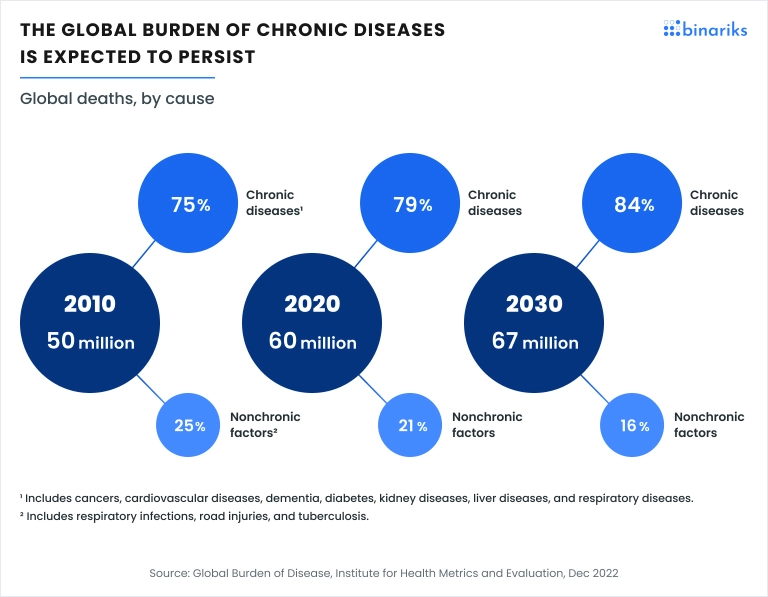
PubMed Central notes that the transition from infectious to noncommunicable diseases began in the early 1900s with improved public health measures, a trend that continues today. As people live longer, the prevalence and cost of chronic diseases rise, with global costs projected to reach $47 trillion by 2030.
Addressing this growing problem is critical, especially with demographic shifts. As the population ages, the prevalence of chronic diseases rises, with many individuals suffering from multiple conditions. In 2018, approximately 27% of U.S. adults had multiple chronic conditions, contributing to over $1 trillion in annual healthcare costs (Source ).
AI in chronic disease management can be a transformative solution for these challenges. By leveraging advanced algorithms and data analysis, you can personalize treatment plans, enhance patient monitoring, and optimize healthcare resources.
Read on to uncover how AI in disease management can be helpful and how you can implement it effectively.
Role of AI in personalized chronic disease management
One of the most significant benefits of AI for chronic disease management is its ability to predict disease progression and outcomes. By analyzing vast amounts of patient data, AI algorithms can identify patterns and trends that human clinicians might miss. This predictive capability allows for earlier interventions and more precise monitoring.
AI can also help create personalized treatment plans. By integrating AI into chronic care management, healthcare providers can consider individual patient data such as genetics, lifestyle, and medical history to develop customized treatment strategies. This approach ensures that each patient receives the most effective care, reducing the risk of complications and improving overall health.
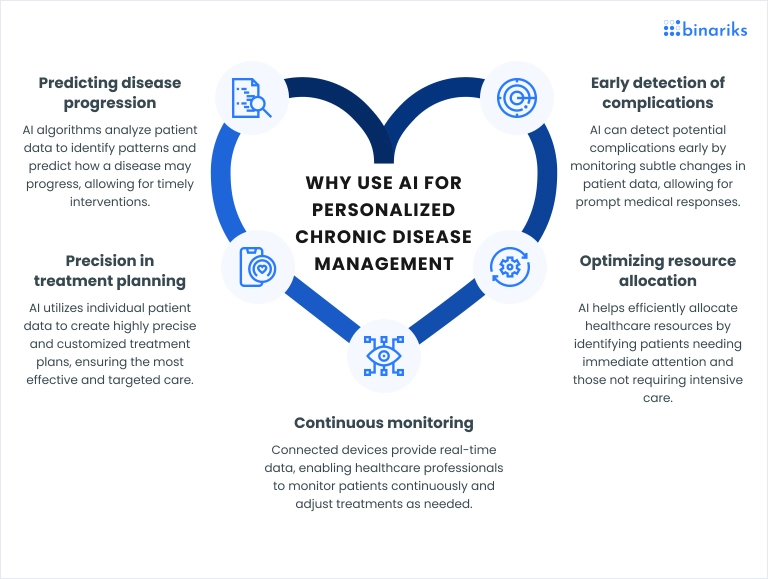
The benefits of AI in personalized chronic disease management include:
- Predicting disease progression: AI algorithms analyze patient data to identify patterns and predict how a disease may progress, allowing for timely interventions.
- Tailored treatment plans: AI utilizes individual patient data to create customized treatment plans, ensuring more effective and targeted care.
- Continuous monitoring: Connected devices provide real-time data, enabling healthcare professionals to monitor patients continuously and adjust treatments as needed.
- Early detection of complications: AI can detect potential complications early by monitoring subtle changes in patient data, allowing for prompt medical responses.
- Optimizing resource allocation: AI helps in efficiently allocating healthcare resources by identifying patients who need immediate attention and those who can be managed with less intensive care.
For example, CareClinic, a Canada-based startup, provides a self-care health management platform for individuals with chronic conditions. The application, powered by artificial intelligence, empowers users to monitor specific symptoms, mood, pain levels, and nutrition.
It collects data from wearables and other user inputs to generate detailed reports and logs, enabling patients to take control of their health and make informed decisions .
Incorporating AI chronic disease solutions into healthcare not only enhances the accuracy of diagnoses and treatments but also improves the overall patient experience. As AI technology advances, its role in chronic disease management is expected to grow, offering even more sophisticated tools and methods for managing these conditions effectively.
Key strategies for success
Implementing AI requires a strategic approach to maximize its benefits. Here are six key strategies that can help ensure the successful integration and utilization of AI in your company.
1. Data collection and integration
Effective chronic disease management with AI begins with robust data collection and integration . By gathering comprehensive patient data from various sources such as electronic health records (EHRs), wearables , and patient-reported outcomes, healthcare providers can create a holistic view of a patient's health. This integrated data is essential for AI systems to accurately analyze and predict disease progression.
2. Advanced machine learning models
Implementing advanced machine learning models is key for AI healthcare for chronic diseases. These models can analyze complex datasets to identify patterns and correlations that might not be evident through traditional methods.
Machine learning algorithms can predict potential health issues, enabling early disease detection with AI and catching diseases at a more treatable stage.
3. Patient-centric design
AI tools should be designed with the user in mind, focusing on ease of use and accessibility. That's why a patient-centric design is fundamental to the success of AI personalizes chronic disease management.
By prioritizing the patient experience, these tools can encourage better adherence to treatment plans and more active participation in their own health management. Features such as intuitive interfaces, personalized notifications, and easy access to health data empower patients to take control of their health.
4. Collaboration and multidisciplinary approach
Successful chronic disease management with AI requires collaboration across multiple disciplines. Healthcare providers, data scientists, engineers, and policymakers must collaborate to develop and implement AI solutions.
A multidisciplinary approach ensures that AI tools are technically sound, clinically relevant, and ethically designed. Collaboration can drive innovation, leading to more effective and comprehensive chronic disease management strategies.
5. Privacy and security
One of the most important aspects of integrating AI into chronic care management is ensuring privacy and security. Protecting patient data from breaches and unauthorized access is critical to maintaining trust and compliance with regulations such as HIPAA or GDPR.
Adopting HL7 standards , including FHIR, also ensures a secure and standardized exchange of healthcare information, further safeguarding patient data.
AI systems must incorporate robust security measures to safeguard sensitive health information. Implementing encryption, secure access controls, and regular security audits, including human oversight (human-in-the-loop), can help mitigate ethical and security risks and ensure the confidentiality and integrity of patient data.
6. Monitoring and evaluation
This part is important for the ongoing success of AI in chronic disease management because regularly assessing AI tools' performance helps identify areas for improvement and ensures that they remain effective and relevant.
This part is important for AI's ongoing success in chronic disease management because regularly assessing AI tools' performance helps identify areas for improvement and ensures that they remain effective and relevant.
By tracking outcomes and patient feedback, healthcare providers can fine-tune AI models and refine the approach to meet patient needs better. The more precise and calibrated the system, the better care can be provided.
Related Case Study
Redeveloping an EHR platform: Legacy system transformation delivers seamless workflows and regulatory compliance


Redeveloping an EHR platform: Legacy system transformation delivers seamless workflows and regulatory compliance
Binariks transformed a healthcare organization's outdated EHR system into a modern, cloud-native platform using .NET 8, React, and Azure. The modernization improved user experience, enabled seamless third-party integrations, and strengthened regulatory compliance for behavioral health practices.

Best practices for adopting AI in chronic disease management
Adopting AI in chronic disease management requires careful planning and execution. Here are some best practices to ensure successful implementation and to address common challenges effectively:
- Start with clear objectives: Define what you aim to achieve with AI, such as improving personalized chronic disease management or enhancing patient monitoring. Clear goals will guide your implementation strategy and help measure success.
- Ensure data quality: High-quality data is critical for effective AI solutions. Invest in robust data collection and integration systems to ensure accuracy and completeness. This will enhance the reliability of AI predictions and insights.
- Focus on user training: Train healthcare providers and patients on how to use AI tools effectively. Proper training ensures that users can maximize the benefits of AI solutions and reduce the risk of errors.
- Utilize remote patient monitoring: Incorporate remote patient monitoring (RPM) to enhance chronic care management. RPM allows for continuous monitoring of patients, providing real-time data and enabling timely interventions. Check out these chronic care management and remote patient monitoring tips for more information.
- Implement feedback loops: Establish mechanisms for continuous feedback from users to improve AI tools. Regularly update and refine AI algorithms based on user feedback and performance data.
By following these best practices, healthcare providers can effectively implement AI solutions for chronic disease patient care, enhancing patient outcomes and optimizing resource use.
The future of AI in chronic disease management
AI is transforming chronic disease management by offering advanced tools for early detection, personalized treatment plans, and continuous patient monitoring.
For instance, managing type 2 diabetes can be challenging due to the difficulty in calibrating insulin doses. About 25% of the 33 million patients in the US have poor glycemic control. However, conversational AI apps can help patients self-titrate insulin, improving chronic disease management.
Studies show that such AI-based voice assistants can improve medication adherence rates by over 30% and help patients achieve optimal insulin dosing more quickly through generative AI .
Also, AI enhances personalization in chronic disease management. By analyzing individual and population data, AI creates detailed health profiles, tailoring prevention and treatment strategies.
Success stories include improved glucose control in a type 1 diabetes trial (where AI was used to adjust insulin pump doses based on real-time CGM readings), reduced heart failure hospitalizations by 20% with AI-aided dosing, and using AI to personalize cancer immunotherapy based on tumor genetics and biomarkers.
These are just some of the many examples. AI is poised to revolutionize chronic care management across a multitude of conditions. By leveraging AI for predictive analytics , healthcare providers can anticipate patient needs and intervene earlier, potentially preventing complications and improving outcomes. Continuous monitoring through wearable devices and smart health applications ensures that patients receive real-time care adjustments, enhancing their quality of life.
Investing in AI for chronic disease management is not just about keeping up with technological advancements—it's about providing better, more efficient, and more accessible patient care. As AI continues to evolve, its applications in chronic care will only expand, enabling all forward-thinking healthcare organizations to deliver more personalized, precise, and proactive care while reducing healthcare costs.
Contact Binariks now to learn how we can help you seamlessly integrate AI into your chronic care solutions and stay ahead of the curve.