


No wonder that data quality is important across industries. It impacts all areas of business, from decision-making to customer service. In insurance, accurate data is essential for policy pricing, claim processing , and fraud detection. In healthcare, data determines patient care and outcomes, as well as research impact. In banking, data is critical to personalized services and risk assessments.
Traditional approaches to data quality, like manual data cleansing and rule-based validation, often face problems like poor data integration from siloed sources, manual data cleaning processes leading to inefficiencies, and the inability to scale with increasing data volumes. These methods lack the predictive capabilities of AI/ML, which can automate data cleansing, detect anomalies in real-time, and adapt to new data patterns .
AI and ML services from experts like Binariks give your business a competitive advantage. This article will review ML and AI's role in data quality management, from the benefits and challenges of AI/ML-driven data quality to our best practices for integrating AI/ML solutions.
Fundamentals & challenges of data quality management
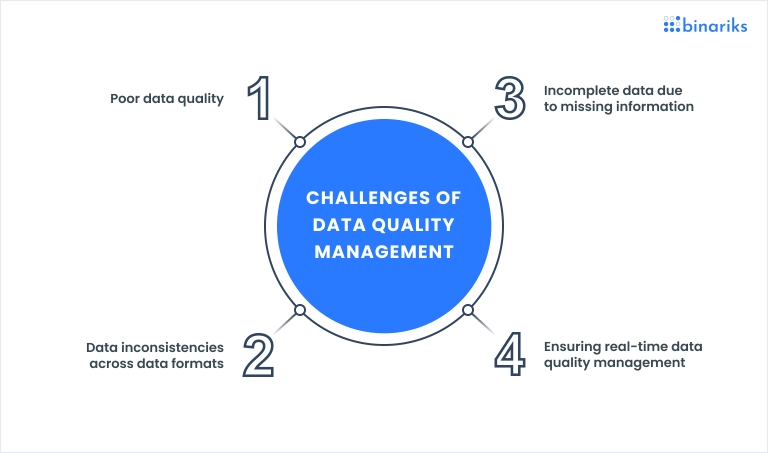
Data Quality Management (DQM) is crucial for organizations relying on data-driven decisions involving practices to ensure data is accurate, complete, and timely. Let's name the basic principles behind data quality management and the main challenges behind machine learning and data quality management.
Here are the basic principles behind data quality management:
- Data quality management must ensure that data correctly reflects real-world scenarios or objects.
- All necessary data is complete and captured without missing elements.
- Data remains consistent over time and across different sources.
- Data is relevant, meaning it is pertinent and applicable to the context in which it's used.
- Data is up-to-date and available when required for decision-making.
How ML enhances data quality processes
Machine learning for data quality is at the heart of high-quality data management. Here is how it works:
Data cleansing
ML algorithms can automatically identify and correct errors in the data, such as misspellings and incorrect entries, which reduces the need for human intervention. Advanced ML models, such as neural networks, can learn to recognize complex patterns and anomalies in the data. Natural language processing (NLP) is often used to standardize and cleanse text data.
Deduplication
ML-based data quality algorithms can efficiently sift through large datasets to identify duplicate entries, even when the duplicates are not exact matches (e.g., variations in names or addresses).
After identifying duplicates, ML can assist in merging records or suggesting the most accurate version of duplicated data based on learned patterns. Deduplication helps support data integrity.
Anomaly detection
Anomaly detection is at the heart of data quality. ML models, especially unsupervised learning algorithms like clustering or one-class SVM, are adept at identifying outliers or anomalies, including errors and frauds. ML enables real-time monitoring of data streams to detect and alert anomalies promptly.
Uncovering patterns and insights
ML can analyze historical data to uncover patterns and trends, predict future outcomes, and identify relationships that were not previously apparent.
Using ML for data quality can also help with feature engineering. ML algorithms can help determine the most relevant features or create new ones that enhance the model's predictive capabilities and the insights derived from the data.
Enhancing data quality strategies
ML models can continuously learn and adapt to new data, improving performance and ensuring that data quality processes evolve with changing data landscapes. Insights gained from ML-powered data analysis can even inform strategic decisions. Organizations can prioritize data quality initiatives based on ML data that significantly impact business outcomes.
AI role in predictive QA for data quality
The role of AI in data quality management is broader than that of data quality with machine learning, even though AI/ML-driven data quality is at the heart of data-driven quality assurance. Machine learning for data quality specifically focuses on algorithms that learn from data to make predictions or decisions.
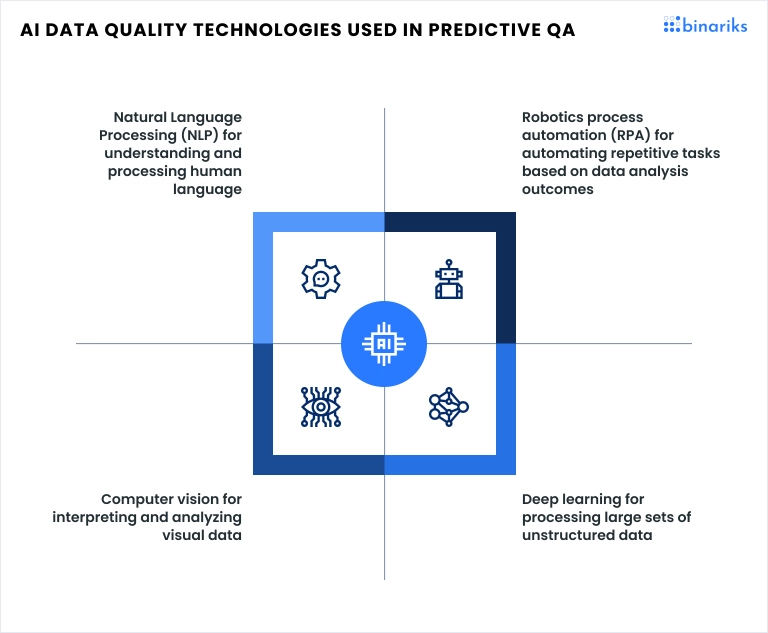
AI data quality technologies used in predictive QA:
Benefits of using ML and AI for data quality
In 2024, it's hard to imagine effective data quality management without AI/ML-driven data quality practices. Here is why you should use data quality and machine learning:
- Improved accuracy and completeness of data
ML algorithms can detect anomalies, inconsistencies, and errors in data more efficiently than traditional methods. These systems can also automatically correct common errors by learning from examples, resulting in higher data accuracy.
- Increased efficiency and cost savings in data management
ML and AI automate routine data quality tasks such as cleansing and validation. This reduces the need for manual data handling, which is time-consuming and prone to errors. Additionally, AI and ML systems can process vast amounts of data at scale, helping organizations accommodate their growing data needs without an increase in cost or effort.
- Enhanced decision-making capabilities based on reliable data
With more accurate and complete data, organizations can unlock valuable insights previously obscured by poor data quality. This leads to better, more informed decision-making across all levels of the organization.
ML models can identify trends and patterns in the data, enabling predictive analytics, which allows organizations to anticipate future trends, customer behavior, and potential risks.
- Reduced risks associated with poor data quality
Improved data quality with machine learning helps ensure compliance with regulations such as GDPR, HIPAA, etc., by ensuring personal data is accurately processed and protected. This reduces the risk of legal penalties and reputational damage.
By identifying inaccuracies and inconsistencies in data, ML and AI help mitigate risks associated with making decisions based on poor-quality data, such as financial losses, strategic missteps, and operational inefficiencies.
Real-world examples of ML-based data quality tools
If you are to choose a data quality strategy for your business that integrates AI/ML capabilities, there is a set of already existing platforms to consider. Below is their short overview:
Cloudera DataFlow
Cloudera DataFlow is a comprehensive data management solution allowing data collection, curating, and analysis. It employs ML-based data quality techniques to enhance data quality through real-time stream processing.
The key features of Cloudera DataFlow include capabilities for real-time data quality checks, anomaly detection, and data enrichment. The platform's creators emphasize that it streamlines the end-to-end data movement process. If you need immediate data insights and processing, Cloudera DataFlow is the platform to pick.
Informatica Intelligent Data Platform
Informatica's platform uses AI and ML to automate data management tasks. Informatica automates data quality tasks across an organization. Features include automated discovery of data quality issues, recommendations for data quality rules, and machine learning models to improve data cleansing processes.
Informatica is the right platform for machine learning and data quality management if your organization focuses on data governance and quality across various interconnected systems.
Talend Data Fabric
Talend Data Fabric focuses on real-time data integration and governance. It offers a suite of real-time apps to manage data management. The platform leverages ML to improve data quality and operational efficiency. Its features include automated anomaly detection, data deduplication, and validation processes.
Talend Data Fabric is best suited for organizations seeking comprehensive real-time data integration and integrity management.
Databricks LakeFS
Databricks Lakehouse combines data lakes and warehouses optimized for ML and analytics. It includes features to ensure data quality through ML-driven analytics and governance. The platform uses ML for data discovery, profiling, and quality checks.
Databricks Lakehouse is optimal for those needing a unified data analytics and ML approach across data lakes and warehouses.
Trifacta Wrangler
Trifacta Wrangler simplifies data preparation with predictive transformation suggestions. It offers predictive transformation suggestions and anomaly detection to enhance data quality. Trifacta Wrangler is best at data preparation for analysis, which is ideal for teams that prioritize ease of use in transforming and enriching data for insightful analytics.
Improve your data quality management with Binariks
Using ML for data quality requires the development team's expertise, which will help integrate these solutions smoothly into your overall organizational and technical processes. Binariks has a proven track record of bringing AI/ML capabilities to QA across industries .
Here's what we do:
- Evaluate data infrastructure for AI/ML compatibility
- Identify data quality and integration challenges
- Train staff on AI/ML concepts and tools
- Implement data governance practices
- Choose suitable AI/ML models for specific data tasks
- Utilize cloud services offering AI/ML capabilities
- Monitor AI/ML systems for performance and accuracy
- Continuously update models with new data
- Leverage NLP for data categorization and analysis
- Adopt agile methodologies for iterative improvements
Partner with Binariks for seamless integration of data quality and machine learning. With extensive experience across various industries, we offer flexible processes for optimal integration. In recent years, it has become clear that the future of QA lies in AI/ML-driven data quality, so it is the right time to fully leverage AI/ML and ensure the highest quality of your data.