

ML and AI algorithms for disease detection are algorithmic models that analyze medical data to find signs of diseases before they become severe.
Disease detection using machine learning and AI can revolutionize healthcare, allowing us to predict common conditions that result in mortality and treat them on time. With many types of cancers, fatal outcomes result from untimely diagnosis.
This article is a technology overview for healthcare and life sciences companies exploring AI for early disease detection. It explains how AI/ML works for disease detection, which conditions benefit most, and what's involved in building an AI-based disease detection system.
How AI/ML can affect disease detection and diagnosis
A disease detection system based on AI is used for various classification and pattern recognition problems for many diseases.
In particular, AI and ML disease detection are used for imaging analysis, signal processing, and identifying multiple pathologies. AI and machine learning in disease detection can also evaluate genetic markers for mutations and analyze biomarkers.
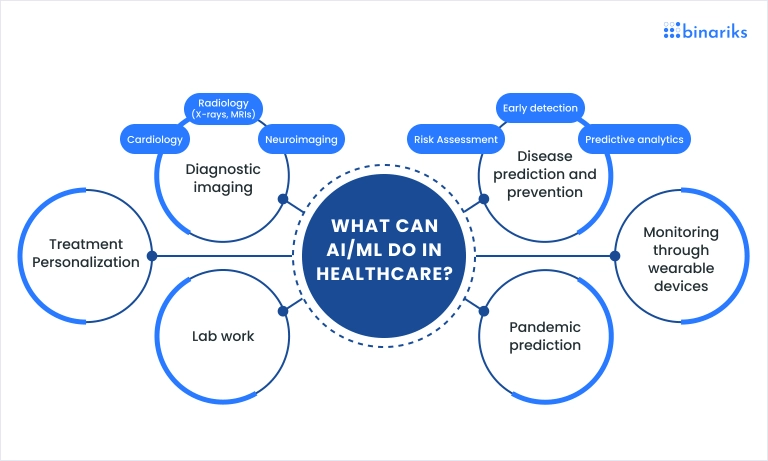
Below is the list of diseases that can be detected early with the help of AI and machine learning:
Cancer
According to the World Health Organization, cancer is the leading cause of death. Worldwide, with 10 million deaths attributed to it in 2020. In the United States, cancer is the second-leading cause of death.
Early detection makes a lot of difference for cancer. ML assists in AI analysis of medical imaging to help early detection of cancers. For example, the 5-year survival rate for melanoma, a malignant skin cancer, is 99% for localized cancers and only 32% for distant cancers. This demonstrates the criticality that early diagnosis holds for cancer patients.
AI analysis of medical imaging can also analyze blood to suggest the best course of treatment in a patient's particular case. Here is how the disease detection algorithms work for different types of cancer:
- Breast cancer: Algorithms can analyze mammogram images to detect tumors or abnormal patterns with 94% accuracy. Google's AI model for detecting breast cancer in mammograms showed a reduction of 5.7% in false positives and a reduction of 9.4% in false negatives compared to human radiologists.
- Lung cancer: AI tools can examine CT scans to detect early-stage tumors. Like with breast cancer, the early stages of lung cancer were detected with 94% accuracy.
- Skin cancer: By analyzing skin images, disease detection algorithms can differentiate between benign moles and malignant melanomas. Datasets with hundreds of thousands of different images of skin lesions help detect signs of skin cancers early on.
- Prostate cancer: MRI images and tissue biopsies can be analyzed to detect cancerous patterns.
AI medical diagnosis apps for early cancer detection
AI-based medical diagnosis apps for early cancer detection typically combine on-device or cloud-based image analysis with a clinical workflow layer that integrates results into existing EHR systems.
A typical architecture includes a data ingestion module (accepting DICOM images, lab results, or patient-reported inputs), an inference engine running a trained CNN or ensemble model, and a results interface that presents findings to a clinician with confidence scores and highlighted regions of interest.
From a regulatory standpoint, AI medical diagnosis apps intended for clinical use in the US must meet FDA requirements under the Software as a Medical Device (SaMD) framework – and in the EU, under the MDR and the AI Act's high-risk AI provisions applicable from August 2026.
This means clinical validation studies, documented model performance across demographic subgroups, and clearly defined intended use are non-negotiable before deployment. Human-in-the-loop design is a requirement, not an option, in this category.
AI outputs are intended to support clinician decision-making without replacing it. Apps that present AI findings without a clear pathway for clinician review and override fail both regulatory standards and clinical safety requirements.
Cardiovascular diseases
Cardiovascular diseases, the leading cause of death worldwide with almost 19 million deaths, benefit greatly from preventative health assessments. Machine learning in disease detection can help by:
- Detecting arrhythmias from ECG data.
- Predicting heart failure based on patient health records and test results.
- Identifying atherosclerotic plaques in arterial images.
- Predicting the immediate and long-term risk of stroke and heart attacks with the help of wearable devices that monitor vital signs. For example, the prediction alert predicted the risk of stroke in 87,6% of cases.
Neurological diseases
Neurological diseases like Alzheimer's and Parkinson's use machine learning for medical diagnosis. Even though they are incurable, early detection helps to prepare for and organize quality care in time. Here is how the disease detection algorithm works in the case of neurological diseases:
- Alzheimer's disease: ML can analyze brain imaging data to detect early signs of the disease. Currently, the technology is being adapted to demonstrate the early signs of decline before the symptoms become apparent.
- Parkinson's disease: AI can analyze voice data, hand movements to detect early signs. The technologies to diagnose the disease before the symptoms become apparent are also relevant.
Diabetes
Diabetes is a leading chronic condition in the world, with 1 in 10 adults worldwide living with diabetes. A disease detection system based on AI can predict onset based on patient records, genetic data, and lifestyle factors. Moreover, disease detection algorithms can predict diabetes complications. For example, it can offer retinopathy detection from retinal images.
Eye diseases
Disease detection driven by AI proved to be helpful for a number of eye conditions, including:
- Glaucoma: Analyzing eye scans for early detection.
- Macular degeneration: Early signs can be detected in retinal images.
Infectious diseases
AI-based disease detection and machine learning for medical diagnosis have the potential to identify outbreaks and predict disease spread based on data from various sources. Moreover, it can also analyze genetic sequences of viruses to predict their virulence or resistance patterns. For example, AI algorithms for disease detection are useful for early detection of Covid-19.
Liver diseases
The diseases of the liver have the potential to be cured if detected early. Disease detection algorithms can detect fibrosis or fatty liver from MRI or ultrasound images. They can also predict the risks of severe liver disease and identify potential consequences.
Respiratory diseases
AI and ML in medical diagnosis can detect conditions like asthma or chronic obstructive pulmonary disease (COPD) based on patterns in spirometry data or audio breathing analysis.
Bone and joint diseases
AI algorithms for disease detection can identify early signs of osteoporosis or arthritis from X-ray or MRI images.
In addition to disease-specific detections, AI and ML can be employed for:
- Genetic disorder predictions: By analyzing genetic sequences to detect mutations that might lead to diseases.
- Predicting patient deterioration: Monitoring vital signs in real-time to detect and alert clinicians of potential adverse events in hospitalized patients.
- Drug interactions and side effects: Predicting potential adverse drug reactions based on the patient's medical history and current medications.
How can AI support earlier disease detection?
AI supports earlier disease detection by continuously analyzing data that would be impractical for clinicians to monitor manually. Predictive analytics models process patient records, lab results, and lifestyle data to generate risk scores – flagging individuals likely to develop a condition before any symptoms appear.
In cardiovascular care, for example, ML models trained on EHR data can identify patients at high risk of a cardiac event months in advance, enabling preventive intervention rather than reactive treatment.
Wearables and remote monitoring devices have extended this capability outside clinical settings. Continuous data streams from ECG patches, glucose monitors, and pulse oximeters feed real-time ML models that detect anomalies as they emerge. This is particularly valuable for conditions like atrial fibrillation, where episodes are intermittent and easily missed in a single clinic visit.
At the population level, AI systems can identify outbreak patterns and flag geographic clusters of symptoms before a diagnosis has been formally confirmed – enabling faster public health response to infectious disease spread.
How does generative AI contribute to early disease detection?
Generative AI contributes to early disease detection primarily through its ability to synthesize, summarize, and explain complex clinical data at speed.
In radiology, generative AI tools can automatically draft structured reports from imaging findings , reducing the time between scan acquisition and clinician review. When integrated into screening workflows, this means earlier triage of high-risk findings and faster referral to specialist care.
In clinical documentation, large language models analyze unstructured notes across a patient's history to surface patterns that a busy clinician may not have time to connect manually. A patient with recurring mentions of fatigue, unexplained weight loss, and elevated inflammatory markers across three separate encounters may be flagged for further investigation – where previously each note existed in isolation.
Generative AI also plays a role in patient-facing communication. Rather than returning a raw probability score, AI systems can generate plain-language explanations of screening results, improving patient understanding, reducing anxiety from ambiguous findings, and increasing the likelihood that a patient follows through on recommended next steps.
AI/ML algorithms for disease detection and medical diagnosis
Disease detection and artificial intelligence use different algorithms to arrive at results. All of these algorithms have unique pros and cons regarding their performance. Different algorithms may be better suited for different data types and medical applications. Most often, a combination of these algorithms is used for maximum advantage.
Let's look into some of the most popular disease-detection algorithms:
Decision tree
A decision tree is a flowchart-like tree structure where an internal node represents a feature, a branch represents a decision rule, and each leaf node represents an outcome.
Applications include differential diagnosis based on patient symptoms and medical history and identifying risk factors for diseases like diabetes or cardiovascular disorders. Decision trees are also great for identifying co-occurrences.
Decision tree is easy to interpret and understand. It works well with both categorical and numerical data. However, it is prone to overfitting, especially when the tree is deep. For this reason, it may be less accurate than other, more sophisticated algorithms. Diseases where decision trees prove to be effective include eye diseases, cardiovascular conditions, and kidney diseases.
Support vector machine (SVM)
SVMs are algorithms used for classification and regression tasks. They work by finding the hyperplane that best divides the dataset into classes.
SVMs are mainly used to classify medical images for disease detection, such as in breast or lung cancer. They are also very useful for protein sequence classification, applied in genetic testing and classifications.
SVMs are effective in high-dimensional spaces and robust to outliers. However, they require careful kernel choice and are less interpretable than decision trees.
K-Nearest neighbor (KNN)
KNN is an instance-based algorithm that classifies a new instance based on the majority class of its "K" closest models in the feature space.
It predicts disease outcomes based on symptom patterns and classifies heart disease patients. KNN works best for classification and regression analysis.
KNN is relatively simple to implement. However, it is also expensive and sensitive to irrelevant or redundant features.
Logistic regression
Logistic regression is used for classification. It estimates the probability that a given instance belongs to a particular category. In healthcare, this ml medical condition algorithm is used for predicting patient readmissions and diagnosing diseases like diabetes based on various metrics.
Logistic regression provides probabilities in addition to classifications. and is easy to implement and interpret. At the same time, it is unsuitable for identifying complex relationships between instances. For example, it would not be used to determine the disease risk.
Deep learning
Deep learning algorithms use neural networks with many layers for complex pattern recognition. They are used in image recognition in radiology for detecting tumors, fractures, and other abnormalities.
A very different way of using deep learning is natural language processing for medical records. Deep learning is highly accurate for complex tasks and can automatically extract features. However, it requires large amounts of data and computing power.
Convolutional neural network (CNN)
CNNs are a particular type of neural network mainly used for image recognition. They are used in analyzing medical images like X-rays, MRIs, and CT scans for various diseases.
CNNS are exceptionally good at detecting patterns in images and can automatically learn features. At the same time, they require large datasets for training and are less interpretable, often considered a "black box." It is difficult for a healthcare professional to understand how the algorithm arrived at a particular decision.
How to build an AI-based disease detection system
Building an AI-based ML disease detection system is a multi-step process involving technical and domain expertise. Here's a step-by-step guide:
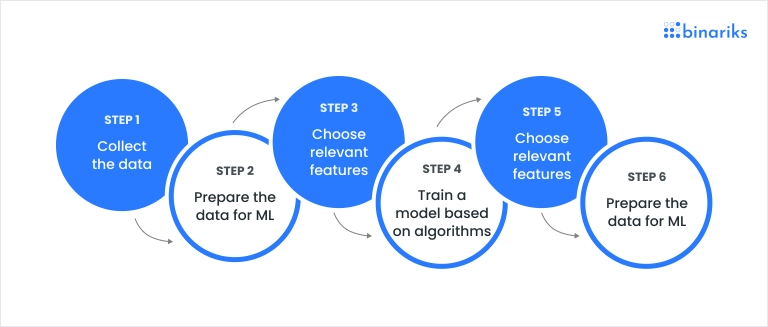
1. Data collection
At this stage, you identify reliable sources for data collection, such as hospitals and research institutions. An IT team like Binariks can assist you in integrating various data sources like EHRs . We can also ensure that the data collection complies with regulations like HIPAA or GDPR.
2. Data preparation
To prepare the data, the IT team needs to remove inconsistencies and errors in data and convert the data into a format suitable for machine learning.
3. Feature selection
At this stage, you must select features most relevant to the disease you are focusing on. Domain expertise is essential here. Binariks will support the data science team by offering the software tools needed for feature selection.
4. Model training
At this stage, a business chooses a suitable machine learning algorithm or a combination of algorithms. The IT team sets up resources for training complex machine learning models and helps to automate the training process.
5. Model evaluation
Now, you must choose appropriate metrics to evaluate the model, such as accuracy, precision, recall, etc. You must use cross-validation techniques to assess how the results will generalize to an independent dataset and evaluate the model using the validation set and chosen metrics. It's crucial to understand why the model makes certain predictions for medical applications.
Techniques like SHAP (Shapley Additive Explanations) can help. Binariks can build tools to track the model's performance metrics in real time.
6. Model deployment
Before full-scale deployment, test the model on a smaller group to assess its real-world performance. Once satisfied, deploy the model into the desired environment, such as a cloud-based platform for medical professionals. Binariks can implement the pilot testing of a model and maintain the performance of the selected model.
Conclusion
Disease detection driven by AI and ML shows incredible promise and excellent results today, as demonstrated by numerous studies in radiology, cardiology, and other branches of medicine. The AI/ML disease detection system is capable of early correct diagnosis, which is the most crucial step to reduce mortality and improve outcomes for most common diseases, including cancers, cardiologic conditions, and diabetes.
With time, disease detection driven by AI will expand to involve more conditions and will focus even more on personalized treatments. Investing in ML and AI for disease detection is the best step for healthcare businesses and individual patients, given the progress it helps achieve for the most common diagnoses contributing to mortality worldwide.
Binariks can help you get the most out of machine learning for medical diagnosis by building AI-based disease detection solutions.