

Predictive analytics in healthcare uses data and AI/ML algorithms to predict future health outcomes, diagnoses, and other aspects related to individual treatments, the functioning of healthcare organizations, and population health. It is a technology that can genuinely revolutionize healthcare because of how many elements it disrupts.
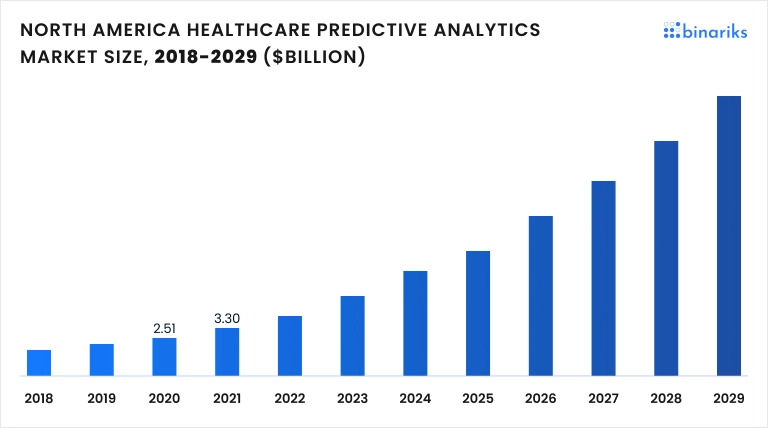
The global healthcare analytics market is growing at a rapid pace. It is expected to reach USD 69.63 billion in the US alone by 2029 at 31.8% CAGR throughout the 2021-2029 forecast period (source ).
At Binariks, we know all the pain points of implementing predictive analytics into the workflow of a healthcare organization. This article focuses on examples of predictive analytics in healthcare, benefits of predictive analytics in healthcare, and some of the most exciting predictive analytics in healthcare use cases.
Benefits of predictive analytics in healthcare
Predictive analytics has rapidly gained traction in healthcare due to its potential to improve patient outcomes, reduce costs, and streamline operations. Using predictive analytics in healthcare results in many benefits, both immediate and observed through time. Let's provide an overview of them:
Early disease identification
As a subset of AI and combined with machine learning, predictive health analytics assists early disease identification. For example, a study has discovered that a deep learning algorithm can predict Alzheimer's disease six years before the diagnosis with an accuracy of over 90% (source ).
Better health outcomes
One of the groundbreaking benefits of predictive analytics in healthcare is the proven ability to improve patient outcomes. The healthcare team can allocate resources more effectively by predicting which patients are at risk of severe complications.
The power of predictive analytics to help medical teams deliver the proper care at the right time is supported by the American Health Information Management Association (source ).
Operational efficiency and cost reduction
Predictive tools can forecast patient inflow. This, in turn, helps hospitals have better resource allocation, reduce wait times, and optimize staff schedules. For example, predictions about patient inflow can help optimize staffing and analyze patient admittance rates to foresee hospital activity.
In retrospect, the contribution of predictive analytics in healthcare to operational procedures helps save millions of dollars annually.
Accurate diagnoses and personalized treatment
Predictive analytics can increase the accuracy of diagnoses, enabling more effective treatments. In personal medicine, doctors can use predictive healthcare analytics and big data to identify treatments for unfamiliar diseases.
Moreover, predictive health analytics can help track that some drugs work differently across populations because of genetic differences.
Healthcare predictive analytics use cases involve predicting medical events. For instance, the University of Pennsylvania uses predictive analytics to foresee septic shock in patients 12 hours before onset (source ).
Examples & use cases of predictive analytics in healthcare
There are dozens of examples of predictive analytics in healthcare related to treatment, prevention, and administrative tasks. Their effectiveness is supported by research and the practice of actual hospitals. Let's evaluate some of the most drastic examples of data analytics in healthcare:
1. Preventing readmission
Predictive modeling in healthcare can help decrease readmission through a hospital deploying a model that assesses a patient's likelihood of readmission within 30 days post-discharge based on data points like the patient's medical history, socioeconomic status, and previous hospitalizations. As a result, hospitals can work on personalized care plans and targeted interventions to avoid readmissions.
One example of this is the reduction of readmissions for patients with diabetes in the University of Kansas Health System. The predictive analysis helped determine that the inability to access follow-up care and patient discharge disposition were the grounds for readmission. As a result, readmission in the patient group fell from 25% to 13,9% in less than a year (source ).
2. Managing population health
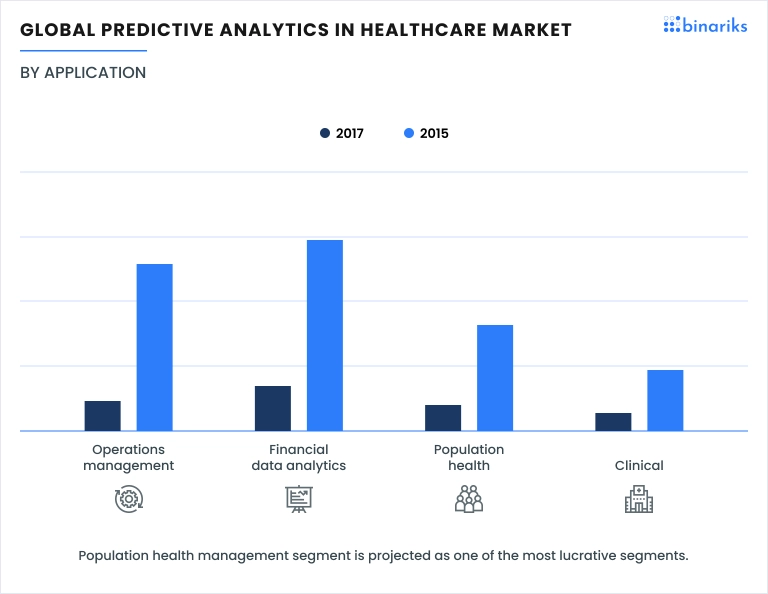
Among other things, using predictive analytics in healthcare helps to manage population health. The patient population can be categorized based on risk factors like chronic disease prevalence, demographics, and lifestyle habits. Access to digitized health records offers insights into community health. This leads to targeted interventions like anti-smoking or obesity campaigns.
Healthcare providers and officials can implement proactive strategies such as community health programs and wellness checks to prevent the development of chronic conditions.
For instance, The Kaiser Permanente Research Program on Genes, Environment, and Health (RPGEH) by a Californian health company has completed epidemiologic studies of genetic and environmental influences on health and disease with the help of predictive healthcare analytics. As a result, they created a database of genetic and environmental determinants of aging-related diseases of 100,000 adults (source ).
3. Enhancing cybersecurity
Predictive analytics in healthcare use cases are not limited to disease and treatment. A predictive analytics solution can observe suspicious activities on the hospital's network based on patterns of previous cyber threats, which is important as healthcare facilities are prime targets for cyberattacks. By using predictive analytics in healthcare, security anomalies can be detected in real-time.
For example, hospitals have begun employing predictive analytics tools to assess real-time network traffic and discover phishing attempts or unauthorized access to sensitive patient data (source ).
4. Increasing patient engagement and outreach
Another excellent use of predictive analytics in healthcare is increased patient engagement. Not only do patients participate more in their treatments with the help of predictive analysis, but it is also easier to find that they are not following the assigned treatments.
Personalization helps engagement. Healthcare providers can tailor outreach campaigns to engage specific subsets of their patient population and ensure patients receive information most relevant to their health needs. Predictive modeling in healthcare can help identify patients who are more or less likely to follow treatments and change strategies based on this information.
5. Speeding up insurance claims submission
Even medical insurance benefits from predictive analytics in healthcare projects. An analytics system predicts which insurance claims might get rejected based on historical data and the patterns of previous rejections. As a result, medical professionals prepare insurance claims better with fewer errors.
6. Predicting suicide attempts
With suicide being the 9th leading cause of death for people aged 10-64 and the second leading cause for people aged 10-34, the benefits of predictive analytics in healthcare for suicide prevention are crucial (source ).
Mental health institutions and hospitals utilize models that factor in clinical notes, past attempts, socioeconomic conditions, and other data to determine the risk of a patient attempting suicide. By identifying high-risk individuals, healthcare providers can ensure timely intervention to prevent suicide. For example, a study has found that Longitudinal EHR data is helpful for suicide prevention (source ).
7. Forecasting appointment no-shows
Appointment no-shows comprise a serious financial burden on the healthcare system in the United States. A hospital can use healthcare predictive analytics to gauge the probability of a patient missing their appointment based on factors like previous no-shows or distance from the clinic.
As a result, a doctor can improve patient scheduling. A clinic might implement reminder systems or offer transportation solutions for high-risk patients.
Data types used for predictive analytics in healthcare
Predictive analytics in healthcare is a complex mechanism that relies on different data types to deliver precise results.
- Electronic health records (EHRs): Predictive analytics in healthcare projects is closely integrated with EHRs . The data from EHRs used in predictive analytics includes patient medical history (including diagnoses, treatment plans, etc.), medication information, laboratory results, and imaging. EHR data forms the backbone of most healthcare predictive models. It is used for many things, including predicting disease onset and patient outcomes.
- Claims data: This is data that healthcare providers send to insurers to receive payment. It includes billing information, provided services, provider vendor data, and all costs. Aside from ensuring that medical services are utilized correctly, this data helps to access population health trends and optimize insurance claims.
- Patient surveys: These are the way to integrate patient feedback directly into predictive analytics in healthcare projects. The patient questionnaires can include questions about patient satisfaction, self-reported health status, behavior, and potential barriers to care. Patient survey data can be used to predict patient compliance and assess risk factors not captured in clinical data.
Algorithms that can be used for predictive analytics
Aside from data, predictive modeling in healthcare also utilizes complex algorithms. Here are some of them:
- Logistic regression: This is a statistical method used to predict a binary outcome's probability based on one or more predictor variables. In simple terms, it involves a "yes" or "no" answer. The healthcare predictive analytics use cases of this algorithm include more straightforward tasks like disease predictions, readmission predictions, and analyzing responses to medication.
- Decision trees: This model presents different outcomes depending on different decisions. It is called a decision tree because the visualization of this model resembles a tree. Decision trees are used in diagnostics, reassessing treatment pathways depending on the patient's response, and segmenting the patient population.
- Neural networks: These complex models are inspired by human brain structure. They consist of interconnected nodes (neurons) arranged in layers. Neural networks are used for most difficult tasks, like medical imaging, genomic sequence analysis, and natural language processing.
Challenges and regulation issues
Despite all the benefits of predictive analytics in healthcare, there are still challenges associated with the quality of algorithms, ethics, and regulation. While holistic strategies to address these challenges are being developed, many issues remain in limbo.
Data quality and availability
Predictive models are only as good as the data fed into them. Incomplete, outdated, or biased data can skew results, leading to inaccurate predictions. Moreover, predictive healthcare analytics can introduce bias if not based on comprehensive data representative of the entire population.
There still needs to be more regulation when it comes to data quality. The European Union's GDPR vaguely mandates explaining algorithmic decisions, but interpretation varies. Meanwhile, self-regulation examples exist, such as protocols for electronic blood pressure machines.
Moral hazards
Using predictive modeling in healthcare is an interesting case from an ethical perspective. If doctors rely too much on predictive analytics, they may ignore their judgment, which can lead to shifting responsibility and even medical errors. The solution to that is understanding healthcare predictive analytics.
However, the balance between the tools and the healthcare professional's judgment is still fragile due to the lack of precedents.
Data privacy
Ethical and regulatory issues that stem from using personal data are inherent to any IT healthcare field. What makes predictive analytics in healthcare special in this regard is that it has larger datasets than many other tools.
Individual patient data can be used to treat larger population sets. However, this should only be done with the patient's consent. Better data privacy requires more detailed standardization, after all.
Our expertise
Now that you know how to use predictive analytics in healthcare, it is time to think of the best ways to implement it into your practice. Working with a remote IT team like Binariks is an excellent solution. We can:
- Assist with data infrastructure development, including creating data exchange channels with EHRs.
- Develop algorithms and models for healthcare predictive analytics.
- Integrate predictive modeling in healthcare with existing systems.
- Create User Interface & Experience (UI/UX) to interact with data.
- Ensure security and regulation compliance.
Final thoughts
The growing integration of predictive analytics in numerous healthcare settings results in more tailored patient care, timely interventions, and decreased hospital expenses. Using predictive analytics in healthcare allows us to dream even bigger and imagine the reality when most conditions are treatable even before the symptoms emerge.
To fully realize the potential of healthcare predictive analytics, we need simple, organized processes with clear algorithms that are convenient for healthcare providers and patients alike.