

Business Intelligence (BI) is a technology-driven process for analyzing data and presenting actionable information for better decisions . In healthcare, it improves the efficiency and effectiveness of health services.
BI comprises data collection, mining, storage, and processing, as well as visualization, predictive analytics, and performance management. BI is paramount in healthcare as it plays a role in healthcare providers' clinical decisions , the financial and operational management of the healthcare organization, and even population health.
In this article, you'll learn:
- What healthcare business intelligence is and how it differs from traditional BI
- How interoperability standards like HL7 and FHIR power modern healthcare analytics
- The core components of healthcare BI architecture, from ETL to identity management
- The most impactful use cases, including clinical decision support, hospital operations, and population health management
- How leading organizations like Cleveland Clinic and Mayo Clinic use BI at scale
- Which BI tools dominate the healthcare market and how to choose the right one
- What security, HIPAA, and GDPR requirements mean for healthcare analytics implementation
- How BI supports value-based care and long-term strategic growth
By the end, you'll understand how healthcare BI works, why it matters now more than ever, and what it takes to implement it successfully.
What is healthcare business intelligence?
Healthcare business intelligence is a data and analytics framework that brings together clinical, administrative, and financial information to support informed decision-making across healthcare organizations and deliver actionable reporting. Use cases range from tracking readmission rates and OR utilization to monitoring payer mix and population health trends.
Healthcare BI implementations must comply with HIPAA, HL7, and FHIR standards while connecting to legacy systems that vary across care settings. Moreover, healthcare data is highly unstructured (clinical notes, imaging, lab results) compared to the transactional data most BI tools are built for, and clinical decisions can't wait for overnight batch processing the way business reporting often can.
Healthcare business intelligence market overview
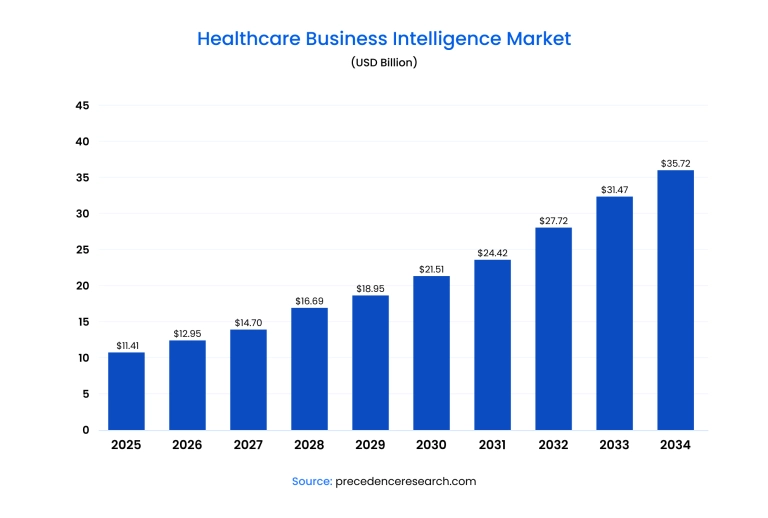
Business intelligence in healthcare is becoming increasingly popular due to its unique ability to improve patient care and optimize operational efficiency simultaneously. Here are some current statistics on business intelligence in the healthcare industry that demonstrate its value and relevance for the industry:
- The market for business intelligence systems in healthcare is expected to grow at a CAGR of 13.52%, reaching .72 billion by 2034. In the US, it is expected to reach 15.13 billion. This growth is driven by both the need to manage chronic disorders and technological advancements across the healthcare sector, including advancements in remote patient monitoring.
- At least 71% of US healthcare providers have embraced predictive analytics, a key component of BI. The healthcare industry is one of the leaders in embracing business intelligence compared to the overall BI adoption of just 26% in sectors like insurance business development . Demand for analytics is also increasing as roughly 60% of US healthcare payments are now tied to value-based care models (HCP-LAN), making performance tracking and outcome measurement essential.
- Other leaders in embracing predictive analytics are Singapore (93%), China (79%), the USA and Brazil (66%), Germany (54%) and South Africa (33%).
- North America leads the BI market with a 48.4% revenue share.
- The financial analytics segment of BI for healthcare has the highest revenue share at 38%, with the patient care segment growing the fastest.
- Leading vendor of business intelligence and healthcare is Mode, with 26% market share.
- Cloud-based healthcare business intelligence tools are the most popular by delivery mode.
- Amazon Web Series is a leading IAAS vendor, with a 60% market share.
Healthcare business intelligence components
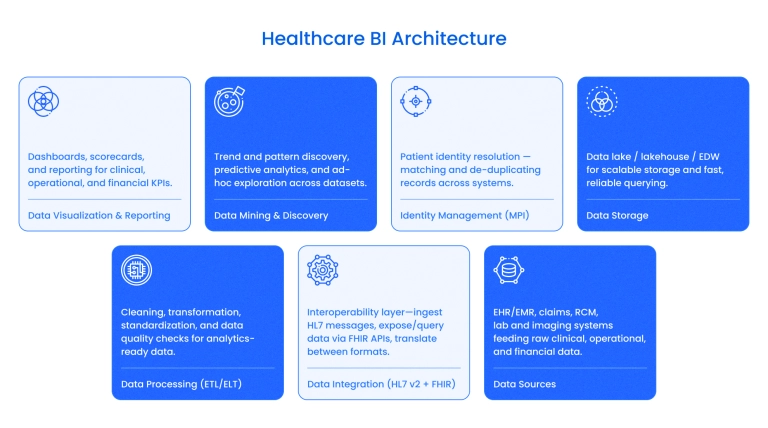
Healthcare BI gathers data from multiple clinical and administrative systems and transforms it into actionable insights. While traditional BI is often described through four core layers : data processing, storage, analysis, and visualization, healthcare BI requires an additional foundational layer built around interoperable clinical systems and identity management.
1. Data sources
Healthcare analytics and business intelligence begin with collecting data from specialized systems that generate clinical, operational, and financial information. These systems supply the raw data that BI depends on.
Key sources are:
- EHR / EMR systems that store patient medical histories and clinical data.
- Claims data, which capture payer interactions and reimbursement activity
- Revenue Cycle Management (RCM) systems that manage billing workflows and payment tracking
- Laboratory and imaging systems
2. Data integration
Healthcare data integration is the process of pulling data from disparate clinical and administrative systems and standardizing it for consistent analysis.
Healthcare-specific integration relies on HL7 v2 messaging and FHIR APIs.
HL7 v2 is a messaging standard that's been in use since the 1980s. It defines a format for sending real-time notifications between hospital systems, things like "patient admitted to room 4B" or "lab result ready." It's text-based, widely supported, and still the backbone of most hospital communication despite being old and inconsistent across implementations.
FHIR (Fast Healthcare Interoperability Resources) is a newer standard developed by HL7 that uses modern web technologies (REST APIs, JSON) to make healthcare data easier to access and share. Instead of sending text-based messages, FHIR exposes data as structured resources: a Patient, a Medication, an Observation. Any system can then query them on demand. It powers most modern EHR integrations and is now required by US federal regulations for patient data access as per the 21st Century Cures Act (2016) and the CMS Interoperability and Patient Access Rule (2020).
In practice, most healthcare environments run both in parallel, with an integration engine translating HL7 v2 messages into FHIR-compatible resources that downstream systems can query.
3. Data processing (ETL)
Once integrated, data must be prepared for analysis through Extract, Transform, Load (ETL) processes.
This process involves extracting data from multiple sources, transforming it into a consistent format, and loading it into a data warehouse. ETL is foundational for ensuring data is accurate, complete, and available for analysis.
4. Data storage
Healthcare analytics requires storage systems capable of handling large data volumes. Healthcare organizations typically use:
- Data lakes for large volumes of raw, diverse healthcare data
- Lakehouse architectures combine the open storage of a data lake with the query performance and data management capabilities of a warehouse. Therefore, it allows organizations to run analytics directly on raw data without maintaining two separate systems.
- Enterprise Data Warehouses (EDW), which store structured data for reporting and trend analysis. An EDW serves as the central repository for the organisation's data. It consolidates data from various sources, making comprehensive analyses easier. An EDW supports complex queries and stores historical data, both of which are crucial for trend analysis and long-term planning in healthcare.
5. Identity management
Reliable analytics depend on accurate patient identification.
Healthcare BI relies on Master Patient Index (MPI) systems to assign a unique identifier to each patient and resolve records that refer to the same person across different source systems. MPIs work even when the patient name and other ID information are inconsistent.
6. Data mining & discovery
This involves exploring large datasets to find patterns, correlations, and insights that are not readily apparent. In healthcare, data mining can reveal trends in patient outcomes, treatment efficacy, and resource utilization. Strategic decisions are made based on data mining and discovery findings.
7. Data visualization & reporting
Visualization tools and reporting systems help translate complex healthcare data into understandable, actionable information. Effective visualization enables quicker, more accurate decisions by presenting real-time insights into operational performance, clinical outcomes, and patient statistics through dashboards, graphs, charts, and reports. Analytics capabilities built on this reporting layer allow organizations to move beyond describing what happened to understanding why it happened and predicting what is likely to happen next.
7 benefits of embedded BI in healthcare
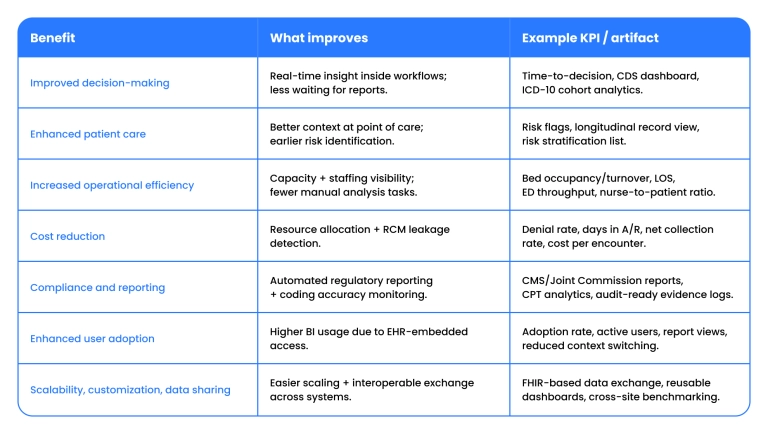
The benefits of business intelligence in healthcare are multidimensional, spanning from improved patient care and higher treatment quality to the optimization of hospital internal processes. Here are the most essential advantages:
1. Improved decision-making
Embedded BI in healthcare allows healthcare professionals to access real-time data and analytics within their workflow. This immediacy helps clinicians and administrators make informed decisions quickly. Traditional data analysis involved physicians requesting reports from the data team.
However, BI for healthcare professionals eliminates the middleman, allowing physicians to extract insights themselves.
Clinical decision support dashboards surface relevant patient data, risk flags, and outcome probabilities at the point of care. ICD-10 is the International Classification of Diseases coding system used to standardize the documentation of diagnoses, symptoms, and procedures across healthcare systems.
In a hospital BI context, ICD-10 coded diagnosis analytics means grouping and analyzing patient populations by standardized diagnosis codes, so you can, for example, track how many patients across a health system have a primary diagnosis of Type 2 diabetes, compare readmission rates by diagnosis category, or identify coding inconsistencies that affect reimbursement.
Self-service BI tools extend this access further, allowing administrators to extract operational insights independently and patients to access their own health data without intermediaries.
2. Enhanced patient care
With analytics embedded directly in patient management systems, clinicians can gain insights into a patient's medical and family history, treatment outcomes, and potential risks without switching between systems.
Longitudinal patient records (continuous, time-ordered histories drawn from EHR systems) give clinicians the full context of a patient's care journey, from first diagnosis through current treatment.
Population risk stratification uses that data at scale, grouping patients by shared risk factors or condition severity so care teams can identify who is most likely to deteriorate and intervene before complications develop.
All of this leads to better diagnostic accuracy , personalized treatment plans, and improved overall patient outcomes. Satisfied patients are the best way to attract new patients.
3. Increased operational efficiency
Embedded BI tools can automate routine data analysis tasks, freeing staff to focus more on patient care than data management.
Bed utilization analytics track occupancy rates, bed turnover times, average length of stay, and discharge delays. With it, the administrators gain visibility into where capacity is being wasted and where demand consistently outpaces supply.
Staff workload data captures how clinical labor is distributed across departments and shifts, including nurse-to-patient ratios and overtime hours, helping managers identify overburdened units and adjust scheduling before burnout or quality issues emerge.
Together, these capabilities help optimize hospital operations across staffing, scheduling, and inventory management from within the tools staff already use.
Business intelligence software in healthcare can also streamline processes for peak performance hours to minimize wait times.
4. Cost reduction
The role of healthcare BI in patient care includes significantly reducing costs by optimizing processes and allocating resources based on data-driven insights.
Healthcare BI solutions help identify the trends that lead to a better understanding of patient inflow and logistics. Claims analytics examines submitted, paid, denied, and adjusted insurance claims to identify denial patterns, coding errors, and reimbursement delays, pinpointing where revenue is being lost due to payer friction or documentation gaps.
The costs should be cut without compromising the quality of care.
RCM (Revenue Cycle Management) optimization covers the full financial lifecycle of a patient encounter. BI tools are applied to healthcare to address RCM surface bottlenecks and leakage points across the cycle, helping organizations reduce days in accounts receivable and improve net collection rates.
On the clinical side, predictive analytics reduces the need for costly emergency interventions by identifying at-risk patients early. At the same time, improved operational efficiency frees up resources for investment in equipment and new patient services. Patients can also save costs and improve their health because predictive healthcare analytics reduces the need for emergency interventions, as health issues can be addressed early.
5. Compliance and reporting
Healthcare is a highly regulated industry that requires stringent compliance with various legal and safety standards.
Embedded BI can help organizations monitor compliance in real time and automatically generate reports that meet regulatory requirements through two key capabilities.
Regulatory reporting in healthcare refers to the mandatory submission of data to government agencies and accreditation bodies – CMS, Joint Commission, state health departments – covering metrics like quality measures, patient safety incidents, readmission rates, and infection control. Business intelligence tools for healthcare automate the aggregation and formatting of this data, reducing the manual effort required to meet reporting deadlines and lowering the risk of submission errors that can trigger audits or penalties.
CPT (Current Procedural Terminology) coding analytics tracks how medical procedures and services are being coded across the organization. CPT codes are the standardized codes used to bill payers for every clinical service performed.
BI applied to CPT data helps identify undercoding (where services are being billed at a lower complexity than performed, losing revenue), upcoding (where codes are inflated, creating compliance risk), and coding inconsistencies across providers or departments that could trigger a payer audit.
6. Enhanced user adoption
Because embedded BI is integrated directly into EHR interfaces, placing clinical and operational insights within the same screen where care is documented and orders are placed, it typically sees higher adoption rates than standalone BI tools that require context switching.
Clinicians are far more likely to engage with data when it surfaces within their existing workflow rather than requiring a separate login to an external analytics platform. Higher adoption leads to more consistent data use across the organization, more comprehensive analysis, and better clinical and operational outcomes.
7. Scalability, customization, and data sharing
Embedded BI solutions can be customized to meet a healthcare organization's specific needs and scaled as those needs change. This flexibility ensures that healthcare providers can continue to benefit from BI as they grow and evolve.
FHIR-based data exchange enables standardized, API-driven sharing of clinical data across systems and institutions, allowing BI platforms to pull from a broader pool of sources without custom point-to-point integrations for each connection.
Interoperable BI ecosystems built on this foundation allow clinicians to contextualize an individual patient's data against population-level or nationwide datasets. They compare symptoms, treatment responses, and outcomes at a scale that would be impossible within a single organization's data alone.
Use cases of business intelligence in healthcare
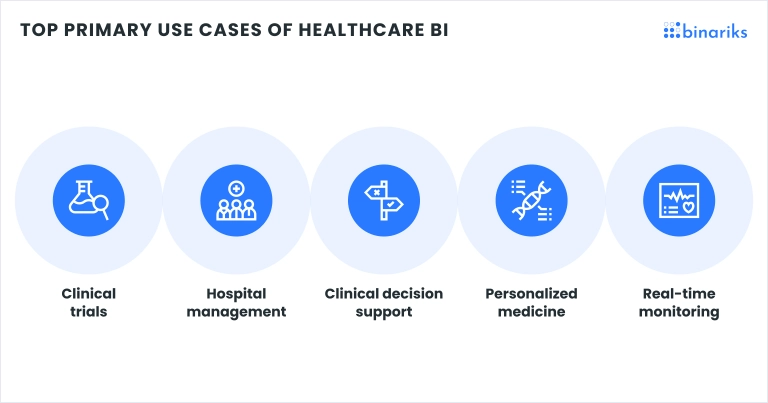
There are hundreds of ways to use BI in healthcare, but hospitals and other healthcare companies have limited resources, so they have to prioritise what's most important to them. Below is the list of the most helpful use cases of BI in healthcare.
Clinical trials
Healthcare BI tools enhance the efficiency and effectiveness of clinical trials. By analyzing data from past trials, researchers can identify patterns and predictors of outcomes to better design future studies.
Healthcare BI also helps in patient selection by identifying suitable candidates based on historical data, thereby increasing the likelihood of successful outcomes. For instance, a pharmaceutical company can use BI to pinpoint the ideal demographic and medical profiles for participants in a trial for a new diabetes drug.
From the safety and compliance side, real-time data monitoring helps detect adverse reactions or anomalies early, potentially saving lives and resources.
By leveraging business intelligence software, healthcare professionals can conduct more effective clinical trials, thereby reducing the time to market for drugs discovered during drug trials.
All in all, BI solutions for healthcare in clinical trials help:
- Patient cohort identification
- Trial outcome analytics
- Adverse event monitoring
- Protocol adherence tracking (ensuring the trial follows its pre-approved procedural rules)
Hospital management
Hospitals use BI to analyze everything from bed utilization rates to patients' average time in the emergency department. This information helps administrators manage supply chains and improve hospital operations, thereby reducing costs and enhancing patient care.
In one particular example, hospitals use BI tools to manage capacity. This includes everything from admission rates and discharge rates to bed occupancy. For example, a BI system might predict peak admission times in an emergency department and adjust staffing and bed availability.
BI tools help hospitals track and analyze financial data, including expenditures, service revenue, and insurance claims processing. This analysis supports financial planning and identifies cost-reduction opportunities.
Business intelligence in the healthcare industry also helps optimize staffing. This reduces hiring costs and helps healthcare professionals avoid burnout. Healthcare business intelligence also effectively prevents fraud in hospitals, including insurance fraud and healthcare system abuses.
Business intelligence for hospitals enables:
- Bed occupancy analytics
- Emergency department throughput analysis (measuring how efficiently patients move through the ED from arrival to discharge)
- Staffing demand forecasting
- Supply chain analytics
- Financial performance monitoring
Clinical decision support
Healthcare BI systems use predictive analytics to identify patients at risk of chronic diseases like diabetes or heart failure based on their medical history, lifestyle data, and other determinants. Clinicians can use this information to implement preventive measures or tailor treatment strategies. These predictive analytics models are built on
Patients with chronic diseases can be tracked with IoT wearable devices, significantly improving their quality of life.
Healthcare BI tools also analyze outcomes from various treatment protocols using cohort analysis and treatment effectiveness dashboards to determine the most effective approaches for different patient groups, thereby improving outcomes.
Personalized medicine
BI tools tailor treatments to individual patients by analyzing genetic information alongside clinical data. This approach improves treatment efficacy and minimizes side effects by considering each patient's unique genetic makeup, lifestyle, and existing conditions.
Medical BI combines:
- Genomic sequencing data (e.g., SNP profiles, mutation panels)
- Longitudinal EHR records, including diagnoses and medication history
- Pharmacogenomic data, linking genetic variants to drug response
- Laboratory results and biomarker data for therapy selection
BI integrates genomic data with clinical outcomes to tailor drug prescriptions and other treatments to individual patients' genetic profiles.
By analyzing long-term patient data, BI helps develop personalized treatment plans that account for each patient's individual characteristics.
Real-time monitoring
Real-time monitoring is critical for patient safety and care quality, particularly in high-acuity environments such as intensive care units and emergency departments. BI tools help monitor vital signs, lab results, and other patient data in real time, providing immediate alerts to healthcare providers when a patient's condition deteriorates or requires urgent intervention.
In critical care settings, BI systems continuously analyze data streamed from ICU monitoring equipment, enabling clinicians to detect early warning signs of patient deterioration before a crisis develops.
Beyond hospital walls, healthcare BI solutions also collect and analyze data from remote patient-worn devices, allowing providers to track health indicators such as blood glucose levels and heart rate around the clock, and to intervene swiftly the moment concerning patterns emerge.
Population Health Management (PHM)
Population Health Management (PHM) applies business intelligence at the system level rather than the individual patient level. PHM focuses on managing defined patient populations across regions, health plans, or provider networks.
For example, it can be used to track patients with diabetes within a state Medicaid program, Medicare Advantage members attributed to an ACO (Accountable Care Organization).
Healthcare BI platforms consolidate data from EHR systems, claims databases, public health registries, and demographic datasets to generate population-wide performance insights. It is done to guide care programs and policies, and plan for reimbursement. PHM is not an element of the clinical decision support in the classic sense.
The medical business intelligence components of PHM include:
- Chronic disease tracking is a systematic monitoring of disease prevalence and progression patterns across defined populations to identify care gaps and outcome disparities.
- Preventive care analytics is a measurement of screening, vaccination coverage, and preventive service utilization to improve compliance and reduce avoidable complications.
- Risk scoring models are population-level risk stratification methods (e.g., HCC Hierarchical Condition Category scoring) that estimate future healthcare costs and utilization to support value-based reimbursement and care coordination planning.
- HCC is a model used to estimate healthcare costs for patients, developed by the Centers for Medicare & Medicaid Services (CMS). Each HCC represents a category of clinically related diagnoses carrying similar levels of medical complexity and projected cost. A higher score reflects greater expected healthcare needs and, therefore, higher reimbursement rates. Conditions are organized hierarchically by severity, with more severe diagnoses taking precedence within the same disease family.
Examples of successful implementation of BI in healthcare
How do actual healthcare organizations implement business intelligence software?
Let's examine two famous US clinics as examples of business intelligence in healthcare.
Cleveland Clinic
Cleveland Clinic is among the earliest adopters of business intelligence in healthcare. It operates across a 6,500-bed health system with 22 hospitals and more than 220 outpatient facilities. The clinic uses business intelligence in health systems through its Virtual Command Centre, built on the Palantir Foundry platform, to enhance hospital operations.
The Virtual Command Center runs three active modules:
- Hospital 360 provides real-time patient census and capacity forecasting
- Staffing Matrix uses real-time volume data to optimize staffing levels
- OR Scheduling streamlines operating room planning and utilization
The system's AI-powered virtual triage achieves 94% accuracy, giving clinical staff a reliable real-time decision-support layer.
Additionally, the Cleveland Clinic has established a long-term partnership with IBM to create the Discovery Accelerator. This collaboration aims to transform how biomedical research is conducted. It integrates business intelligence for healthcare to improve outcomes in genomics and population health.
Mayo Clinic
Mayo Clinic successfully utilizes healthcare business intelligence for multiple purposes, most notably to identify and treat rare diseases and create personalized treatment plans for patients with multiple conflicting diagnoses.
A unified Optum Labs database is used to achieve these goals. Optum Labs is a real-world data platform co-founded by Mayo Clinic and Optum (part of UnitedHealth Group) in 2013.
It combines diverse partner data to generate insights about diseases, treatments, and patient behavior. The scale of the dataset is significant: Mayo contributes over five million clinical records going back 15 years, while Optum brings claims records covering 100 million patients spanning 20 years. Today, the combined database covers more than 300 million de-identified patient lives. The database includes commercial claims, electronic medical records, socioeconomic status data, and Medicare data.
Mayo Clinic shares its expertise with other clinics in the US and Mexico by allowing them to use their expertise and consult with its clinicians. The clinic also uses BI upgrades to utilize team performance and track various operational management metrics.
Data protection and privacy in healthcare BI
Healthcare business intelligence uses a combination of data sources, including medical, administrative, and demographic data, which adds to the complexities of data protection in this context.
HIPAA (Health Insurance Portability and Accountability Act) sets the baseline standard for protecting patient health information. Most of the companies pursuing hospital business intelligence will be primarily concerned with following HIPAA standards and adapting traditional security measures to eliminate the possibilities for data breaches, including:
- Encryption is used both at rest and in transit to prevent unauthorized access.
- Access controls and audit trails to monitor who accesses data and what they do with it.
- Data anonymization techniques are used to remove personal identifiers from the datasets used in BI analysis.
HIPAA does not specify specific best practices that must be followed; it is the prevention of unauthorized access to Protected Health Information (PHI) that matters.
Organizations operating in or serving the EU must also comply with the GDPR (General Data Protection Regulation), which imposes stricter requirements on patient consent, data subject rights, and cross-border data transfers. Unlike HIPAA, GDPR requires patients to give explicit consent for data processing, and patients can request the deletion of their data at any time.
Healthcare organizations with international operations or partners often need to satisfy both HIPAA and GDPR simultaneously.
On the technical side, FHIR APIs are now the dominant standard for health data exchange, but they come with their own security risks. Secure FHIR API implementation requires OAuth 2.0 authentication, TLS encryption for data in transit, and scoped access tokens that limit what each application can read or write.
Companies should also be aware of a growing trend of security breaches involving IoT devices, many of which were not designed with enterprise-grade security in mind but still feed data directly into BI pipelines. Protecting data while using third-party healthcare BI tools is also a challenge that requires vendor security assessments and data processing agreements.
Extensible security policies that are flexible and allow for integrating new security measures without overhauling the existing infrastructure appear to be the best course scenario.
Top BI tools for decision-making in healthcare
Now that we have covered use cases with examples, let's look into what the market offers regarding business intelligence software in healthcare. Here is the overview of the most prevalent healthcare business intelligence tools for healthcare:
Tableau
A leading data visualization platform that enables healthcare professionals to build interactive, shareable dashboards from complex clinical and operational datasets. It is known for an intuitive drag-and-drop interface that makes it accessible across skill levels without requiring SQL or coding knowledge.
Bedside nurses can use it to review unit metrics, and C-suite executives can track system-wide KPIs. This medical BI tool works for everyone.
Unique advantages:
- Industry-leading visualization with highly customizable, publication-quality dashboards
- Tableau Pulse delivers AI-driven metric summaries and anomaly alerts directly to stakeholders
- Native connectors to major healthcare data sources including Epic, Cerner, and HL7 FHIR APIs
- Role-based access controls suited for HIPAA-compliant data sharing across clinical teams
- Tableau Public enables community health benchmarking and public-facing reporting
Disadvantages:
- Best suited for small-to-medium datasets; performance degrades at very large data volumes
- Limited native ETL capabilities. The tool requires a separate data preparation layer
- Higher per-user licensing cost compared to self-service alternatives
The price of the tool varies from $15 to $75 per month, billed annually.
Microsoft Power BI
Microsoft Power BI is known for its integration capabilities with other Microsoft products and services. It is a cloud-based BI tool with robust data processing capabilities suited for handling big data, deriving valuable insights from it, presenting them in a comprehensible visual format, and sharing them across the organization.
It offers comprehensive analytics tools, including real-time dashboard updates, data warehousing, and the ability to handle large datasets, which are crucial for hospital data management.
Unique advantages:
- Augmented analytics capabilities, (e.g., intelligent narratives and anomaly detection)
- Can be used as a stand-alone tool
- Seamless integration with other Microsoft healthcare software
- Real-time dashboard updates and enterprise-grade data warehousing
Disadvantages:
- Steep learning curve makes it not available for non-technical users
- Azure-only deployment required
- The on-premises version offers reduced functionality compared to the more expensive cloud edition.
Prices are very different: from just $14 per month for Power BI Pro to $735.913/month for A1 Power BI Embedded.
Qlik Sense
Qlik is a BI platform built on an associative data indexing engine that allows healthcare analysts to explore datasets in any direction, rather than following a predefined query path.
This architecture helps clinicians and administrators surface non-obvious correlations in patient outcomes and population health data that query-based tools would otherwise miss.
Unique advantages:
- Associative engine retains all data relationships simultaneously, enabling exploratory analysis across any combination of variables
- Multi-cloud and on-premises deployment that is not locked to a single cloud provider
- Built-in AutoML and predictive analytics capabilities without requiring a separate data science environment
- Active Intelligence architecture supports real-time data updates and event-driven alerts for clinical workflows
- Qlik Health connector provides pre-built integrations with EHR systems and claims data formats
Disadvantages:
- Visualization capabilities are less polished than Tableau or Power BI
- Limited native data extraction tools; relies on third-party ETL for complex pipelines
- Steeper scripting learning curve for custom data modeling
The prices start from $30 per user/month to thousands for custom enterprise plans.
IBM Cognos Analytics
One of the enterprise-grade BI tools for healthcare designed for large healthcare organizations that require advanced data integration, regulatory-grade reporting, and AI-assisted analysis.
Cognos supports end-to-end analytics workflows from raw data ingestion through executive scorecards. It is well-suited for health systems managing complex, multi-source data environments across multiple sites.
Unique advantages:
- AI-powered report authoring with natural language query support (Ask Cognos)
- Built-in data governance, lineage tracking, and audit trails for regulatory compliance
- Scalable architecture supports enterprise-wide deployments across large health systems and integrated delivery networks
- Deep integration with IBM Watson Health data models and healthcare-specific content accelerators
- Advanced scorecarding and KPI tracking aligned to clinical and operational benchmarks (CMS, HEDIS, Joint Commission)
Disadvantages:
- Complex implementation requiring dedicated IT resources and professional services engagement
- Not designed for non-technical self-service use without significant training investment
- Limited native support for unstructured data sources such as free-text clinical notes
- Higher total cost of ownership compared to cloud-native alternatives
Sisense
A BI platform built to simplify complex data for healthcare organizations by embedding analytics directly into clinical and administrative workflows. It has a low-code/no-code design suitable for technical and non-technical users alike. In-Chip technology delivers fast query performance on large healthcare datasets without requiring pre-aggregation.
Unique advantages:
- Embedded analytics capabilities allow BI to be surfaced inside EHR interfaces, patient portals, and administrative tools without redirecting users to a separate platform
- In-Chip technology processes data in-memory for near-instant query response on large datasets
- Drag-and-drop dashboard builder requires no SQL or coding knowledge
- Native REST API and SDK support for deep integration with custom healthcare applications
- HIPAA-compliant deployment with fine-grained, role-based access controls
Disadvantages:
- Limited out-of-the-box visualization customization compared to Tableau
- Advanced use cases require developer involvement, offsetting the no-code premise for some organizations
- Smaller ecosystem of pre-built healthcare data connectors compared to enterprise competitors.
Domo
A cloud-native business intelligence platform that consolidates data from disparate healthcare systems into a single, unified environment with real-time visibility. Does not require desktop access, and can be accessed by healthcare administrators from any device.
Unique advantages:
- Fully cloud-based with native iOS and Android apps optimized for point-of-need decision-making
- Magic ETL provides a visual, code-free pipeline builder for connecting and transforming healthcare data sources without SQL or scripting
- Domo Everywhere enables white-labeled embedded analytics surfaced directly inside patient-facing and partner-facing portals
- Pre-built connector library covers major EHR platforms, insurance billing systems, and public health data feeds
- Collaborative features – data stories, annotations, and workflow triggers – built directly into dashboards, reducing the gap between insight and action
Disadvantages:
- Per-user pricing model becomes costly at scale in large health systems
- Advanced statistical analysis capabilities are limited compared to SAS or IBM Cognos
- Heavy cloud reliance may present barriers for organizations with strict data residency or on-premises requirements
SAS Business Intelligence
An analytics and BI suite built on decades of statistical computing research is purpose-designed for organizations that require rigorous, validated analysis rather than self-service dashboarding.
In healthcare, SAS BI is most commonly deployed in life sciences organizations and government health agencies that run longitudinal cohort studies and clinical risk models.
Unique advantages:
- Industry-leading predictive modeling and machine learning for clinical risk stratification, readmission prediction, and population health management
- Native support for advanced statistical methods including survival analysis, mixed models, and time-series forecasting – not available out of the box in general-purpose BI tools
- SAS Health solutions include pre-built analytical models aligned to CMS quality programs, HEDIS measures, and value-based care frameworks
- Regulatory-grade auditability and result reproducibility, meeting the documentation standards required for clinical research and real-world evidence submissions
- Handles structured and semi-structured data at scale, including claims histories, lab result streams, and genomic datasets
Disadvantages:
- Among the highest licensing costs in the healthcare BI market
- Requires SAS programming proficiency for advanced use – not suitable for clinical or administrative self-service without significant training
- Limited native support for unstructured data sources such as free-text clinical notes and imaging metadata without additional licensed modules
- Longer implementation timelines compared to cloud-native BI alternatives
Binariks: your partner in healthcare BI
Implementing business intelligence in healthcare is a complex task that may require hiring services outside the company.
At Binariks, we have experience implementing BI solutions (both cloud and on-premise) and proven healthcare expertise . Here is what we can do for our clients in terms of business intelligence for healthcare companies:
- Integration and consolidation from various sources
- Selecting the appropriate BI tool and managing its use
- Implementing custom predictive analytics and machine learning models
- Data security protection and compliance with standards like HIPAA
- Operational efficiency analysis
- Other big data and analytics services
Final thoughts
To wrap things up, business intelligence is a game-changer for the healthcare industry. It offers many benefits, from enhancing patient care and streamlining operations to cutting costs and improving decision-making.
By using advanced tools, healthcare organizations can dive deep into their data, optimize their workflows, and ultimately deliver better patient outcomes.
As the healthcare landscape evolves and the need for data-driven insights grows, partnering with experts like Binariks can make a big difference. We can help healthcare organizations tackle the challenges of BI implementation by integrating and consolidating data from various sources, selecting the right BI tools, building custom analytics models, and ensuring data security and compliance.
Embracing BI in healthcare isn't just about keeping up with technology; it's about transforming care delivery, making smarter decisions, and fostering a culture of continuous improvement. Looking ahead, integrating BI in healthcare will be crucial in shaping the future of patient care and operational excellence.
If you're ready to take your healthcare organization to the next level, explore our business intelligence services.