Leveraging ML and Computer Vision for Real-Time Surgical Scene Recognition and Enhancing Operating Room Efficiency

- Python
- PyTorch
- Tensorflow
- AWS
- SageMaker
- Docker
- AWS S3
- MLFlow
- DVC
- Gstreamer
SERVICES
Project Context
Solution
Outcome
About Client
Our client is a London-based health tech company providing a leading global healthcare collaboration platform.
Their mission is to digitize and connect operating rooms across hospitals worldwide. By using surgical video and AI, they help healthcare providers enhance procedural visibility, improve decision-making, and streamline operations.
Business challenge
Approach
Binariks approached this project with a data-driven and research-intensive methodology, ensuring that the solution would be both scalable and highly accurate in recognizing key surgical events. The project kicked off in June 2024 as a proof of concept (PoC), where we collaborated closely with the client to validate the feasibility of an AI-powered video recognition system for operating room management.
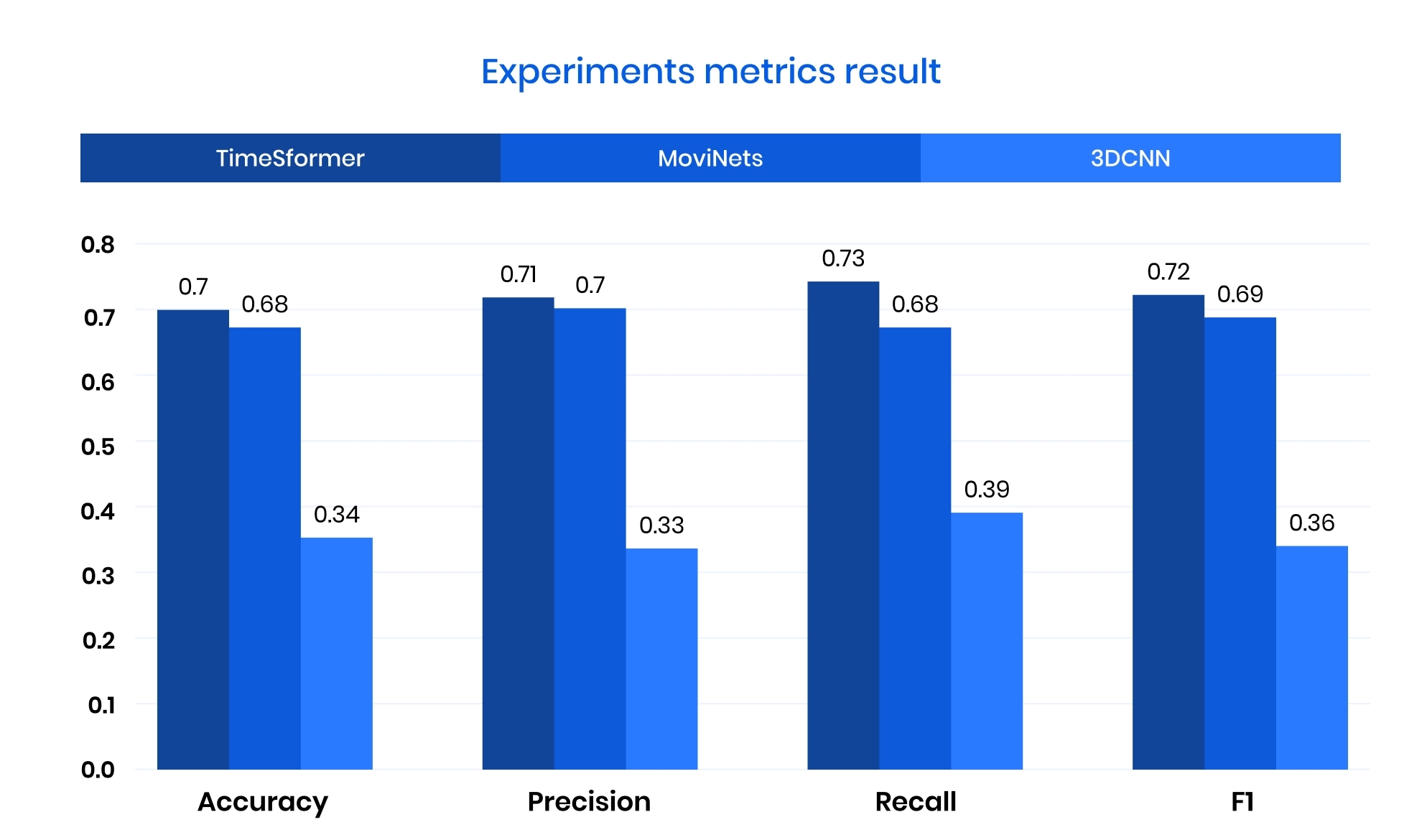
Our team – comprising a Project Manager, Senior Data Scientist, and Lead Data Scientist – began by exploring existing open-source computer vision models to determine the most effective approach. We evaluated MoviNets, TSM, 3DCNN, and TimeSformer, ultimately selecting TimeSformer due to its superior accuracy and efficiency in training and inference.
Initially, we planned to leverage MONAI.io for data labeling and model training, but after thorough investigation, we pivoted to a custom approach using AWS EC2 for model experimentation.
With a focus on real-time tracking, the solution was designed to provide medical staff and hospital management with actionable insights to optimize Operating Room Effectiveness (ORE) – not only streamlining hospital operations but also enhancing patient care by reducing delays and increasing surgical capacity.
Implementation
To achieve the project objectives, Binariks followed a structured, research-driven approach, balancing accuracy, efficiency, and scalability. The implementation phase involved the following key steps:
1. Model selection
We conducted research on open-source computer vision models for video action recognition, evaluating MoviNets, TSM, 3DCNN, and TimeSformer, each trained on about 500 hours of annotated surgical videos from the client.
- MoviNets: Strong accuracy but excessive training time led to its rejection.
- 3D CNNs: Computationally expensive with poor accuracy on surgical videos.
- TimeSformer: Selected due to its transformer-based architecture, superior accuracy, and ability to handle temporal dependencies in video data.
2. Data preparation and preprocessing
- Utilized the client's labeled dataset of surgical videos, containing key events such as "wheels in," "operation start," "operation end," and "wheels out."
- Preprocessed the videos to align with model dataset requirements by segmenting events from full-length recordings.
- Standardized frame rates and resolutions to ensure consistency across the dataset.
3. Model training and implementation
- Used AWS EC2 GPU instances to train models efficiently, reducing computation time.
- Fine-tuned the neural networks using PyTorch,which was chosen due to its flexibility, ease of use, and dynamic computation graph essential for working with complex video models like TimeSformer.
- Achieved an initial accuracy of 82%, targeting 95% through continuous model refinement.
- Integrated MLflow for experiment tracking and hyperparameter optimization.
4. Deployment and real-time inference
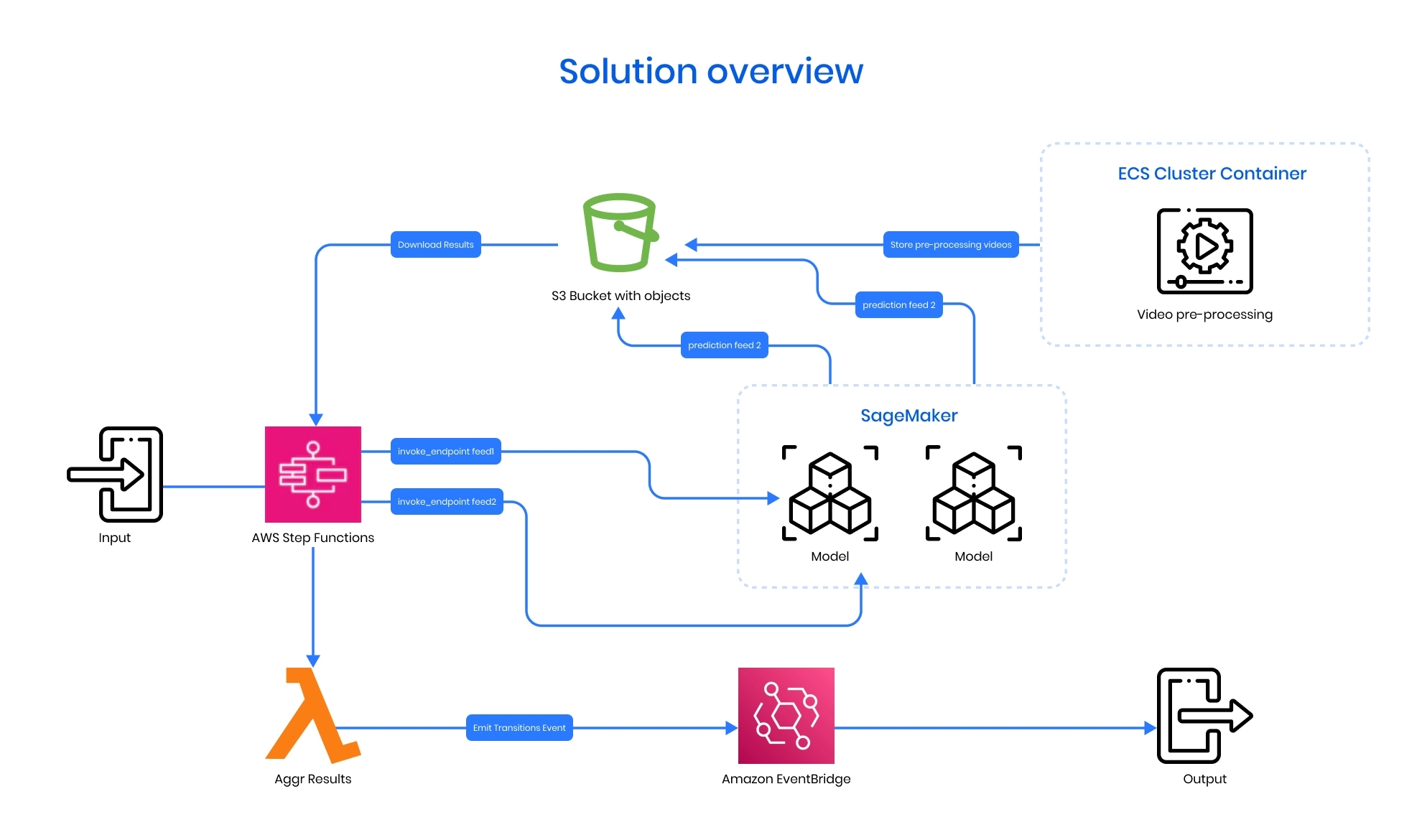
- Deployed the trained TimeSformer model on AWS SageMaker, ensuring scalable and managed inference.
- Implemented GStreamer for video stream processing, enabling real-time detection of surgical events.
- Designed a CI/CD pipeline using Docker and Git, ensuring smooth model updates and version control.


Value Delivered
- Enhanced operational efficiency
By automating the recognition of critical surgical events, hospitals can now monitor OR usage in real time, reducing downtime and optimizing scheduling. This ensures better resource allocation and a more efficient workflow, ultimately leading to improved patient care.
- Improved data tracking and analytics
The solution enables precise data collection on Operating Room Effectiveness (ORE), providing hospitals with actionable insights. By identifying bottlenecks and inefficiencies, healthcare facilities can now refine processes to enhance productivity and reduce unnecessary delays in surgeries.
- Facilitated platform adoption and expansion
The machine-learning-powered approach has helped the client engage more hospitals, expanding its platform usage and increasing its impact in the healthcare sector. By demonstrating the power of AI-driven surgical analytics, the client has strengthened its position as a leader in digital surgery solutions.
Achieved POC objectives & future potential:
- The model successfully predicts targeted surgical events, confirming the feasibility of AI-driven scene recognition.
- With production deployment currently underway, the solution is poised to transform hospital operations further.
- The project has laid the groundwork for future scalability and advancements as more labeled video data becomes available, including predictive analytics and deeper AI-driven process optimization.
Through this collaboration, Binariks has pioneered a scalable, data-driven solution that enhances operational efficiency, hospital management, and patient outcomes.
More case studies


Web and Mobile solution for meditation
Binariks developed a mobile and web meditation app for Spanish-speaking users. We provided software development and QA services to launch a demand on the market product.
Software Development and Design Services for Food Marketplace
Binariks facilitated an American food delivery business by optimizing their web and mobile platforms, providing UI/UX services, and ensuring QA testing.
Secure Messaging Platform Based on ID Authentication
Binariks helped a Swedish technology company in developing a secure messaging platform based on the national BankID authentication.
Let's Start Your Project
We'd love to hear about the project you're working on. Simply complete the form and we'll be in touch.
What happens next?
Our expert will reach out to understand your goals and challenges
If needed, we'll sign an NDA to ensure full confidentiality
You'll receive a tailored roadmap with solution suggestions, timelines, and budget estimates