From 3 Hours to 15 Minutes: AI-Powered Claims Automation for Global Risk Management Provider

80–90%

less manual intake work

2–3 hours → <15 min

intake turnaround

AI-Powered Claims Automation for Global Risk Management Provider

Project Overview

  • Country

    Global

  • Industry

    Insurance

  • Company size

    1000+ employees

Our client is a global provider of comprehensive risk management services, specializing in private investigations and corporate intelligence.

Their services span background screening, fraud investigations, and corporate risk advisory. With operations across North America, Europe, and Asia-Pacific – including offices in Australia – the company supports enterprises in mitigating risks and maintaining compliance across diverse jurisdictions.

  • Global

    operations

  • Risk management

    core specialization

  • 3 regions

    North America, Europe & APAC

Business Challenge

  • Manual email transcription consumed substantial operations-team time for every incoming case request.

  • 20–30 document layouts across PDFs, Word files, and plain text required careful human review.

  • 2–3 hour intake times delayed case readiness and reduced responsiveness to client requests.

  • Manual transcription errors affected names, dates, and required case information.

  • Headcount-dependent scaling made growth increasingly costly and difficult to sustain.

Our Solution

Approach

We recognized that the solution required more than just automation – it needed to handle real-world complexity while maintaining reliability and keeping costs predictable.

Our team began by understanding the full scope of the problem: analyzing the 20-30 document layout variations, mapping the TrackOps API requirements, and establishing clear success criteria with the client's stakeholders.

The goal was to reduce the 2-3 hour intake delays to under 5 minutes while maintaining accuracy and keeping annual infrastructure costs around $2,000.

Binariks designed a tailored solution that addressed the client's specific constraints:

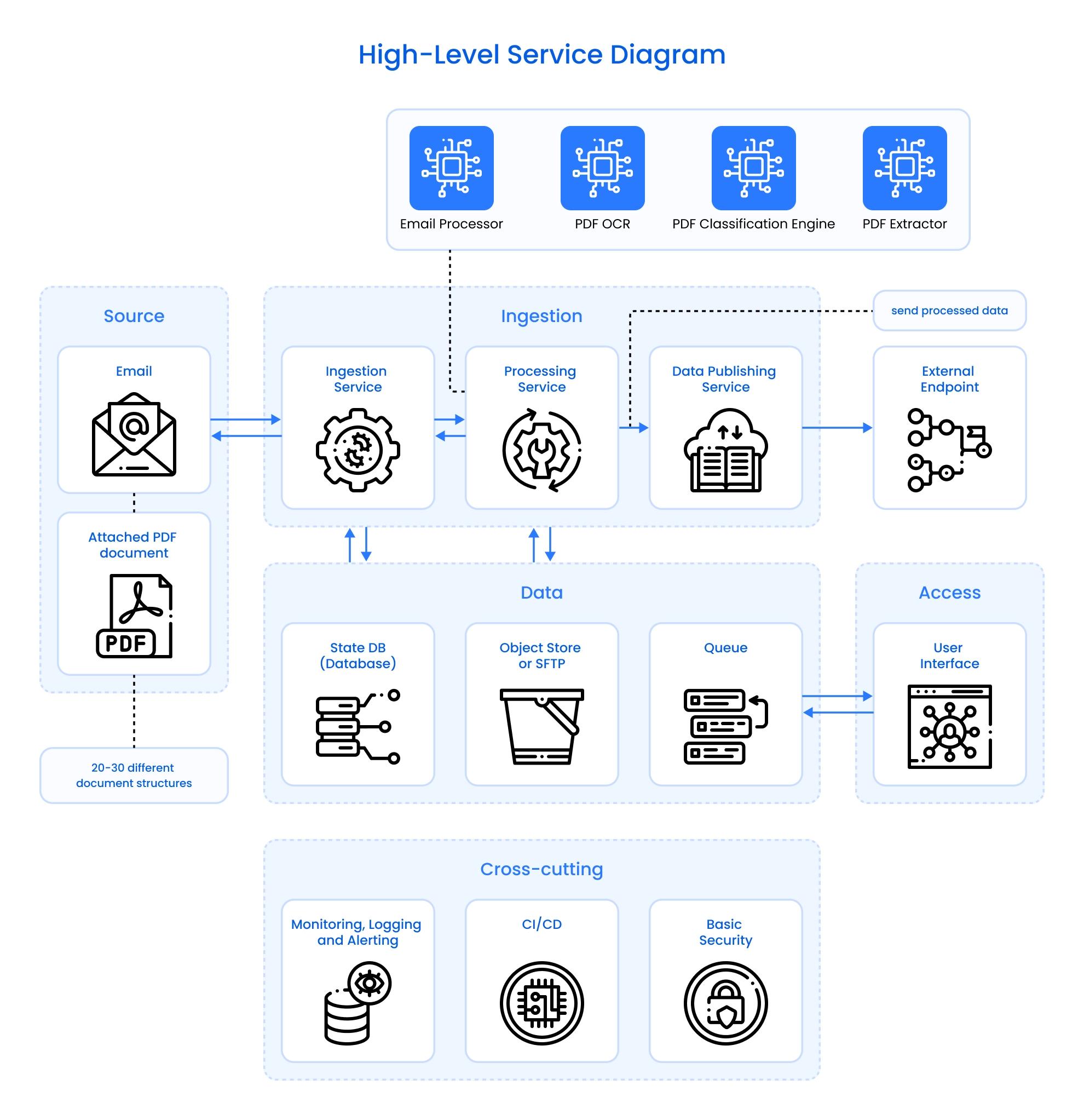
  • The strategy centered on creating an intelligent, event-driven pipeline that could ingest emails automatically, parse diverse document formats using AI, validate the extracted data, and push structured information directly into TrackOps without human intervention for the majority of cases.
  • For handling uncertainty, the team built in a fallback mechanism: documents that couldn't be parsed with high confidence would route to a lightweight admin interface for quick manual review, ensuring nothing slipped through the cracks.
  • To keep operations smooth, comprehensive monitoring and alerting were baked into the design from day one, giving the team visibility into processing times, accuracy rates, and any issues requiring attention.

The project moved from problem framing through historical data validation, automated testing, and deployment across separate development, staging, and production environments.

Implementation

The technical implementation centered on a serverless, event-driven architecture that balances reliability with cost-efficiency.

  • Email ingestion: An Outlook listener captures emails from the centralized inbox, queuing message IDs via Amazon SQS while storing deduplicated content and attachments in S3.
  • AI-powered parsing: The system combines Amazon Textract for layout analysis with Amazon Bedrock (Claude Sonnet) for intelligent entity extraction. A JSON schema guard validates structured output, and documents with confidence scores below 0.8 route to a fallback queue instead of risking incorrect data entry.
  • TrackOps integration: A custom adapter maps extracted JSON to TrackOps API specifications, automatically creating cases with populated fields for high-confidence extractions.
  • Fallback handling: A lightweight Vue.js admin interface allows operators to review and correct uncertain extractions, maintaining 100% processing coverage with minimal manual intervention.
  • Infrastructure: Built on Python 3.12 with Terraform for infrastructure-as-code and GitHub Actions + AWS SAM for CI/CD across separate dev/staging/production environments. Blue-green canary deployments via Lambda aliases roll changes to 5% of traffic first. Amazon RDS PostgreSQL stores processing results and audit trails, with VPC endpoints securing internal communication.

  • Observability: CloudWatch metrics, structured JSON logs, and X-Ray traces provide real-time visibility. Custom alarms send Slack alerts when thresholds are breached.

The architecture processes ~1,000 documents per month (~2,000 pages, ~2.3M tokens) with infrastructure costs at ~$160/month – well under the $2K annual target.

Technologies Used

  • AWS
  • Lambda
  • Vue.js
  • PostgreSQL
  • Python
  • GitHub Actions
  • Terraform
  • AWS S3
  • Amazon Bedrock
  • AWS CloudWatch

Velue Delivered

The AI-powered pipeline transformed claims intake from a manual transcription workflow into an automated, exception-based process, improving processing speed and data consistency while keeping infrastructure costs predictable.

  • 80–90%

    less manual intake work

  • 2–3 hours → <15 min

    intake turnaround


  • 85–90%

    parsing accuracy

The transformation in the client's claims intake process exceeded expectations across every key metric.

  • Manual work dropped by 80-90%. The operations team went from transcribing every claim to reviewing only 10-20% flagged for verification, freeing time for higher-value investigative work.
  • Intake turnaround collapsed from 2-3 hours to under 15 minutes – a 90% reduction that dramatically improved client responsiveness.
  • Parsing accuracy reached 85-90% based on historical data validation. AI-powered extraction proved more reliable than manual transcription, reducing errors and rework.
  • Infrastructure costs stayed at ~$2,000 annually. The pay-per-use architecture enabled scaling without additional headcount, making growth economically sustainable.

Beyond solving the immediate bottleneck, additional value emerged during implementation:

  • Complete audit trails through RDS and CloudWatch provide compliance documentation that didn't exist before
  • Standardized data quality across all cases improved downstream workflow consistency
  • Real-time dashboards give leadership visibility into intake performance they never had
  • Extensible architecture allows adding new document types or automations without re-architecting

Our client now has a scalable, reliable intake process that supports growth while maintaining the speed and accuracy their clients demand.

Let's Start Your Project

We'd love to hear about the project you're working on. Simply complete the form and we'll be in touch.

What happens next?

01

Our expert will reach out to understand your goals and challenges

02

If needed, we'll sign an NDA to ensure full confidentiality

03

You'll receive a tailored roadmap with solution suggestions, timelines, and budget estimates