

The IoT trends of 2026 are no longer on the horizon – they're already reshaping how industries operate. Connected devices, AI-driven automation , and real-time data systems are moving from pilot projects to core infrastructure, and the businesses that adapt earliest will define the next decade of their sectors.
What makes 2026 a turning point isn't just the volume of connected devices but their intelligence. Edge computing is pushing data processing closer to the source. AI is turning raw sensor data into operational decisions. And across healthcare, manufacturing, and smart cities, IoT is becoming less of a feature and more of a foundation.
Key takeaways
IoT in 2026 is no longer about connectivity, it's about intelligence. AI-powered devices don't just collect data; they analyze, predict, and act in real time.
- Edge computing and system disaggregation are shifting processing closer to the source, reducing latency and cloud dependency across industrial and enterprise deployments.
- Security can no longer be an afterthought. As IoT networks scale to billions of devices, blockchain-based authentication and zero-trust architectures are becoming baseline requirements.
- Digital twins and AIoT are closing the gap between physical operations and data-driven decisions, enabling businesses to simulate, optimize, and automate before committing to real-world changes.
- The biggest IoT opportunities in 2026 sit at the intersection of industries – healthcare, smart cities, and manufacturing are leading adoption, but the underlying shift applies across every sector that runs on real-world data.
Get ahead of the curve – see what's next for IoT.
The future of IoT & predictions for 2026-2030
According to IoT Analytics, the IoT industry trends indicate that the enterprise IoT market grew by 15% in 2023, reaching $269 billion. While this was a slowdown from the previous year's 18% growth, the market is expected to reach .74 billion by 2027, with a staggering CAGR of 15% from 2025 to 2030. Despite short-term fluctuations, enterprise IoT spending is set to accelerate as industries continue adopting connected solutions at scale.
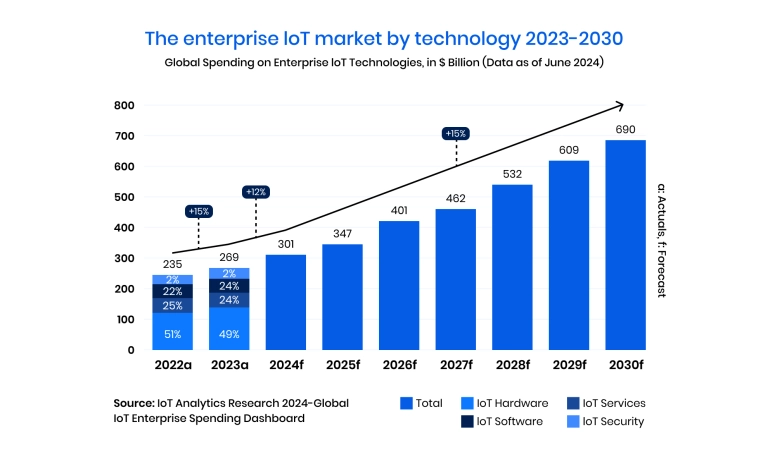
One of the top IoT trends in 2026 is the rapid increase in connected devices, projected to hit 29 billion by 2030, up from 9.7 billion in 2020.
The IoT trend of enterprise adoption is growing, with the highest deployments in electricity, gas, water supply, and waste management. Retail, transportation, and government sectors also heavily invest in IoT, with over 100 million devices deployed across these industries. By 2030, connected vehicles, IT infrastructure, and asset tracking are expected to surpass one billion devices .
In the consumer market, trends in IoT show that smart home adoption is leading the charge, with an estimated 350 million devices deployed by 2025.
Voice assistants are also seeing rapid growth, especially among younger users. Around 65% of people aged 25-34 use voice assistants daily, with those aged 18-24 following closely at 59%. Smartphones and media devices remain this segment's most widely used IoT technologies. Security remains a top concern as IoT expands. As businesses scale their IoT initiatives, leveraging IoT development services will be essential to building secure, scalable, and future-ready solutions.
10 key IoT trends shaping 2026
The IoT is entering a new era, bringing advanced connectivity, smarter automation, and greater efficiency across industries. As technology evolves, new trends are emerging, pushing IoT to new heights. Here are the ten most significant IoT trends shaping 2026 and beyond.
1. Low-power wide-area networks (LPWAN) for scalable IoT
The demand for energy-efficient, long-range connectivity is rising. Low-power wide-area networks (LPWAN) are emerging as a critical solution for connecting devices over vast distances while consuming minimal power.
Unlike traditional cellular networks, LPWAN technologies, such as LoRaWAN and NB-IoT, enable low-bandwidth communication for battery-powered IoT devices, making them ideal for remote and industrial applications.
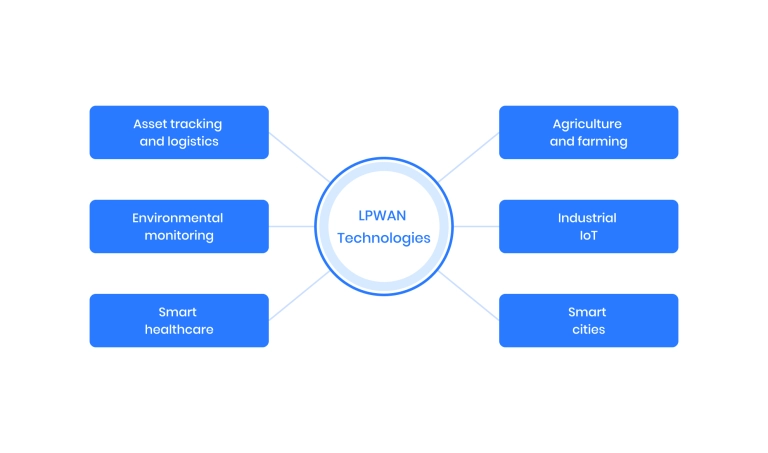
Examples:
- Smart agriculture – LPWAN-connected sensors monitor soil moisture, temperature, and weather patterns, optimizing water and fertilizer use.
- Logistics and supply chain – Low-power trackers provide real-time location updates on goods in transit, reducing losses and improving efficiency.
- Smart metering – Utility companies deploy LPWAN-enabled meters for real-time monitoring of water, gas, and electricity consumption.
According to Forbes, LPWAN is a crucial enabler of massive IoT, connecting billions of devices across industries while minimizing infrastructure costs.
2. System disaggregation for more efficient data processing
As emerging IoT technologies continue to reshape industries, system disaggregation is becoming a key approach to optimizing data processing. This concept involves breaking down monolithic systems into modular components, allowing different hardware and software layers to work independently. By decoupling compute, storage, and networking, organizations gain flexibility, scalability, and efficiency in managing IoT-generated data.
Examples:
- Edge computing – Disaggregated architectures process IoT data closer to the source, reducing cloud dependency and latency.
- AI-driven analytics – Separating AI workloads improves the efficiency of real-time IoT data processing.
- Data centers – Modular infrastructure enhances scalability and energy efficiency for high-performance IoT applications.
System disaggregation is enabling businesses to overcome performance bottlenecks by streamlining data flow between IoT devices and cloud environments. As IoT networks grow more complex, companies looking to enhance efficiency will benefit from AI and IoT projects that leverage disaggregated computing architectures.
3. Hyper-personalized IoT ecosystems
With IoT becoming more adaptive, the latest IoT technology drives hyper-personalized ecosystems where devices learn from user behavior and optimize experiences in real time. AI-powered IoT systems now analyze patterns, predict preferences, and make proactive adjustments, enhancing automation across industries.
Examples:
- Retail – IoT-driven analytics track customer behavior, enabling dynamic pricing, personalized promotions, and AI-assisted shopping.
- Healthcare – Wearable IoT devices monitor patient vitals and adjust treatment plans based on individual health data.
- Smart homes – Connected systems optimize lighting, climate control, and security based on user preferences and routines.
ScienceDirect highlights how hyper-personalized IoT creates more intuitive ecosystems by integrating predictive analytics and context-aware computing. Businesses adopting this approach can enhance customer experiences and increase operational efficiency. With personalization at the core, leveraging IoMT will be essential for optimizing user-centric IoT solutions.
4. AI (AIoT) and ML for intelligent automation
As industries push for more automation, the Internet of Things trend is shifting toward AI-driven IoT (AIoT). IoT systems can process vast amounts of data in real time by integrating machine learning with connected devices, enabling predictive decision-making and autonomous operations. This evolution reduces human intervention, increases efficiency, and unlocks new business opportunities.
Examples:
- Predictive maintenance – AIoT systems analyze sensor data to predict equipment failures before they happen, minimizing downtime.
- Autonomous vehicles – AI-powered IoT sensors improve navigation and real-time decision-making in self-driving technology.
- Energy management – Smart grids use AIoT to forecast energy demand and optimize distribution.
JUMO, a leading automation and sensor solutions manufacturer, has successfully implemented AIoT-driven intelligent automation to optimize its production processes.
The system, developed in collaboration with IoT pioneer Device Insight and Swedish AI specialist Sentian, uses machine learning to analyze starting materials and make real-time adjustments during batch production. Each sensor batch is automatically optimized based on newly acquired data, continuously improving the prediction model.
The impact of this AIoT solution has been significant — JUMO reduced its reject rate and increased the yield of the highest-quality sensors by 20%.
5. Blockchain for IoT security: Enhancing trust in connected devices
As IoT networks expand, ensuring data security and device authentication is becoming a critical future trend in IoT. Blockchain provides a decentralized and tamper-proof ledger that records transactions across multiple devices, reducing the risk of cyberattacks, data manipulation, and unauthorized access. By leveraging blockchain, IoT systems gain enhanced transparency, reliability, and automation through smart contracts.
Examples:
- Supply chain management – IoT sensors track shipments, while blockchain records immutable data on temperature, location, and handling conditions, ensuring product authenticity and traceability.
- Device authentication – Blockchain verifies connected devices without a central authority, preventing identity spoofing and unauthorized network access.
- Automated transactions – Smart contracts trigger secure payments, inventory updates, and compliance verification in industrial IoT settings.
A real-world example of blockchain securing IoT is in smart homes, where the technology protects data exchanges between security cameras, smart locks, and environmental controls. Blockchain ensures that only authorized users can interact with these devices, eliminating the risk of data tampering and cyber intrusions.

Forbes highlights that businesses integrating blockchain into IoT ecosystems are experiencing fewer security breaches and higher data reliability, making it a crucial technology for scaling connected infrastructure. As IoT innovations evolve, blockchain adoption will play a key role in securing the future of IoT.
6. Digital twins: Bridging physical and virtual worlds
A digital twin is a real-time virtual model of a physical object, system, or process continuously updated with IoT data to simulate real-world behavior.
This technology enables organizations to test scenarios, predict failures, and optimize performance before making costly physical changes. Digital twins evolve beyond static models, integrating AI and machine learning to enable autonomous decision-making and process optimization.
Types of digital twins:
- Component twins – Simulate individual IoT-enabled parts of a system for precise performance analysis.
- Asset twins – Represent multiple components working together, offering insights into interactions and optimizations.
- System twins – Model entire operational systems to predict how assets influence each other in real-time.
- Process twins – Provide large-scale simulations of workflows and production cycles to improve efficiency.
Digital twins significantly improve predictive maintenance in aerospace and energy industries. In wind farm management, operators use IoT sensors to monitor turbine performance and feed real-time data into a digital twin. This has led to up to a 25% increase in energy efficiency and a 30% reduction in unexpected failures by identifying stress points before actual damage occurs.
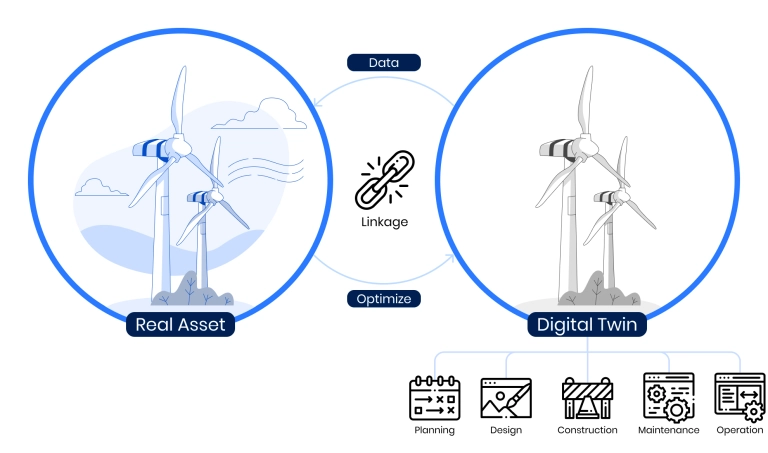
With IoT technology trends driving real-time analytics and automation, digital twins are becoming the key tech for industries aiming to optimize operations, reduce costs, and enhance sustainability. Their ability to bridge the physical and digital worlds unlocks new possibilities in industrial efficiency and smart infrastructure management.
7. Voice-activated IoT and hands-free control
Voice-activated IoT uses speech recognition and AI to enable hands-free control of connected devices. With advancements in machine learning, virtual assistants can now authenticate users securely and respond to commands more accurately.
Examples:
- Smart homes – Voice commands control lighting, security systems, and appliances.
- Automotive – Hands-free navigation, entertainment, and safety features.
- Healthcare – Voice-activated devices assist in patient monitoring and emergency alerts.
Here is an attack example:
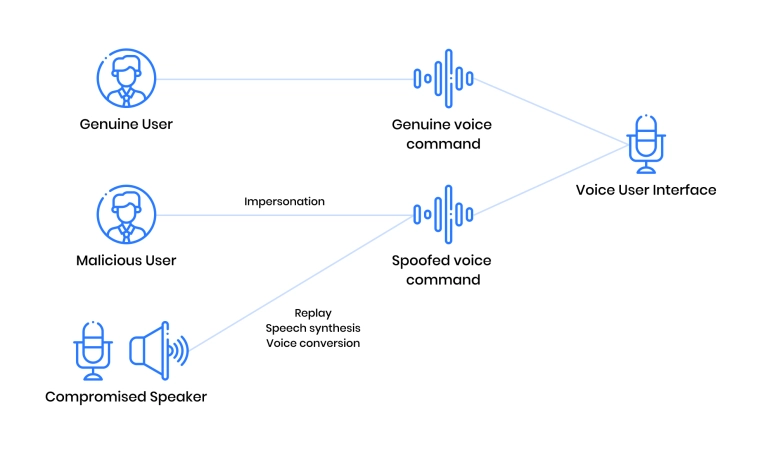
Integrating Internet of Things innovations with biometric voice authentication will enhance security and personalization. Future AI-driven assistants will adapt to speech patterns, making hands-free interactions more intuitive and widely applicable across industries.
8. IoT-powered smart cities for urban optimization
IoT-powered smart cities integrate connected sensors, AI, and automation to improve urban infrastructure, resource management, and public services. By embedding intelligence into city systems, governments can enhance efficiency, sustainability, and safety.
Examples:
- Traffic management – IoT-enabled traffic lights and sensors reduce congestion and optimize flow.
- Waste management – Smart bins signal collection needs based on real-time fill levels.
- Energy efficiency – IoT-powered grids adjust power distribution to reduce waste and lower costs.
Cities adopting new IoT technology are improving sustainability through AI-driven automation. Future developments will focus on predictive urban planning, advanced security systems, and real-time disaster response to create more resilient and intelligent cities.
9. IoT in healthcare for remote and AI-assisted medicine
Integrating IoT and AI in healthcare transforms remote patient monitoring and diagnostics, allowing real-time tracking of vital signs and predictive analytics for disease prevention. By leveraging connected medical devices, healthcare providers can deliver proactive care, reducing hospital visits and improving patient outcomes.
Examples:
- Remote patient monitoring – Wearable IoT devices track heart rate, oxygen, and glucose levels, sending real-time data to healthcare providers.
- AI-powered diagnostics – Machine learning algorithms analyze patient data, detecting early signs of diseases and predicting potential health risks.
- Smart hospitals – Connected medical equipment automates workflows, ensuring accurate diagnostics and efficient treatment plans.
AI-driven IoT solutions are expected to revolutionize healthcare, improving early disease detection and patient care personalization. IoT predictions suggest that by 2030, more than 70% of routine diagnostics will be performed remotely using IoT-enabled AI systems. As hospitals and clinics adopt these technologies, healthcare accessibility and efficiency will continue to advance, reducing costs and enhancing patient outcomes.
10. Metaverse and IoT convergence for immersive experiences
The integration of IoT with the metaverse creates hyper-realistic virtual environments where physical and digital interactions seamlessly merge. IoT sensors provide real-time data that enhances VR and AR applications, making experiences more interactive and responsive.
Examples:
- Virtual workspaces – IoT-enabled AR/VR setups improve remote collaboration with real-time feedback.
- Gaming and entertainment – IoT sensors track motion and haptic feedback, enhancing immersion.
- Smart retail – Virtual shopping powered by IoT personalizes product recommendations based on real-world preferences.
- Healthcare simulations – IoT-driven VR environments enable remote surgery training and patient rehabilitation programs.
The future of IoT will see deeper integration with the metaverse, creating more immersive and context-aware digital experiences. A major trend of IoT is using AI-powered sensors to replicate real-world conditions, allowing industries like healthcare, education, and manufacturing to adopt VR training, remote diagnostics, and digital twin simulations on an unprecedented scale.
Tips for businesses on using trendy IoT technologies
Integrating IoT technology trends into business operations requires a clear strategy focused on scalability, security, and real-time data processing.
Companies should first define their goals—whether optimizing processes, enhancing customer experiences, or reducing costs—and select IoT solutions aligning with these objectives. Ensuring interoperability between devices and cloud platforms is crucial to avoid data silos, while strong security measures like encryption and authentication help protect business data from cyber threats.
Given IoT's complexity, businesses should collaborate with technology service providers specializing in IoT development and integration.
Expert partners help navigate challenges like device compatibility and AI-driven automation, accelerating deployment and maximizing efficiency. Working with industry specialists also ensures access to future IoT innovations, allowing businesses to scale and adapt as new trends emerge. Companies can drive long-term success in the evolving IoT landscape by leveraging expert partnerships.
Final thoughts
The future of IoT belongs to organizations that treat connectivity as strategy, not infrastructure. By 2030, over 29 billion devices will be generating data across every industry but the competitive advantage won't come from being connected. It will come from what businesses do with that connection: how fast they act on data, how securely they manage devices, and how intelligently they automate decisions.
The trends shaping that future – AIoT, digital twins, blockchain security, edge computing – aren't independent developments. They're converging into a single shift: IoT systems that don't just collect data, but think, adapt, and act. For businesses, the question is no longer whether to invest in IoT. It's whether they're building the right foundation to scale it.
To stay ahead in this evolving landscape, companies must invest in scalable, secure, and interoperable IoT solutions that integrate seamlessly with existing infrastructure.
At Binariks , we leverage deep expertise in IoT development , cloud integration , and data analytics to help businesses unlock the full potential of connected technologies. Whether you want to improve operational efficiency, enhance security, or scale IoT solutions, our team is ready to assist. Let's create a connected future together.