

Generative AI for business is revolutionizing the way companies operate, offering a powerful tool to enhance creativity, personalize customer experiences, and drive innovation.
Generative AI and business are no longer just about productivity tools or content assistants; they now form the core of how modern companies operate. With the rise of AI agents, Enterprise AI platforms, and fully embedded AI operating models, businesses are increasingly running on AI systems rather than just using them.
From dynamic customer interactions to autonomous decision-making loops, generative AI is becoming a foundational layer across workflows.
This article explores how companies are using generative AI to transform the business, focusing on:
- The current state of the Gen AI market
- Use cases of Gen AI for business.
- Strategic benefits
- The ways specific industries use Gen AI
- Role of enterprise AI platforms and AI agents in insurance , healthcare, and other sectors
- Implementation roadmap
- Potential challenges
Generative AI market size and forecasts
The adoption of generative AI in business is on the rise, with businesses across industries recognizing its transformative potential. Here's a look at the current state of generative AI use in business, in numbers.
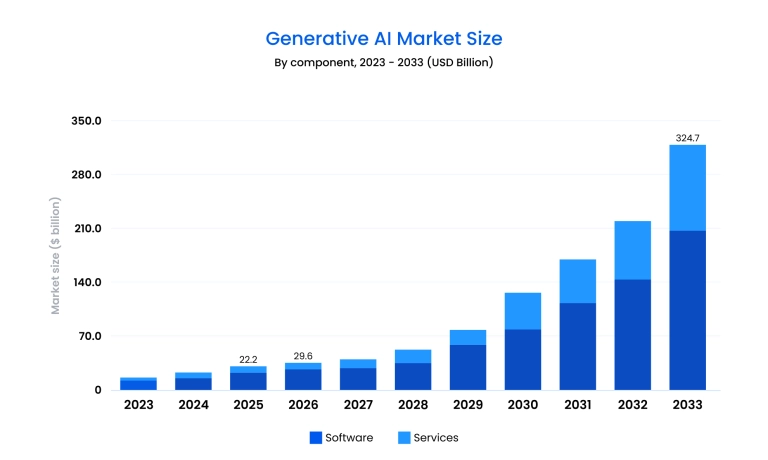
Global market size & CAGR
- The generative AI market was valued at around USD 28.9 billion in 2024 and is projected to reach approximately USD 142.7 billion by 2030, growing at a compound annual growth rate (CAGR) of about 31.2% over 2025‑2030.
- Alternative forecasts show the market expanding even faster, with CAGR estimates ranging from ~37% to over 40% depending on modelling assumptions and inclusion of software, services, and enterprise spending.
- Across the broader AI landscape, the total AI market, including generative models, automation tools, and embedded systems, reached an estimated USD 244 billion in 2025 and is projected to grow toward nearly USD 827 billion by 2030, driven in part by enterprise AI implementation and GenAI investments.
- A recent industry survey by McKinsey shows that 23% of large organizations are scaling agentic AI systems across multiple business functions, with an additional 39% experimenting with AI agents, indicating growing operational transformation beyond initial pilots.
These stats indicate that the use of generative AI in business operations is switching from generic applications to enterprise‑scale systems that integrate directly into core workflows.
Generative AI adoption by sector
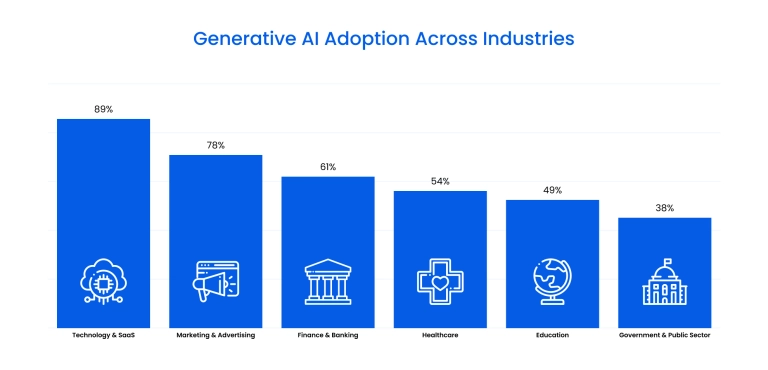
Healthcare:
- A survey of healthcare executives found that 95% believe generative AI will transform the industry, and a majority are already seeing meaningful ROI from early implementations in diagnostics and workflow automation .
Retail & E‑Commerce:
- Industry forecasts suggest that AI shopping agents could connect with nearly half of U.S. online shoppers by 2030, offering personalized recommendations and automated comparison shopping.
- In practice, leading retailers are already deploying AI assistants to optimize inventory placement and shorten the customer decision funnel.
Manufacturing:
- For example, recent data suggests that over 76% of manufacturing firms are now using AI technologies. Among these adopters, predictive maintenance systems are installed in roughly 42–68% of plants, and AI‑based quality control systems in 31–59% of manufacturers.
Finance & Insurance:
- According to recent industry research, about 90 % of financial institutions now use AI to fight fraud and financial crime.
Proven use cases of generative AI for businesses
1. Automated content creation
2. Personalized marketing and customer experience
3. Fraud detection and risk management
4. Drug discovery and medical research
5. Product design and optimization
The rise of AI agents in business operations
AI agents are software systems based on LLMs and generative AI that can perceive context, make decisions, and autonomously take actions within business workflows to achieve defined goals with limited human oversight. They can dynamically plan the course of action based on changing data and system feedback.
In the context of business operations, AI agents:
- Automate complex tasks across sales, support, finance, HR, and IT
- Coordinate multi-step processes (e.g., onboarding, claims, procurement)
- Learn from outcomes to continuously improve performance
Generative AI itself is not capable of performing tasks autonomously, but AI agents are. For example, a generative AI agent architecture in customer support can autonomously read a support ticket, draft a personalized response, update the CRM, and escalate the issue if sentiment analysis detects urgency.
Strategic benefits and business impact
Generative AI is reshaping how businesses innovate by changing how value is created and delivered inside the company. Here are the strategic benefits of generative AI impact on business:
1. Driving product innovation and R&D efficiency
Generative AI enables simulation-driven design, rapid prototyping, and variant testing, all of which compress R&D cycles from months to weeks. This scales up the capacity and results in a faster time-to-market. As of 2024, about 43.8% of manufacturing organizations implementing generative AI tools have seen significant reductions in product development timelines, with average decreases of over 9 weeks from concept to production.
BMW is one of the companies that famously uses AI‑supported simulations and design tools in product development to reduce reliance on physical prototypes and accelerate development cycles.
2. Enhancing internal operations and workflow automation
Generative AI for business transformation streamline coordination-heavy tasks across teams. This helps team members avoid being overloaded by constant context switching. Companies, on average, report 50–60% productivity gains in internal documentation workflows.
For example, Slack’s AI tools reduce backscroll time by 50% with auto-generated digests that summarize conversations. In 2026, most of the tools that people use for work now have embedded generative AI to help teams make sense of different conversation contexts.
3. Accelerating legal and compliance drafting
In regulated industries like law, generative AI reduces time spent on drafting and reviewing complex regulatory or legal content. This cuts costs, reduces the risk of manual errors, and makes companies more confident in their compliance.
For example, American multinational investment bank Citi uses generative AI internally to draft regulatory disclosures and summarize compliance documents, reducing turnaround time for internal legal reviews by 30–40% .
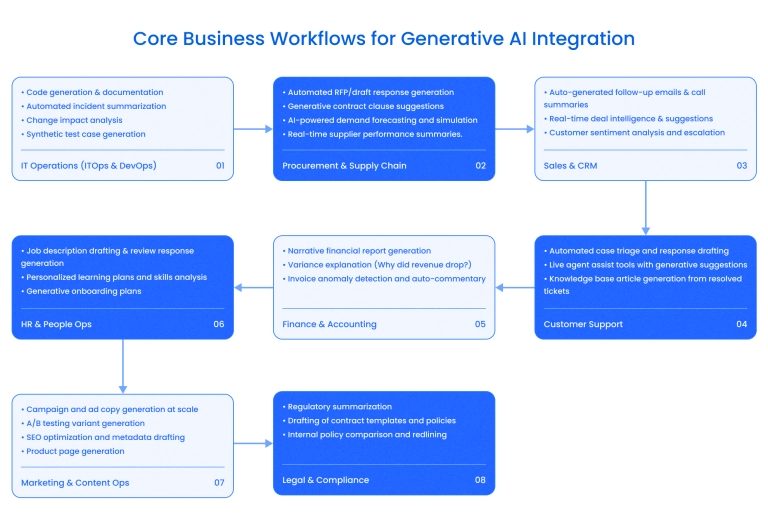
4. Embedding AI into core workflows
The companies that are using generative AI in business operations integrate it directly into into CRM, ERP, HR, and financial systems to drive decisions from within. As of 2025, 88 % of organizations report using AI in at least one business function, and many are moving beyond pilots toward broader operational use.
Here are the core workflows generative AI in business can be embedded into:
5. Enabling agile, AI-led supply chain planning
Generative AI business applications include supply chain management. AI can be used to simulates disruption, regenerate supply plans, and coordinate logistics, all of which help companies to better manage supply chain risks. GenAI improves supply forecast accuracy and response speed.
For example, Schneider Electric states that AI and data‑driven supply chain platform delivered:
- A 6‑day reduction in days‑in‑inventory, resulting in an overall ~10 % inventory decrease
- Delivery time reduced by 6 days
- 15 % yield improvement on specific manufacturing lines
- Over €100 million generated in value and productivity improvements of €30 million
Industries leveraging generative AI
Healthcare
Financial services
Manufacturing
Marketing
Logistics and supply chain
Generative AI optimizes logistics operations by automating tasks, predicting demand, and optimizing delivery routes.
It enables businesses to analyze real-time data from sensors, logistics systems, and customer behavior to identify potential disruptions, optimize inventory management, improve overall supply chain efficiency, reduce costs, minimize downtime, and ensure the seamless delivery of goods and services.
These diverse industries represent just a glimpse into the transformative potential of generative AI for enterprises. Businesses that embrace and integrate it into their strategies are poised to gain a competitive edge, enhance their operational efficiency, and unlock new opportunities for growth and success.
Enterprise AI platforms and operating models
As organizations move beyond isolated AI pilots and proofs of concept, they increasingly need enterprise-grade infrastructure and governance to scale AI across teams and use cases. Two foundational pillars of this evolution are enterprise AI platforms and AI operating models.
What are enterprise AI platforms?
- Data layer: Tools for collecting, cleaning, labelling, and governing structured and unstructured data.
- Model layer: Support for training, fine-tuning, and serving machine learning and generative AI models (including MLOps and LLMOps).
- Orchestration layer: Workflow management, scheduling, and integration with enterprise applications (e.g., CRMs, ERPs, EHRs).
- Monitoring and governance: Capabilities for explainability, bias detection, performance tracking, and audit logging.
- Security and compliance: Role-based access, encryption, and support for HIPAA, GDPR, and other regulatory frameworks.
What are AI operating models?
- Centralized model: An AI Centre of Excellence (CoE) leads all AI development and governance.
- Hub-and-spoke model: A central CoE provides shared tools and guidance, while business units own implementation.
- Decentralized model: Each team runs its own AI projects with limited alignment with central standards.
- Cross-functional teams that combine domain experts, data scientists, engineers, and legal/compliance staff.
- Model lifecycle processes that define how models are proposed, validated, deployed, and monitored.
- AI governance policies covering ethical use, data privacy, model risk, and IP ownership.
- Feedback loops that connect AI outcomes with business metrics and continuous improvement cycles.
Gen AI implementation roadmap
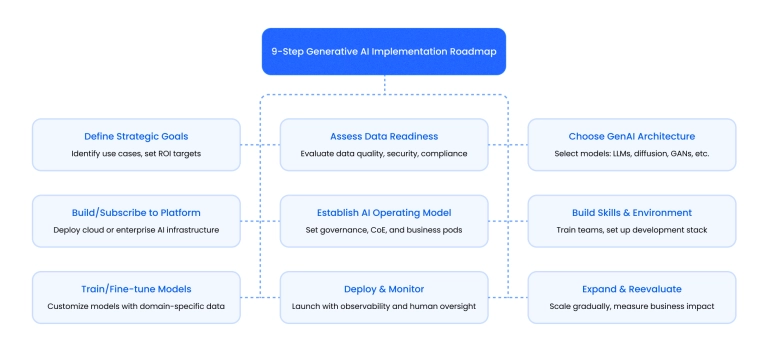
1. Define strategic goals and business use cases
- Automated document summarization for legal or insurance workflows
- Personalized marketing content generation
- Code assistance or test case generation in software teams
2. Assess data readiness and infrastructure
- Data availability and quality: Do you have labeled, structured, and accessible datasets?
- Security and compliance: Are you storing and processing data in compliance with GDPR, HIPAA, or other industry-specific regulations?
- Compute power: Do you have access to GPUs or cloud-based AI infrastructure?
3. Choose the right GenAI architecture
- LLMs (e.g., GPT-4, Claude): for text generation, summarization, chat interfaces
- Diffusion models: for realistic image generation or in design-heavy industries
- VAEs and GANs: for synthetic data generation or anomaly detection in complex systems
4. Build or subscribe to an enterprise AI platform
- Public cloud generative AI companies: AWS Bedrock, Azure OpenAI, Google Cloud Vertex AI
- Enterprise AI platforms: Cohere, Anthropic Console, Mistral API, IBM WatsonX
- RAG solutions: LangChain or LlamaIndex for internal data augmentation
5. Establish an AI operating model
- AI center of excellence (CoE): Central team for governance, model evaluation, and vendor management
- Business-aligned pods: Small teams owning use-case delivery across sales, finance, HR, etc.
- MLOps integration: Align model development and deployment with CI/CD, testing, and rollback mechanisms
6. Build development environment and skills
- Train internal developers on prompt engineering and model evaluation
- Use low-code tools for non-technical stakeholders
- Implement secure sandboxes for experimentation
7. Train, fine-tune, or integrate pretrained models
- Fine-tune existing models (e.g., LLaMA 2, Mistral, GPT-J) using domain-specific data
- Use retrieval-augmented generation (RAG) for safe integration of proprietary data
- Evaluate model performance via acceptance tests: accuracy, hallucination rate, bias checks
8. Deploy and monitor in production
- Set up observability tools: monitor usage, performance, and failure cases
- Implement human-in-the-loop where risks are high
- Collect feedback from users and domain experts
9. Expand gradually and reevaluate
- Iterate based on lessons learned
- Expand to parallel use cases (e.g., internal knowledge assistant, contract analysis)
- Use business metrics (e.g., time savings, revenue uplift) to reassess priorities
The main difficulties in using generative AI
- Data challenges:
- Algorithmic challenges:
- Integration and deployment challenges:
Implement generative AI with Binariks
Binariks is a technology partner specializing in end‑to‑end AI, machine learning, cloud, and software engineering solutions for global enterprises.
Our work spans healthcare, fintech, insurance, and other data‑intensive industries, with a growing focus on generative AI integrations that move beyond prototypes into embedded, scalable enterprise systems.
In terms of generative AI, Binariks delivers full-cycle solutions – from data readiness and use case discovery to model development, fine-tuning, system integration, and governance-ready deployment. The team specializes in both API-based implementations (e.g., OpenAI, Claude, Cohere) and open-source customization (e.g., LLaMA, Mistral), supported by RAG pipelines, orchestration frameworks, and domain-specific safeguards.
Example 1: AI-powered document analysis for insurance claims
- Challenge: A global commercial insurance provider processing thousands of claims documents daily faced severe bottlenecks in manual document review. Insurance agents spent excessive time extracting risk insights from unstructured legal documents, introducing inconsistency, human error, and compliance risks. The company needed to automate insight extraction while maintaining full auditability for regulatory requirements.
- Solution: Binariks built an AI-powered RAG pipeline using LangChain, LangGraph, and OpenAI LLMs to transform unstructured insurance documents into structured, traceable risk insights. The system combined OCR for document ingestion, retrieval-augmented generation for citation-backed answers, Chain-of-Thought prompting for multi-step reasoning, and Reflection agents for self-evaluation. All outputs were grounded in source documents and monitored through LangSmith for transparency. The solution was deployed securely in Azure with full encryption and compliance controls.
- Result: 90% reduction in time required to extract risk-related data, 80-90% fewer manual review cycles, and 20-30% improvement in decision confidence. The system enabled faster claim triage, improved SLA compliance, and freed senior experts for higher-value work – all while maintaining the auditability required for regulatory scrutiny.
Example 2: Agentic AI for clinical workflow automation
- Challenge: A healthcare platform developer faced growing inefficiencies in hospital workflows where medical staff spent significant time on manual documentation and fragmented task management. Repetitive check-ins, unstructured task tracking, and delayed follow-ups disrupted operations and contributed to clinician burnout. The company needed an intelligent assistant capable of handling routine communications and scheduled tasks autonomously.
- Solution: Binariks implemented an agent-based system using LangChain and OpenAI GPT that autonomously manages scheduled events, composes contextual messages, and maintains conversation history. The architecture combined APScheduler for time-based triggers, PostgreSQL for storing user and event data, and prompt engineering with Chain-of-Thought logic to guide the agent through healthcare-specific reasoning. The entire solution was containerized with Docker and deployed as microservices for scalability.
- Result: Medical staff saved 30% of time previously spent on follow-up documentation, task completion compliance doubled, and asynchronous workflows allowed clinicians to interact on their schedules without disrupting patient care. The MVP validated LLM-based agents in routine hospital operations and laid groundwork for expanded automation across care coordination.
Example 3: AI-driven legal documentation search for first responders
- Challenge: A U.S. emergency services startup recognized that frontline officers lacked fast, reliable access to critical legal and procedural documentation during high-pressure field situations. Officers relied on memory, supervisor calls, or printed manuals – none guaranteed speed or accuracy. This information gap created delays, increased legal exposure, and led to inconsistent decision-making across departments.
- Solution: Binariks engineered a mobile-first AI search system powered by retrieval-augmented generation. The solution used AWS Textract for OCR, custom embedding generation with hierarchical document relationships, advanced semantic chunking, and reranking strategies optimized for law enforcement terminology. Instead of generating answers, the chatbot returns exact citations from uploaded policy documents, eliminating LLM hallucinations. The system integrated real-time feedback loops and usage analytics to continuously improve retrieval accuracy.
- Result: Real-time access to verified legal guidance with precise document citations dramatically reduced cognitive load on officers. The solution improved response accuracy by eliminating hallucination risks, supported domain-specific language understanding, and is now actively used by over 1,000 first responders. Officers gained the ability to make compliant, informed decisions in seconds rather than minutes.
Binariks is your trusted partner in implementing AI technologies and unlocking their transformative potential. Contact us today to discuss your journey of innovation.
Final thoughts
Generative AI and business operations are converging. What began as experimental content tools has evolved into foundational infrastructure – embedded in CRMs, supply chains, compliance systems, and customer workflows. The companies seeing measurable ROI aren't treating generative AI for business transformation as a side project. They're treating it as a core capability.
The key challenges, such as data readiness, algorithmic complexity, or integration into existing systems, haven't disappeared. But the playbook for addressing them is clearer now.
Successful generative AI in business operations depends less on chasing the newest model and more on asking the right question upfront: What business outcome are we actually solving for?
How companies are using generative AI in 2026 reveals a pattern: start with one high-impact use case, measure results honestly, and expand gradually based on what works. The organizations that move fastest aren't necessarily the ones with the biggest budgets – they're the ones with clear goals, clean data pipelines, and cross-functional teams aligned on what success looks like.
Binariks helps enterprises turn generative AI business applications into production-ready systems – not prototypes that stall after the pilot phase. From AI agent architecture and enterprise AI implementation to HIPAA-compliant clinical documentation and RAG-powered knowledge assistants, we build solutions designed for regulated industries where failure isn't an option.
Ready to move beyond pilots and deploy generative AI that delivers measurable business value?
Contact Binariks to discuss your AI implementation strategy.