

AI in fraud detection has become a necessity, not an experiment.
Most enterprises already feel the limits of fraud detection systems still powered by outdated rule engines. Fraud teams drown in false positives. Legitimate customers get blocked. Actual fraud slips through because attackers evolve faster than static thresholds can keep up. And instead of preventing fraud, many systems only flag incidents after the money is gone, when it's too late to recover losses.
The core issue isn't the volume of fraud – it's the mismatch between modern threat behavior and legacy detection logic. Rules were designed for a world of predictable patterns. Today's fraud is dynamic, multi-channel, and behaviorally complex. As a result, organizations are forced into reactive detection instead of real-time prevention.
This article explains how AI-driven fraud detection enables a shift from rule-based controls to real-time, adaptive intelligence, and what it takes to do it responsibly, measurably, and at enterprise scale.
What you'll learn in this guide:
- Why legacy rule engines create more than 70% false positives and miss new fraud patterns;
- How modern AI models analyze behavior, context, and relationships in real time;
- Which AI architectures are used in enterprise-grade fraud systems;
- How to measure fraud loss reduction, model accuracy, and ROI;
- A practical roadmap for starting and scaling AI-based fraud prevention;
- Industry-specific use cases across fintech, insurance, and healthcare;
- How Binariks delivers end-to-end AI/ML development services for fraud detection.
If your goal is to reduce fraud losses, lower operational overhead, and scale securely, keep reading; this is the strategic foundation your fraud program needs.
Why traditional rule-based fraud detection fails enterprises
For years, fraud programs were built around rule engines, static thresholds, blocklists, and a handful of anomaly checks. It worked in a slower world, when fraud patterns evolved gradually, and attackers reused the same tricks.
But today's threat landscape is fluid. Payment flows are real-time, fraud rings operate across channels, and synthetic identities can mimic legitimate customers with unsettling precision. Rule engines, built on rigid logic, can't keep pace.
The result is a system that behaves reactively rather than defensively. It flags too much, too late, and too inconsistently. Investigators end up buried in alerts, customers get declined for harmless activity, and real fraud often slips through untouched.
In many enterprises, this is the moment leaders begin exploring AI fraud prevention to escape the limitations of legacy controls.
The structural problems hiding inside rule engines
- False positives dominate, frequently 70% or more
As IBM puts it, "rules-based systems cannot account for evolving fraud patterns and contribute significantly to false positives and operational inefficiency." This drains analyst time and inflates operational expenses.
- Detection occurs post-transaction rather than in real time
Traditional tools wait for the transaction to complete before evaluating it. By then, damage is done. Teams turn into recovery units rather than prevention teams, which is why enterprises shift toward AI-based fraud detection capable of scoring events instantly.
- They miss new or emerging attack patterns
Fraud rings adapt faster than rule updates. Anything unfamiliar simply passes through because no one has written a rule for it yet, a critical blind spot in modern commerce and financial systems.
- Operational overhead grows every year
Every false alert becomes a mini-investigation. Teams escalate, review, annotate, and close cases that never posed a risk. Multiply this across millions of transactions, and the hidden cost becomes enormous.
- Compliance loses trust in the system
When false positives rise, and genuine fraud goes undetected, compliance teams grow frustrated. Accuracy declines, regulatory pressure increases, and process owners recognize they need a different approach, often prompting a shift toward AI in fraud-prevention strategies.
Rule engines weren't built for today's environment. Fraud is behavioral, contextual, and dynamic, and legacy systems see it as static, rule-triggered noise. This mismatch is precisely why enterprises are moving toward intelligent, real-time models that learn from patterns rather than chase them.
How AI transforms fraud detection: From static rules to real-time intelligence
AI changes fraud detection in one fundamental way: instead of reacting to predefined conditions, it learns patterns: transactional, behavioral, relational, and contextual, and evaluates risk as events unfold. Legacy systems wait for a rule to fire. Modern AI fraud detection techniques measure thousands of signals simultaneously and adapt as new fraud behaviors emerge.
At a high level, AI fraud detection works by training models on historical transactions, device fingerprints, user behavior, session flows, network relationships, and external threat indicators. These models learn what "normal" looks like for each customer, product, geography, or business line – and then detect even subtle deviations in real time.
Unlike static thresholds, AI understands patterns over time rather than just snapshots.
One of the biggest advantages of AI for fraud detection is its ability to provide real-time scoring. Every transaction, login attempt, policy application, or insurance claim is evaluated instantly.
Instead of deciding based on a handful of attributes, the model weighs dozens or hundreds of factors: velocity of activity, behavioral biometrics, spending anomalies, IP irregularities, document inconsistencies, and more.
This is why AI systems catch emerging fraud rings early: they spot behaviors that don't fit any known legitimate pattern.
AI also makes fraud prevention more dynamic. Models evolve as new data arrives, allowing enterprises to detect synthetic identities, multi-step fraud journeys, and cross-channel coordination.
This capability is especially relevant in specialized domains such as life insurance fraud detection , where fraud signals often hide across documents, claim histories, and behavioral cues rather than in single, isolated events.
In short, AI replaces brittle rules with adaptive intelligence, delivering real-time, context-aware decisions that help organizations prevent losses long before they appear in reports.
Core AI fraud detection techniques and architectures
Modern fraud systems rely on advanced modeling architectures that go far beyond simple statistical checks. These approaches analyze relationships, behavior patterns, anomalies, and document-level evidence to detect sophisticated fraud schemes. They form the technical backbone of fraud detection using AI, enabling models to adapt as fraud strategies evolve.
As noted in Deloitte's 2024 Financial Services Industry Predictions, "AI-enabled fraud losses could reach billion by 2027," highlighting the scale and complexity of today's fraud landscape and why enterprises are shifting toward artificial intelligence for fraud detection.
Graph neural networks for relationship-based fraud detection
Graph Neural Networks (GNNs) analyze how users, devices, accounts, merchants, and transactions are connected. Fraud rarely occurs in isolation; it creates clusters, rings, and multi-entity schemes. GNNs reveal hidden relationships that traditional models overlook.
- Detects collusion rings, mule accounts, and synthetic identity clusters;
- Learns patterns from network topology, not just attributes;
- Identifies fraud earlier by spotting abnormal relationships between nodes;
- Ideal for payments, ecommerce, telecom, and insurance networks.
GNNs are especially powerful when fraudsters coordinate activity across multiple identities or shared infrastructure.
Behavioral modeling and anomaly detection
Behavioral models learn how legitimate users normally behave, their transaction timing, device patterns, navigation flows, typing biometrics, and spending profiles. Fraud is detected when behavior deviates from these learned baselines.
- Real-time anomaly detection on sessions, payments, logins, and claims;
- Captures synthetic identity behavior that looks "valid" on paper;
- Identifies atypical user journeys, velocity spikes, or bot-driven activity;
- Supports continuous risk scoring throughout the user session.
This technique is central to AI and fraud detection in environments where fraudsters try to mimic legitimate actions.
Ensemble and hybrid models
No single model catches every type of fraud. Ensemble systems combine multiple algorithms – decision trees, gradient boosting, neural networks, anomaly detectors, and rule signals – into a unified risk score.
- Blends pattern recognition, probabilistic modeling, and rules
- Reduces false positives by giving weight to multiple independent signals
- Increases robustness against shifting fraud patterns
- Allows domain experts to incorporate business logic into AI models
Hybrid models strike a balance between interpretability and predictive power, making them suitable for regulated sectors.
NLP and document/claims analysis
Fraud often hides in claims, applications, correspondence, and supporting documents. NLP models read and interpret this unstructured data at scale.
- Extracts entities, inconsistencies, and suspicious language patterns;
- Flags mismatched dates, contradictions, or fabricated narratives;
- Evaluates supporting documentation (receipts, invoices, medical files);
- Detects claim inflation, staged incidents, and repeat fraud strategies.
This approach is essential in insurance, healthcare, and financial onboarding, where text carries the same level of risk as transactions.
These architectures work together to deliver adaptive, real-time fraud intelligence across channels.
Whether analyzing relational networks, behavioral signatures, ensembles of risk signals, or unstructured documents, modern AI systems provide a depth of insight that static rules could never achieve. And as Deloitte emphasizes, AI now sits at the core of any fraud program designed to scale with modern threat complexity, not just react to it.
Measuring impact: Fraud loss reduction, false positives, and ROI
The success of AI-driven fraud detection is measured through a blend of financial, operational, and accuracy-focused metrics. Unlike rule engines, AI models continuously improve as they ingest more data, which means their impact compounds over time.
Key metrics that matter
- Fraud loss reduction – the primary indicator of value; AI typically cuts losses by up to 40%.
- False positive rate (FPR) – a lower FPR reduces investigator load and customer friction. AI systems commonly decrease false positives by 20–50%.
- Detection latency – AI flags risk in real time instead of after the transaction, shifting fraud teams from recovery to prevention.
- Operational workload – fewer false alerts = fewer investigations, lower compliance overhead, and more efficient case handling.
- Model precision and recall – ensuring the system catches more real fraud while minimizing unnecessary escalations.
A simple ROI example
Suppose an enterprise incurs $10M in annual fraud losses. If AI reduces losses by up to 40%, the savings look like this:
40% reduction → $4M saved annually
If the full cost of implementation and operations is around $600K per year, the ROI is substantial:
$4M saved → 6.6× ROI
This excludes additional operational benefits such as:
- fewer investigations
- lower chargeback and dispute costs
- improved customer experience
- better regulatory compliance
Most organizations see ROI within the first 6–12 months, especially once real-time scoring is fully deployed.
Implementation roadmap: Where to start with AI in fraud prevention
Enterprises often struggle not with the idea of AI fraud detection, but with knowing where to begin. A successful program follows a structured roadmap: start small, validate quickly, and scale only once models prove their accuracy and operational fit.
The framework below outlines the four phases most enterprise fraud teams use to adopt AI responsibly and effectively.
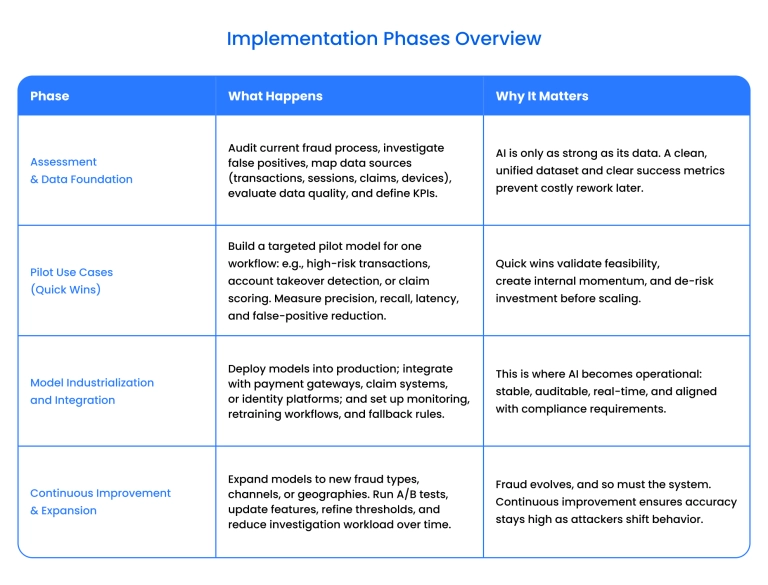
AI-powered fraud prevention isn't a single deployment; it's a structured journey. With the right sequencing, enterprises avoid "pilot limbo," reduce risk, and unlock measurable improvements in detection accuracy and operational efficiency. This roadmap gives leaders a practical foundation to adopt AI confidently and scale fraud defenses in a controlled, high-impact way.
Industry-specific use cases: Fintech, insurance, healthcare
AI-powered fraud prevention takes a different shape in each industry because fraud patterns, regulatory demands, and data structures vary significantly. Below are three high-impact examples that reflect where AI delivers the strongest results.
- Fintech: Real-time transaction risk scoring
AI evaluates each transaction using behavioral, device, and contextual signals to block fraud before funds move. Many fintech teams rely on methods similar to those used in financial fraud detection to reduce chargebacks, detect account takeovers, and minimize customer friction.
- Insurance: Intelligent claims and policy fraud detection
NLP and computer vision analyze claims documents, medical records, receipts, and submission histories to identify inconsistencies, inflated losses, or repeat offender behavior. AI also screens life and health insurance applications to detect mismatches or suspicious patterns that rules cannot catch.
- Healthcare: Provider fraud, waste, and abuse (FWA)
AI highlights unusual billing patterns, duplicate claims, phantom procedures, and statistical anomalies across providers. This is especially critical as digital and telehealth claims increase in volume and complexity, making manual oversight ineffective.
These three areas demonstrate how AI adapts to the unique fraud challenges of each industry and delivers higher accuracy and earlier detection than traditional methods.
Challenges, risks, and how to mitigate them
AI delivers major advantages in fraud detection, but it also introduces risks that must be managed deliberately. The table below outlines the core challenges enterprises face and the practical steps to reduce exposure.
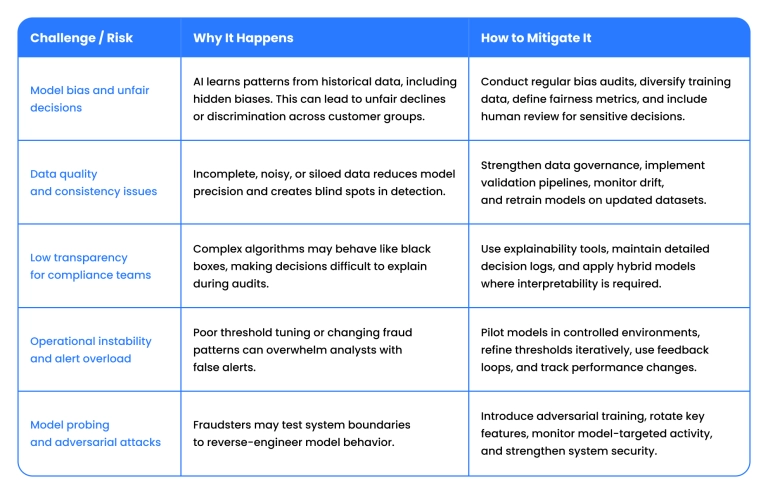
This balanced view ensures AI strengthens fraud programs without introducing new operational or regulatory vulnerabilities.
How Binariks delivers AI-powered fraud detection solutions
Enterprises quickly learn that fraud prevention is not solved by deploying a single AI model in isolation. Effective AI fraud detection requires an end-to-end capability: robust data foundations, real-time decisioning, investigator-ready workflows, and continuous model governance across the full fraud lifecycle. This is exactly where Binariks positions itself as an engineering and delivery partner, not just a model provider.
Binariks works alongside fraud, risk, and engineering teams to map real fraud patterns, unify fragmented data sources, and design production-grade architectures that support low-latency, real-time decisions. From there, we engineer, integrate, and validate AI models against historical and live data, and deploy them into production with monitoring, drift detection, explainability layers, and audit-ready governance controls.
Our experience spans regulated environments across healthcare, insurance, and financial services, including solutions that combine behavioral analytics, document intelligence, and transaction-level risk scoring in a single, coherent system.
The result is not a standalone algorithm, but a complete enterprise fraud detection capability: scalable under real transaction volumes, explainable for compliance and investigations, and aligned with existing operational processes rather than disrupting them.
Conclusion
AI has reshaped fraud prevention by replacing rigid rules with real-time, adaptive intelligence. Enterprises that adopt modern models see fewer losses, fewer false positives, and more efficient investigation teams. The shift is not only about technology but about building fraud defenses that evolve as quickly as attackers do.
If you're exploring how to modernize your fraud program, Binariks can help you evaluate your data, design the exemplary architecture, and deploy production-ready AI systems that deliver measurable impact.
Reach out to our team to discuss your fraud prevention goals and next steps.