

AI in operations management is about solving stubborn, everyday problems that slow businesses down: brittle planning models, delayed decisions, disconnected systems, and operations that break the moment demand shifts.
As data volumes grow and processes become more interdependent, manual coordination simply doesn't scale. AI steps in where human-driven operations hit their natural limits, not by replacing managers, but by giving them faster signals and better options.
At Binariks, we see this shift play out across logistics, manufacturing, retail, and digital platforms. Companies aren't adopting AI to "innovate" for the sake of it. They're doing it to stabilize operations, reduce waste, and make decisions that used to take weeks in minutes. Through our AI/ML development services, we help teams embed AI directly into forecasting, planning, and execution layers, so intelligence becomes part of daily operations rather than a separate analytics experiment.
In this article, you'll learn:
- Where AI operations outperform traditional, manual workflows
- How AI improves planning accuracy, speed, and operational resilience
- Which real-world use cases deliver measurable efficiency and margin gains
- What it takes to implement AI without disrupting critical operations
Keep reading to understand how AI is reshaping operations management from the inside out.
What is AI in operations management?
Traditional operations vs. AI-powered operations
Traditional operations rely on predefined rules, manual coordination, and periodic human intervention.
AI-powered operations introduce adaptive systems that learn from data, adjust in real time, and scale decision-making beyond human limits. This transition is already reshaping how organizations approach operational control, efficiency, and resilience.
| Dimension | Traditional Operations | AI-Powered Operations |
| Decision logic | Fixed rules and SOPs shaped by historical experience | Data-driven models that continuously learn from live inputs |
| Response time | Minutes or hours due to approvals and coordination | Seconds through automated, event-driven decisions |
| Scalability | Directly tied to staff size and management capacity | Scales independently of headcount through automation |
| Error detection | Reactive, based on lagging KPIs or incidents | Proactive anomaly detection before failures escalate |
| Forecasting | Linear forecasts using averages and assumptions | Scenario-based forecasting with probabilistic outcomes |
| Process optimization | Periodic, often manual reviews | Continuous optimization through model retraining |
| Data integration | Fragmented across ERP, CRM, and operational tools | Unified pipelines aggregating real-time operational data |
| Automation scope | Task-level scripts and macros | End-to-end workflow automation across systems |
| Adaptability | Slow reaction to disruptions or demand shifts | Rapid adaptation as models ingest new data |
In production-heavy environments, artificial intelligence in production management enables predictive maintenance, adaptive scheduling, and real-time quality control that manual systems cannot sustain at scale.
Separately, in digital-heavy environments, AI in IT operations management is used to predict incidents, correlate signals across systems, and automate remediation before service degradation becomes visible to users.
AI-powered operations increasingly incorporate advanced reasoning and explanation layers, allowing teams to understand why decisions are made and what scenarios were evaluated. This is where generative AI in business plays a role, supporting simulation, decision transparency, and faster alignment between operational data and business strategy.
Traditional operations reduce complexity by limiting it. AI-powered operations handle complexity directly, enabling predictive, scalable, and resilient execution across the organization.
Core benefits of AI in operations management
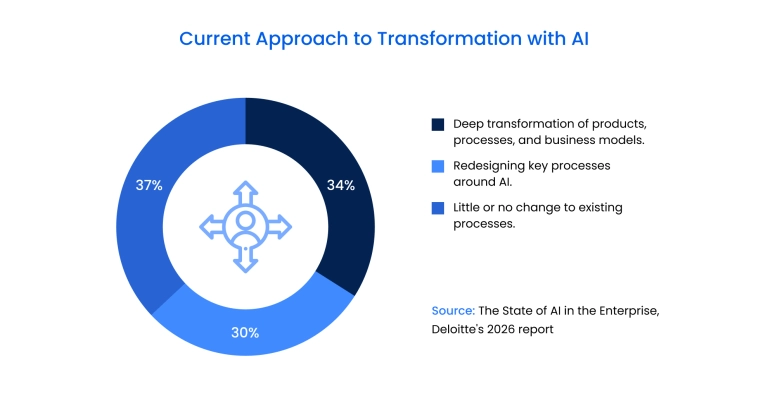
According to Deloitte's State of AI in the Enterprise 2026 , most organizations are already moving beyond pilots and into measurable operational transformation. What stands out is not abstract innovation, but concrete gains in efficiency, cost control, and decision quality driven by artificial intelligence in operations at scale.
Operational efficiency and productivity gains
AI-driven automation removes friction from routine operational tasks, from scheduling and inventory tracking to workflow orchestration.
For now, 66% of organizations already see improvements in efficiency and productivity today, not as future expectations but as realized outcomes. This directly translates into faster cycle times, reduced manual workload, and fewer operational bottlenecks across departments.

Cost reduction through predictive and preventive control
Unlike traditional rule-based systems, AI models continuously learn from operational data, allowing organizations to anticipate failures, demand shifts, and supply chain disruptions before they escalate.
40% of companies already report cost reductions, with expectations climbing sharply as AI maturity increases. In insurance and financial operations, similar predictive logic underpins use cases like automated claims processing , where processing time and operational overhead drop simultaneously.
Data-driven decision-making at operational speed
One of AI's strongest advantages is decision velocity. By synthesizing data across systems in real time, AI supports faster and more consistent decisions without relying on fragmented reports or intuition.
Over 61% of organizations cite improved decision-making and data-driven insights as a current benefit, while long-term expectations push this even higher. This is where AI operations management moves from support function to strategic capability.
Revenue growth and service innovation
Operational AI doesn't just cut costs, it enables growth. Deloitte reports that 74% of organizations expect AI to directly increase revenue, primarily through better demand forecasting, service personalization, and faster time-to-market.
AI-powered operations create the conditions for scaling without linear increases in headcount or complexity.
Infrastructure resilience, security, and data sovereignty
As AI becomes embedded in core operations, organizations are paying closer attention to data residency, compute dependencies, and governance.
Over 80% of enterprises consider data residency and compute constraints at least moderately important, while 66% express concern about reliance on foreign-owned AI infrastructure. These concerns are reshaping operational architecture decisions, especially in regulated industries.
Physical AI and automation at the operational edge
AI adoption is also extending beyond software into physical operations.
Today, 58% of organizations already use physical AI such as robotics or automated machinery in at least a limited capacity. Within two years, 80% expect physical AI usage, signaling a shift toward fully integrated, AI-optimized operational environments.

AI delivers operational value where it matters most: efficiency, cost control, decision speed, and scalability. The data shows that organizations adopting AI systematically are already outperforming peers who treat it as an isolated experiment.
5 Real-world AI applications for scaling business operations
AI becomes operationally valuable when it moves from theory to repeatable results. Below are five applications where companies have already embedded AI into daily operations and achieved measurable efficiency, cost, or scalability gains.
1. Dynamic pricing
Dynamic pricing is one of the clearest examples of artificial intelligence in operations management applied at scale. Uber's surge pricing shows how AI works as a real-time operational control system , not just a revenue tool.
Machine-learning models continuously balance rider demand with driver availability across micro-zones, keeping the system stable during demand spikes. In a successful surge period, average wait times remained at 2.6 minutes while prices increased from x1.2 to x1.8, doubling driver supply without reducing completion rates.
When the system failed on New Year's Eve, wait times jumped to 8 minutes and 25% of requests went unfulfilled, highlighting how critical AI-driven price signals are for throughput, resource utilization, and service reliability in volatile environments.
2. Smart forecasting and replenishment
Walmart provides a clear example of how AI-driven operations scale inventory management in complex, high-volume environments.
By embedding machine learning into demand forecasting, warehouse automation, and omnichannel inventory synchronization, the company continuously balances stock across stores, fulfillment centers, and suppliers in real time.
These capabilities are built around three tightly connected pillars that define how Walmart keeps inventory available, costs controlled, and operations responsive at scale.

This intelligence extends beyond warehouses into supplier coordination and pricing decisions.
Walmart's AI-enabled vendor-managed inventory allows suppliers to access real-time data and replenish products automatically, reducing lead times and manual errors. At the same time, dynamic pricing, fraud detection, and RFID-based tracking help optimize margins and protect inventory across channels.
Together, these capabilities cut logistics costs, improve product availability, and support fast e-commerce fulfillment at global scale – a textbook example of ML in operations management replacing static forecasts with adaptive, data-driven replenishment across thousands of stores and distribution centers.
3. Streamlined recruitment and onboarding
Unilever processes close to two million applications per year, a volume where manual resume screening and interviews become slow, inconsistent, and biased. Traditional hiring methods could not scale without increasing costs, extending hiring cycles, and degrading candidate experience, turning recruitment into an operational bottleneck rather than a talent advantage.
Unilever redesigned recruitment as a data-driven pipeline combining neuroscience-based assessments, AI-analyzed video interviews, and human decision-making. AI handles early screening at scale using standardized criteria, while recruiters make final calls using AI insights as support. This structure delivers speed and consistency without removing human judgment.

The results are measurable: hiring cycles shortened by 75-90% , over £1 million saved annually, and candidate completion rates reached 96%. By reducing resume bias and focusing on behavioral signals, Unilever also increased workforce diversity by 16% while improving offer quality and acceptance rates.
Recruitment shifted from manual screening to a scalable, performance-driven operation.
4. Boosted collaboration
AI-driven collaboration tools remove operational friction between teams by automating coordination, context sharing, and decision alignment. These systems aggregate data from multiple tools, summarize conversations, track dependencies, and surface relevant information at the right moment.
In complex organizations, this reduces delays caused by miscommunication, fragmented ownership, and manual handoffs, while enabling faster cross-functional execution across operations, IT, finance, and customer-facing teams.
For distributed teams, this type of tooling has become a foundational layer of AI tools for operations management, especially in IT, product, and customer-facing operations.
5. Chatbots and virtual assistants
AI-powered chatbots and virtual assistants act as always-on operational interfaces for both employees and customers.
Internally, they handle recurring requests such as workflow guidance, system access, reporting, and scheduling, reducing load on support teams. Externally, they manage high volumes of inquiries, order updates, and issue triage with consistent quality.
By resolving routine tasks instantly and escalating only complex cases to humans, these assistants improve responsiveness, lower operational costs, and stabilize service levels at scale.
All these use cases show how AI moves operations from manual control to adaptive, data-driven execution. By improving speed, accuracy, and scalability across pricing, supply, hiring, and collaboration, AI turns operational complexity into a competitive advantage.
Industry-specific applications of AI in operations management
AI delivers the most value in operations when it is applied with industry context in mind. Below are practical examples across priority sectors, showing how organizations use AI to solve domain-specific operational challenges at scale.
Fintech
In fintech, AI is embedded directly into transaction processing, risk assessment, and compliance workflows. Machine learning models analyze transaction patterns in real time to detect fraud, automate credit scoring, and optimize liquidity management.
For AI for operations managers, this means fewer manual reviews, faster approvals, and continuous risk monitoring without slowing down core financial operations.
Healthcare
Healthcare operations rely on AI to coordinate scheduling, resource allocation, and clinical support systems.
AI-driven models optimize staffing levels, predict patient flow, and automate administrative tasks such as billing or claims handling. When teams understand how to use AI for operations management, they can reduce operational bottlenecks while improving care delivery consistency.
Insurance
In insurance, AI streamlines underwriting , policy administration, and claims operations.
Intelligent systems classify documents, estimate risk exposure, and route claims automatically based on complexity and urgency. This allows insurers to scale operations without linear increases in headcount, while maintaining regulatory control and service quality.
Delivery & logistics
Logistics platforms use AI to optimize routing, fleet utilization, and last-mile delivery performance.
Predictive models account for traffic, weather, and demand fluctuations to reduce delays and fuel costs. At scale, machine learning in operations management enables continuous optimization of supply chains that would be impossible to manage manually.
IT & technology services
In IT operations, AI supports incident management, capacity planning, and infrastructure optimization. Intelligent monitoring systems predict outages, prioritize alerts, and automate remediation steps. This allows technology teams to shift from reactive firefighting to proactive operational control.
Together, these industry examples show that AI in operations management is not a generic toolset, but a set of adaptive systems tailored to the operational realities of each sector.
The best AI tools for operations management
Many organizations want to adopt AI but struggle with execution. The fastest path forward is not custom model development, but applying proven platforms to core operational workflows: understanding requests, extracting data, and completing tasks reliably at scale. This is where AI business operations move from experimentation into measurable operational value.
Before looking at specific platforms, it helps to frame where AI delivers the fastest operational wins.
In most organizations, early impact comes from automating intake, data handling, and decision support, areas where volume is high, rules are repeatable, and delays are costly. The visual below highlights four common entry points that consistently deliver value in operations teams.

IBM Maximo Application Suite
- Operational focus: Asset management, maintenance optimization, operational resilience;
- AI category: Predictive analytics, machine learning, condition monitoring.
IBM Maximo is widely used in asset-intensive environments where uptime, safety, and maintenance efficiency directly affect performance. The platform applies predictive analytics and machine learning to anticipate equipment failures, optimize maintenance schedules, and improve asset utilization.
In practice, Maximo supports artificial intelligence for IT operations by turning equipment data into actionable maintenance decisions rather than reactive alerts.
Oracle Intelligent Business Cloud
- Operational focus: Supply chain planning, forecasting, inventory optimization;
- AI category: Machine learning, predictive planning, scenario modeling.
Oracle embeds AI directly into planning and supply chain workflows, focusing on forecasting accuracy and operational coordination. Its models analyze historical trends, demand signals, and real-time data to support inventory balancing and scenario planning.
This approach shows how to use AI for operations management without disrupting existing processes, allowing teams to improve decisions incrementally rather than replacing systems wholesale.
Workday Adaptive Planning
- Operational focus: Workforce planning, financial forecasting, decision coordination;
- AI category: Predictive modeling, automated planning, anomaly detection.
Workday Adaptive Planning targets operational and workforce planning, where manual spreadsheets often slow down decision-making. AI-driven forecasting and anomaly detection help organizations update plans continuously as conditions change.
The main operational impact comes from shorter planning cycles, fewer manual reconciliations, and improved alignment between finance, HR, and operations, a practical example of artificial intelligence operations supporting coordination at scale.
Some of the fastest operational gains come from automating document-heavy processes such as onboarding, invoicing, and claims handling. Intelligent extraction and classification reduce manual effort while improving accuracy.
A concrete example is AI-driven claims analysis , where automation accelerates insurance workflows by extracting structured data from unstructured documents and routing it directly into downstream systems. These use cases demonstrate AI to save time in operations by removing repetitive work from critical service flows.
Across platforms and industries, AI delivers the most value when applied to high-volume, repeatable operational tasks rather than edge cases. For operations managers, the key is selecting tools that integrate into existing workflows, improve decision quality, and scale gradually as data confidence grows, turning AI into a reliability layer rather than a risky experiment.
Implementing AI solutions in operations management
How exactly do you go about implementing these solutions in your business? Here's a roadmap to guide you through the process.
Step 1: Define your goals and needs
Before diving headfirst into the pool of artificial intelligence in operations management, take a step back and assess your current state.
What are your biggest pain points? Where can AI have the most significant impact? Are you looking to optimize your supply chain, improve quality control, or streamline financial planning? Defining your goals will help you choose the right AI tools and ensure a smooth implementation process.
Step 2: Assemble your team
AI is a powerful tool, but it's not magic. Successful implementation requires buy-in from all levels of your organization. Educate your team on the benefits of AI and how it will augment, not replace their roles. Foster a collaborative environment where employees feel comfortable providing feedback and participating in the AI adoption process.
Step 3: Select the right AI tools
Remember those excellent AI tools we discussed earlier? This is where they come in! Once you've identified your goals, research different AI solutions and select the ones that best address your needs. When choosing, consider factors like scalability, ease of use, and integration capabilities.
Step 4: Prepare your data infrastructure
AI thrives on data. The quality and quantity of your data will significantly impact the success of your AI implementation. Ensure your data is clean, consistent, and organized for optimal AI performance. This might involve data cleansing, establishing data governance policies, and investing in data storage solutions.
Step 5: Start small, scale smart
Begin with a pilot project focusing on a specific area of your operations. This allows you to test the waters, identify challenges, and refine your approach before scaling up. As you gain experience and confidence, you can gradually introduce AI into other parts of your business.
By following these steps and partnering with a reliable AI implementation expert like Binariks, you can successfully integrate AI into your operations management and unlock a new era of efficiency, productivity, and profitability.
Overcoming challenges in AI adoption
Implementing AI-powered operations management can present some challenges. Here are some common issues you might face and how Binariks can assist you in overcoming them:
Challenge 1: Disorganized data
AI is all about data, and poor data input can compromise the output. If your data is inconsistent, incomplete, or disorganized, your AI solution will struggle to perform optimally. Binariks can assist you in cleaning, organizing, and structuring your data to ensure a successful AI implementation. This preparation is crucial for maximizing the effectiveness of your AI systems.
Challenge 2: Integration into existing systems
Merging AI with existing systems can be intricate. Binariks provides expertise in seamless integration, ensuring that AI tools effectively communicate with your current infrastructure.
Challenge 3: Workflow disruption
It is normal that adopting new technologies can disrupt existing workflows. Binariks addresses this challenge by supporting your team through comprehensive change management practices.
We facilitate a smooth transition to advanced AI operations by providing user training, designing user guides and manuals, and sharing knowledge with your IT team.
Challenge 4: Cost management
Implementing AI solutions can come with a substantial price tag, but it's an investment in the future of your operations. Binariks can help you navigate this financial challenge by identifying the most impactful areas for AI integration.
By prioritizing these key segments, we ensure cost-effective implementation, avoiding the pitfalls of widespread deployment without strategic planning. This approach optimizes costs and maximizes the benefits, ensuring a smarter allocation of your investment.
AI solutions require specialized skills for both implementation and maintenance. Binariks boasts experienced business analysts, architects, and AI software engineers who can handle the entire process, from selecting the right tools to ensuring seamless integration. Additionally, Binariks offers dedicated development team services, which may be an excellent option for accommodating your project's evolving needs.
Final thoughts
When embedded into planning, pricing, staffing, and service workflows, AI helps companies reduce friction, respond faster to change, and run operations with far greater precision. The biggest gains come from augmenting existing processes, not replacing them, turning reactive operations into adaptive systems.
For businesses, the key question is no longer if AI belongs in operations, but where it delivers the fastest, most measurable value. That means choosing the right use cases, integrating AI cleanly into current systems, and keeping humans in control where judgment matters.
If you're ready to move from ideas to real impact, Binariks can help you design and implement AI solutions that fit your operational reality, from first pilots to scalable, production-ready systems.