


In hospitals and other healthcare organizations, understanding patient feedback helps to exceed in providing top-notch care. Sentiment analysis to enhance patient care is the way to know how patients feel about different service aspects, including processes, infrastructure, treatment, and healthcare professionals.
Enhancing healthcare with sentiment analysis means removing human bias through consistent analysis, gaining real-time insights about patient satisfaction, and improving standards of care by incorporating patient feedback.
In this article, we will look into different aspects of using sentiment analysis for patient satisfaction, including types of sentiment analysis, how it is used in healthcare, and how exactly it is performed.
Understanding sentiment analysis
Sentiment analysis, also known as opinion mining or emotion analysis, uses NLP and other methods to identify and extract subjective information from text, including attitudes, opinions, and emotions.
In healthcare, it helps in understanding patients' feelings and opinions about treatments, medications, and overall care. Integrating sentiment analysis into DTx can provide real-time insights into patients' emotional and psychological states, allowing for more personalized and responsive care. This contributes to the importance of sentiment analysis in healthcare.
One of the critical aspects of sentiment analysis in general and patient care sentiment analysis, in particular, is sentiment scoring and polarity classification. The score can be between -100 and +100, with 0 representing a neutral statement.
Types of sentiment analysis
Common types of healthcare sentiment analysis are polarity detection, emotion detection, aspect-based sentiment analysis, and fine-grained sentiment analysis.
Polarity detection:
- Determines whether the text is positive, negative, or neutral.
- Example: "This service is great!" is positive; "This service is terrible!" is negative.
Emotion detection:
- Identifies emotions such as happiness, sadness, anger, fear, surprise, etc.
- Example: "I am thrilled with the service!" expresses happiness, while "I am frustrated with the delays" expresses anger. This method goes beyond simple positive/negative classification to provide a more nuanced understanding of emotional states, which can be crucial for applications like mental health monitoring.
Aspect-based sentiment analysis:
- Analyzes sentiments related to specific aspects or features of a product or service.
- It analyses specific aspects or themes within the service, such as the quality of nurse care or cleanliness/comfort of the hospital room.
- Aspect-based sentiment analysis in healthcare identifies sentiments related to specific aspects of patient care. For example, in "The nurses were very caring, but the room was not clean," the sentiment towards the nurses is positive, while the sentiment towards the room cleanliness is negative.
Fine-grained sentiment analysis:
- Provides more detailed sentiment scores on a scale (e.g., from 1 to 5 stars).
- Example: "I would rate this service 4 out of 5." This allows for more precise feedback, such as slightly more positive or somewhat negative, rather than broad categories.
- Fine-grained sentiment analysis can also expand categories beyond positive, negative, or neutral represented in polarity detection. Thus, a 1-star review can be determined as very negative, while a 5-star one is very positive.
Collecting accurate data for sentiment analysis
Data collection is a crucial step in sentiment analysis, especially in healthcare, where understanding patient sentiments can lead to improved care and outcomes. The types of data considered for sentiment analysis include:
1. Patient reviews:
- Feedback left by patients on healthcare provider websites, review platforms, and other online sources.
- These reviews can provide direct insights into patient experiences and satisfaction levels.
2. Surveys:
- Structured questionnaires filled out by patients to gather their opinions on various aspects of their care. They can contain open-ended questions or scale responses. Surveys can be conducted to understand the satisfaction levels with care and address the underlying issues.
- Surveys can be conducted post-treatment, during follow-ups, or as part of regular patient engagement efforts.
3. Social media:
- Posts, comments, and discussions on Twitter, Facebook, and health-specific forums.
- Social media data can offer real-time insights into patient sentiments and emerging issues. Social media posts can sometimes be more sincere than information gathered from surveys. Health-specific forums, in particular, shed light on patients' unique emotional concerns concerning their condition. The same goes for articles and blogs written on specific topics related to patient journeys or various problems related to healthcare.
4. Electronic health records (EHR):
- Clinical notes, patient histories, discharge summaries, and other unstructured data are contained in EHR systems . This includes full medical history, history of treatments, and drug interactions.
- Analyzing EHR data can reveal patterns in patient sentiments related to their treatments and interactions with healthcare providers.
5. Chatbots and virtual assistants:
- Conversations between patients and AI-driven chatbots or virtual assistants are used for initial consultations or ongoing support.
- These interactions can provide valuable data on patient sentiments and concerns in real time.
6. Call center transcripts:
- Transcripts of call center calls help to identify concerns, emotions, and common issues related to both treatments and customer service.
Ensuring data privacy and regulatory compliance
When collecting and analyzing patient data for sentiment analysis, it is essential to ensure data privacy and comply with relevant regulations. Key considerations include:
Data anonymization:
- Remove or encrypt personally identifiable information (PII) from the data to protect patient identities.
- Ensure that datasets used for analysis do not contain information that could be traced back to individual patients.
Data encryption:
- Use strong encryption methods to protect data during transmission and storage.
- Ensure that only authorized personnel have access to the decrypted data.
Regulatory сompliance:
- HIPAA (Health Insurance Portability and Accountability Act): In the United States, HIPAA sets the standard for protecting sensitive patient data. Any entity handling patient data must comply with HIPAA regulations.
- GDPR (General Data Protection Regulation): In the European Union, GDPR provides data protection and privacy guidelines. Organizations must obtain explicit patient consent before collecting data and process it lawfully and transparently.
Use cases of sentiment analysis in healthcare
1. Enhancing customer experience based on feedback
- Healthcare providers can use sentiment analysis to enhance patient care by analyzing positive and negative sentiments. Analyzing positive sentiments helps to hold on to the positive aspects of care to improve patient satisfaction. This can include rewarding effective staff or investing further in popular digital services like appointment scheduling. Recognizing negative sentiments helps identify areas of improvement by accessing repetitive frustration points for patients.
- Healthcare sentiment analysis can help dwell into a particular aspect of the healthcare service that the organization wishes to improve, such as appointments , cleanliness, nurse professionalism, etc.
- Sentiment analysis of patient feedback can be gathered in real time, which helps address current issues just as they arise. For example, patients can leave feedback that the air conditioning was not working properly during the hospital stay.
- Healthcare facilities can compare patient feedback on their services to feedback on competitor services using open sources. This helps improve competitive advantages.
- Facilities can use predictive analytics in healthcare to leverage future preferences and patient satisfaction levels. In general, patient care sentiment analysis gives a better understanding of patient needs. This leads to better customer satisfaction and patient retention.
2. Evaluating healthcare professionals' feedback
- Understanding the sentiments and opinions of healthcare providers, including doctors, nurses, and staff, is crucial for enhancing the work environment and the quality of patient care.
- By recognizing patterns and sentiments in this feedback, healthcare institutions can make informed changes to boost staff morale, decrease burnout, and improve workflows. When healthcare professionals are happier and more satisfied, it often leads to better patient care and improved overall healthcare outcomes.
3. Monitoring of social media attitude to healthcare issues
- Improving patient care with sentiment analysis includes monitoring social media for discussions of public healthcare sentiments. This involves opinions on a particular healthcare provider, particular medication, new legislation, or a vaccination campaign. These insights can be used for marketing purposes and to uphold a positive reputation.
4. Predicting public health trends and disease outbreaks
- Monitoring an increase in mentions of flu symptoms on Twitter to identify a potential outbreak in a specific region before official reports.
- Tracking discussions on Facebook about vaccine side effects to address misinformation and improve public confidence in vaccination programs.
- Analyzing forums like Reddit for growing interest in alternative health practices, such as telemedicine or new dietary supplements, to stay ahead of public demand and regulation needs.
5. Identifying adverse drug reactions
- Sentiment analysis in healthcare can contribute to studies of adverse drug reactions through patient reviews, surveys, and discussions on social media. Researchers can look into conditions for reactions occurring, the severity of reactions, previously unknown interactions with other drugs, etc.
- Pharmaceutical companies then use this information for drug safety monitoring and product improvement. It is also useful for healthcare professionals to tailor treatments to individual patients based on identified risk factors.
Implementing sentiment analysis for patient care
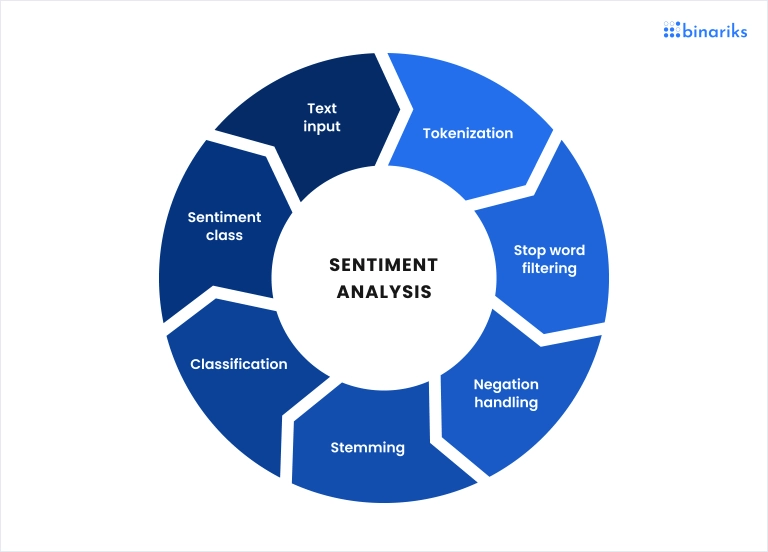
Performing sentiment analysis for patient care involves several key steps, from data collection to preprocessing, model training, and evaluation.
Here's a concise guide on how healthcare sentiment analysis is typically carried out:
1. Data collection
Gather textual data from various sources such as reviews, surveys, social media posts, electronic health records (EHR), and chatbot interactions.
2. Data preprocessing
- Cleaning: Remove irrelevant characters, punctuation, and stop words.
- Tokenization: Split text into individual words or phrases.
- Normalization: Convert words to their base form using lemmatization or stemming.
- Vectorization: Convert text into numerical features using TF-IDF or word embeddings.
3. Sentiment detection
Lexicon-based methods:
- Use predefined dictionaries of positive and negative words to assign sentiment scores to the text.
- Example: VADER (Valence Aware Dictionary and sEntiment Reasoner) for analyzing social media content.
Machine learning methods:
- Train machine learning models (e.g., Naive Bayes, SVM, deep learning models) on labeled datasets where text samples are annotated with corresponding sentiments.
- Convert text into numerical features using TF-IDF, word embeddings (Word2Vec, GloVe), or contextual embeddings (BERT).
- Use labeled data to train the model and evaluate its performance using accuracy, precision, recall, and F1-score metrics.
Deep learning methods:
- Use sophisticated NLP models like RNNs, CNNs, or transformers (e.g., BERT, GPT) to capture context and nuances in text.
- Fine-tune pre-trained models on specific datasets for higher accuracy.
4. Model training and evaluation
- Train the chosen model on the preprocessed and vectorized text data.
- Validate the model using a separate test set to assess its performance.
- Use metrics such as accuracy, precision, recall, and F1-score to evaluate the model's effectiveness.
5. Sentiment scoring
- Assign scores indicating positive, negative, or neutral sentiment.
- Identify specific emotions such as happiness, sadness, anger, etc.
- Determine sentiment related to specific aspects or features of a product or service.
Tools and technologies for sentiment analysis
Natural Language Processing Libraries:
- NLTK (Natural Language Toolkit): A popular library in Python for working with human language data.
- spaCy: An open-source library for advanced NLP in Python, known for its speed and accuracy.
Machine learning models:
- Naive Bayes: A simple and effective algorithm for text classification.
- Support Vector Machines (SVM): Used for sentiment classification tasks.
- Deep Learning Models: Recurrent Neural Networks (RNNs), Convolutional Neural Networks (CNNs), and transformers like BERT and GPT for more sophisticated sentiment analysis.
Sentiment analysis APIs:
- Google Cloud Natural Language API: Provides powerful sentiment analysis capabilities.
- IBM Watson Natural Language Understanding: Offers various text analysis features, including sentiment analysis.
- Azure Text Analytics API: Part of Microsoft's Azure Cognitive Services, providing sentiment analysis and other NLP features.
Data processing tools:
- Pandas: A Python library for data manipulation and analysis.
- scikit-learn: A machine learning library in Python that integrates with NLP tools for building sentiment analysis models.
Training sentiment analysis models
Supervised learning
In supervised learning, models are trained on labeled datasets, where each text sample is annotated with its corresponding sentiment (positive, negative, neutral, or specific emotions).
Process:
- Data collection: Gather a large dataset of text samples with known sentiment labels.
- Feature extraction: Convert text into numerical features using techniques like TF-IDF or word embeddings.
- Model training: Train a machine learning model (e.g., Naive Bayes, SVM, deep learning models) on the labeled data.
- Evaluation: Validate the model using a separate test set and metrics like accuracy, precision, recall, and F1-score.
Advantages: Generally achieves higher accuracy and can be fine-tuned for specific domains.
Challenges: Requires a substantial amount of labeled data, which can be time-consuming and costly.
Unsupervised learning
In unsupervised learning, models work with unlabeled data to identify patterns or clusters within the text that can indicate sentiment.
Process:
- Data Collection: Gather a dataset of text samples without sentiment labels.
- Clustering: Use clustering algorithms like K-means or hierarchical clustering to group similar text samples.
- Sentiment Lexicons: Utilize predefined dictionaries of positive and negative words to assign sentiment scores to text clusters.
- Topic Modeling: Apply techniques like Latent Dirichlet Allocation (LDA) to identify common themes or topics within the text.
Advantages: Does not require labeled data, making it easier to implement when such data is unavailable.
Challenges: Typically less accurate than supervised learning and may need more nuanced or context-specific sentiments.
Challenges and considerations
- Obtaining sufficient labeled data for training models can be challenging, especially in specialized healthcare domains.
- Unstructured data is notoriously difficult to analyze.
- Big chunks of data in patient care sentiment analysis are shared across multiple platforms, which creates a risk of sentiment duplicates.
- There are serious communication gaps between care providers and patients regarding services, which can make the results of sentiment analysis in patient care management unpredictable and inconsistent.
- Data privacy in sentiment analysis of patient feedback has to be guaranteed through robust data encryption and anonymization techniques.
- Ensuring that models generalize well to new, unseen data is crucial. Overfitting to training data can result in poor performance on real-world data.
- The models used in sentiment analysis in patient care management should be transparent and understandable to healthcare providers and clear to customers as well.
How Binariks can help
If your healthcare organization wants to improve patient care through sentiment analysis, an experienced IT healthcare outsourcing partner like Binariks can help make this a reality. Here are the healthcare software development services we can do related to sentiment analysis:
- Assessment and planning according to your goals and challenges
- Identification of data sources (patient reviews, surveys, social media, etc. )
- Data collection
- Data integration
- Data preprocessing
- Choosing and implementing models
- Deployment and system integration
Conclusion
Incorporating sentiment analysis into healthcare provides key insights into patient feedback, transforming how care is delivered. By using natural language processing and machine learning, healthcare providers can understand patient experiences in real time, going beyond traditional feedback methods.
This approach helps pinpoint areas for improvement and highlight excellent care practices, allowing for quick responses to issues. A complete picture of patient sentiments emerges by analyzing data from surveys, social media, and electronic health records. This integration makes healthcare more responsive and personalized.
Ultimately, sentiment analysis boosts patient satisfaction and care quality, so the importance of sentiment analysis in healthcare is apparent. As the healthcare industry continues to evolve, using these advanced tools will be essential for staying competitive.
Partnering with experts like Binariks ensures proper implementation, data privacy, and compliance, leading to the best possible outcomes for patient care.