


P2P lending is a new and innovative way of lending and borrowing money. Between 2020 and 2027, the P2P lending industry will reach a record $558.91 billion, an increase of about 30%.
Keep reading and learn about the crucial elements required to create a successful P2P lending app. We will cover a market review, explain what types of P2P solutions may interest you, list regulatory requirements you should consider, and walk you through the most-wanted app features of P2P solutions.
If you are considering developing a P2P lending app and need professional help and guidance, Binariks is here to assist you. With our team of banking software development experts , we can help bring your vision to life and ensure that your P2P lending app is a success.
How do P2P lending apps work?
P2P lending apps work by connecting borrowers and lenders directly, cutting out traditional financial institutions.
- Step 1. The process starts with the borrower submitting a loan application through the app, which includes information about their financial status and the amount of money they wish to borrow.
- Step 2. Lenders can then fund the loan, either partially or in full.
- Step 3. Once the loan is fully funded, the funds are transferred to the borrower, and the repayment process begins, usually with monthly payments.
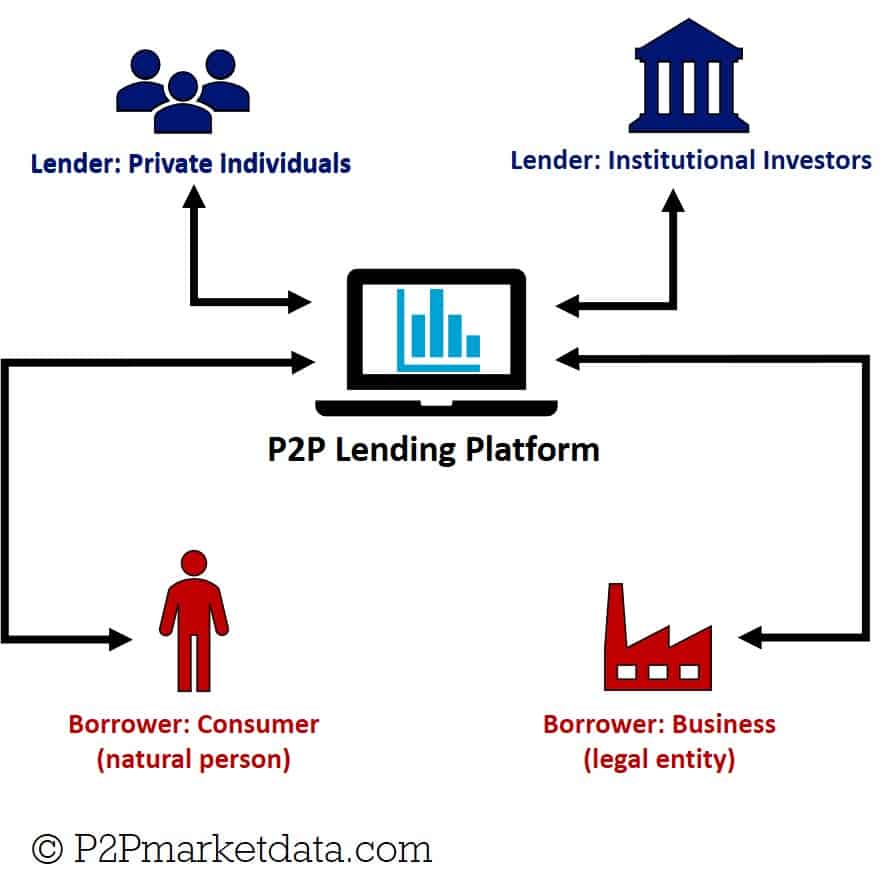
P2P lending platform functioning
The app acts as an intermediary, handling the payment process, ensuring that the funds are transferred securely, and monitoring the loan repayment. In some cases, the app may also implement a system of lender protection, such as a reserve fund, to mitigate the risk of default. The key advantage of P2P lending apps is that they offer a more efficient, accessible, and cost-effective alternative to traditional lending.
Why do people prefer P2P lending apps?
P2P lending apps have become increasingly popular due to the many advantages they offer compared to traditional lending. P2P lending platforms typically offer lower interest rates compared to traditional lending options, making them an attractive option for borrowers. On average, P2P lending interest rates range from 6% to 36%.
Convenience and cost-effectiveness
Borrowers can apply for a loan from the comfort of their own homes. At the same time, lenders can invest their funds without incurring the high costs associated with traditional financial institutions.
Favorable interest rates
With less overhead costs, P2P lending apps can provide lower interest rates to borrowers and higher returns to lenders.
Tailored loan conditions
Allow borrowers to select the terms and conditions that best meet their individual needs. This level of customization is not typically available through traditional lending channels.
Multiple customers for a single lender
P2P lending apps also allow multiple customers to lend to a single borrower, spreading the risk and potentially providing lenders with a more stable return.
Safety and trust
The platforms use encryption and other security measures to protect both borrowers' and lenders' personal and financial information. This, combined with using an intermediary, helps build trust between borrowers and lenders, creating a more transparent and secure lending environment.
The main types of loans for your P2P lending apps
P2P lending apps can offer a variety of loan types, and the choice of which types to focus on will depend on the goals and target market of the app.
According to Advance Market Analytics , personal loans are the most popular type of P2P loan on lending platforms, accounting for over 50% of total P2P lending activity. Personal loans are typically used for debt consolidation, home improvements, and unexpected expenses.
Small business loans and real estate loans are also popular types of P2P loans, accounting for about 20% and 10% of total P2P lending activity respectively. These loans provide financing for small business owners and real estate investors, who may have difficulty accessing traditional loan options.
Medical loans
Medical loans can fund medical expenses, including surgeries, treatments, and procedures that may not be covered by insurance.
Educational loans
Educational loans provide funding for higher education, allowing students to pursue their dreams without the burden of student debt.
Car loans
Car loans offer to fund purchasing a new or used vehicle, helping people maintain their independence and mobility.
Personal loans
Personal loans fund personal expenses, such as home improvements, weddings, and vacations.
Business loans
Business loans fund small businesses, allowing entrepreneurs to grow and expand their ventures.
Ultimately, the choice of which loan types to offer will depend on the goals of the P2P lending app, as well as market demand and the needs of the target audience.
Find out the regulatory requirements before creating a P2P lending application
Before creating a P2P lending application, it is essential to research and understands the regulatory requirements in your target market. The laws and regulations surrounding P2P lending can vary greatly between countries and regions. The bad news is that failing to comply with these regulations can result in significant financial losses and lawsuits.
In some countries, a license may be required to operate a P2P lending platform, while licensing may not be necessary for others. It is important to understand the local regulations and ensure that the app complies with all relevant laws and regulations. This may involve obtaining a license, registering with the appropriate government bodies, and adhering to strict security and data protection standards.
In the United States, P2P lending is regulated by the Securities and Exchange Commission (SEC) and the Financial Industry Regulatory Authority (FINRA). P2P lenders must also comply with state-level regulations, such as obtaining licenses and following consumer protection laws.
In the European Union, regulations for P2P lending vary by country. In the United Kingdom, P2P lending is regulated by the Financial Conduct Authority (FCA), while in Germany, it is regulated by the Federal Financial Supervisory Authority (BaFin). In France, P2P lending platforms must be authorized by the Autorité des Marchés Financiers (AMF) and comply with consumer protection laws.
In Japan, P2P lending is regulated by the Financial Services Agency (FSA) and the Ministry of Economy, Trade and Industry (METI). Lenders must comply with the country's consumer protection laws and obtain FSA licenses.
In China, P2P lending is regulated by the People's Bank of China (PBOC) and the China Banking and Insurance Regulatory Commission (CBIRC). P2P lenders must comply with the country's consumer protection laws and obtain a license from the CBIRC.
Furthermore, it is crucial to understand the legal requirements for loan origination, repayment, and default. This includes the terms and conditions of the loan, the rights and responsibilities of borrowers and lenders, and the processes for handling loan defaults.
In conclusion, researching and understanding the regulatory requirements is a critical step in creating a P2P lending application. Binariks can provide expert consulting services to help ensure that your app is fully compliant with all relevant laws and regulations, and can help you navigate the complex legal landscape of P2P lending.
Read Also: Design and Implementation of Loan Management System Software
Features for your P2P lending app
When developing a P2P lending app, it's important to consider the features that will make it stand out among competitors.
The main features that every P2P lending app should have are:
- Registration: A user-friendly and secure registration process for borrowers and lenders.
- Profile: A comprehensive profile for each user, where they can manage their personal information and lending/borrowing history.
- Loan Application: A streamlined process for borrowers to apply for a loan.
- Payment Section: A secure and efficient payment system to handle loan transactions.
Unique features
To make the app more unique and successful, additional features can be added, such as:
- Analytics using AI: This will help analyze borrowers' creditworthiness and loan risk.
- Calculators: A loan calculator for borrowers to estimate their loan repayment.
- Chatbots: An AI-powered chatbot for customer support and loan information.
- Credit Rating: A credit rating system helps lenders evaluate borrowers' creditworthiness.
APIs integration for P2P lending solutions
APIs, or application programming interfaces, play a crucial role in developing P2P lending solutions. They allow for the seamless integration of different systems and services, enabling the app to access data and functionalities from external sources. This helps to streamline processes, increase efficiency, and improve the user experience.
Here are several useful APIs that can be integrated into a P2P lending app:
- Payment gateway APIs, such as Stripe or PayPal, to facilitate secure transactions.
- Credit check APIs, such as Experian or Equifax, to perform background checks on borrowers.
- KYC (Know Your Customer) APIs, such as Onfido or Jumio, to verify the identity of users.
- Notifications APIs, such as Twilio or Pusher, to send real-time updates to users.
- Geolocation APIs, such as Google Maps or OpenStreetMap, to determine the location of borrowers and lenders.
APIs can significantly enhance the functionality of your P2P lending app and make it easier to use, more efficient, and more secure.
Recommended technologies for a Peer-to-Peer lending app
When developing a P2P lending app, it is important to choose the right technologies and services to ensure the platform is secure, scalable, and user-friendly. Some recommended technologies and services include:
- Front-end development frameworks such as React, Angular, or Vue.js.
- Back-end development technologies such as Node.js, Ruby on Rails, or Laravel.
- Payment gateway integration, such as Stripe or PayPal, for secure and efficient money transfers.
- Mobile app development frameworks, such as React Native, for creating a seamless mobile experience for users.
- Cloud-based infrastructure, such as Amazon Web Services or Google Cloud, for increased scalability and security.
- Database management systems, such as MongoDB or PostgreSQL, for storing and retrieving large amounts of data.
- Cybersecurity measures, such as encryption and two-factor authentication, to protect sensitive user information.
Choosing the right technologies and services for your P2P lending app is crucial for the success and longevity of your platform.
How much does it cost to build a P2P lending platform
The cost of developing a P2P lending platform can vary greatly depending on several factors, including the size and complexity of the platform, the features and functionality you want to include, and the region where your development team is located.
Typically, a basic P2P lending platform can cost anywhere from $50,000 to $150,000, while a more complex platform with advanced features and integrations can cost upwards of $500,000 or more.
The development process for a P2P lending platform can take several months to a year or more, depending on the project's scope. Factors that can impact the timeline include the size of your development team, the complexity of the platform, and the number of iterations and changes that may be required during the development process.
Why is it better to outsource P2P lending platform development?
Outsourcing the development of your P2P lending platform can provide many benefits, including cost savings and access to a broader range of expertise and resources. By working with an experienced outsourcing team, you can reduce development costs and allocate more resources to other areas of your business.
Many successful P2P lending apps, such as Lending Club and Prosper, were created through outsourcing. These companies leveraged the expertise of specialized development teams to bring their platforms to market more quickly and cost-effectively.
Some examples of P2P lending apps
There are many well-known P2P lending apps, including Lending Club, Prosper, Upstart, and Funding Circle. These apps have established themselves as leaders in the industry by providing borrowers with access to fast and convenient loans, while also offering lenders the opportunity to earn competitive returns on their investments.
Create your first peer-to-peer lending app with Binariks
Creating a P2P lending app is a complex and challenging process, but with the right support, it can be a highly rewarding experience. Binariks is a team of experienced developers and consultants specializing in developing P2P lending solutions.
Our team can help you navigate the complex landscape of P2P lending and ensure that your app meets all the regulatory requirements and security standards. We can assist you in choosing the right business model, integrate credit risk assessment tools, and build a user-friendly platform accessible to both borrowers and lenders.
With our extensive experience in the industry, Binariks can provide you with the support you need to create a successful P2P lending app. Our team will work closely with you from concept to launch to help you achieve your goals and build a profitable, user-friendly, secure platform. Contact us today to learn more about how we can help you create your first P2P lending app.
Final thoughts
P2P lending is a rapidly growing industry with tremendous potential for growth and innovation. With the right strategy, tools, and expertise, you can develop a P2P lending app that is both profitable and beneficial to its users.
Developing a P2P lending app requires careful planning and attention to detail. From understanding regulatory requirements to ensuring the security and privacy of user data, there are many factors to consider when creating a P2P lending platform.
Choosing the right business model, assessing credit risk, and building a user-friendly platform are important steps in the development process. By following these guidelines and working with experienced professionals like Binariks, you can create a successful P2P lending app that meets the needs of borrowers and lenders alike.