


Conversational AI in banking enables intuitive voice or text-based interactions between customers and their banks. Basically, it means that customers can now chat with AI in a human-like conversation to resolve most of their queries. Having entered the mainstream just a couple of years ago, this technology is now everywhere because it is convenient for financial institutions and customers.
In this article, we will guide you through the driving forces behind AI-powered banking. We will also look into technologies for conversational AI banking, the benefits for all actors, and use cases of this disruptive trend. Finally, you will get advice on implementing conversational AI in financial services with the help of a remote IT team.
The rise of AI-powered banking
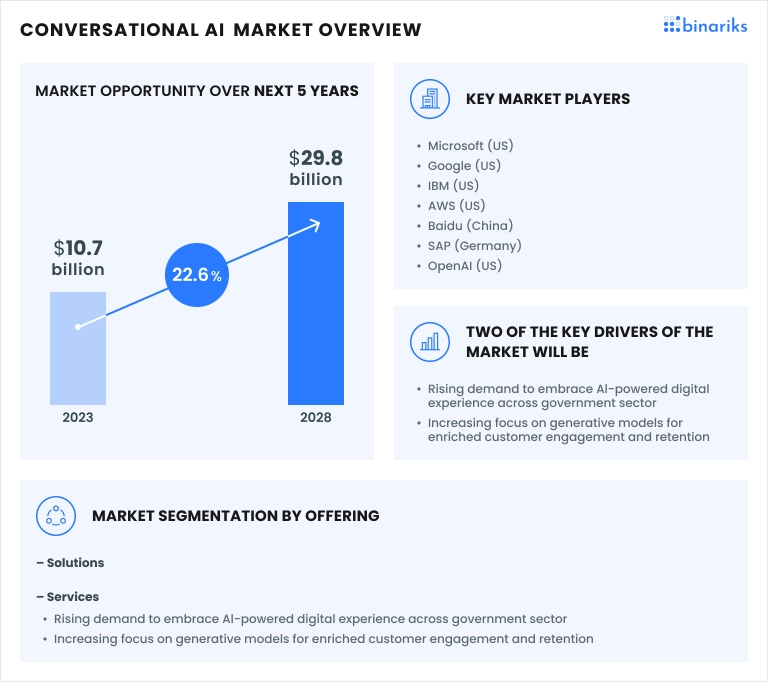
The rise of AI-powered banking is a phenomenon that has been gathering momentum since the mid-2010s. The impact of conversational AI is the transformation of the way financial institutions interact with their customers. The conversational AI market is on the journey to grow from USD 10.7 billion in 2023 to USD 29.8 billion in 2028 (source ). As artificial intelligence and machine learning technologies become more widely available, banks worldwide utilize conversational finance on a massive scale.
Сonversational AI for banking is a unique opportunity for financial institutions and customers as it helps to guarantee fast and efficient 24/7 service while cutting operational costs. The rise of generative AI models, such as ChatGPT, is a mass driver of conversational AI for banks as it signals that technologies are becoming more widely available (source ).
The market of conversational AI in financial services is dominated by established and recent tech giants such as AWS, Microsoft, and Open AI. Conversational AI in mobile banking is the fastest-growing segment of conversational finance (source ).
Сonversational AI in financial services incorporates a set of diverse technologies. Let's focus briefly on some of them:
- Natural Language Processing (NLP): The algorithms of this technology understand and respond to user queries conversationally. NLP algorithms proceed with the content of the conversation to predict the levels of customer satisfaction and respond to this predicament. NLP can also automatically read and interpret legal documents.
- Machine Learning (ML) technologies analyze and segment data at a fast pace. This makes them helpful in credit scoring, fraud detection, and segmentation of the customer base.
- Robotic Process Automation (RPA) automates repetitive tasks like data input or report generation. This mechanism is especially useful in reducing human errors.
- Automatic Speech Recognition (ASR): Customers can now perform all actions with voice commands. What is more, automated analysis of customer calls can help improve service quality and compliance. Voice authentication technologies improve the safety of banking transactions and provide access to services for people who might have difficulty with traditional interfaces.
- Deep learning helps to make sense of large and unstructured data sets. An example would be interactions with customers on social media. They also predict the failure of servers and equipment, such as ATMs. This reduces downtime and helps notify customers about potential inconveniences.
Use cases of conversational AI in banking
The use cases of conversational AI in banking go beyond just chatbots. Here are several creative ways that the conversational AI is used for banking:
To resolve common and repetitive queries
Customers can ask the conversational AI about their account balance, transaction history, and other basic queries that would typically require them to log in to a mobile app or call customer service if not for conversational banking. Conversational AI can answer frequent queries about loan procedures, interest rates, account types, and so forth without human intervention.
This saves customers time and takes the burden of mundane tasks away from banking professionals. In this way, human interactions can be reserved specifically for difficult, personalized queries that require the attention of a specialist.
To manage payments and transactions
Users can set up and manage recurring bills or make one-time payments through conversational interfaces. Money transfers can also be handled with Conversational AI for banks: customers can send money to contacts or make wire transfers by interacting with the AI.
Transaction confirmations also proceeded through conversational AI banking: conversational AI can confirm transactions through an additional layer of security such as OTP (One Time Password).
To perform uncomplicated but critical tasks
Conversational AI in banking is perfect for easy but crucial tasks like setting up alerts or blocking cards because it's fast and secure. The AI can guide the customer through activating or deactivating accounts or help customers freeze lost cards.
To ease document collection and sharing
Customers can upload necessary documents through a chat interface, and the AI can verify the uploaded documents in real time. Conversational AI in banking can assist in filling out forms for loan applications or account openings. Users can enjoy a hassle-free experience using conversational AI in mobile banking for document tasks.
Minimized bureaucracy and faster times for creating and processing documents are also a plus. Conversational AI in financial services can use blockchain to make the processing of documents safer.
To up-sell and cross-sell
The AI can offer personalized financial products like loans or investments based on the customer's transaction history and behavior. It can also personalize recommendations using feedback collected during the conversation. These are perfect methods for banks to increase revenue through more effective marketing conversions.
Benefits of conversational AI in banking
Conversational AI for finance offers benefits for customers and banks alike. Let's look into some of them:
- Enhanced and smooth customer experience: Conversational AI for banking is available 24/7, unlike traditional banking services. What is more, chatbots can answer many customer queries simultaneously, which means that both response and resolution will be fast. Finally, conversational AI enhances customer experience through personalization.
- Saving operational costs: Automating routine tasks like conversational AI answering FAQs and assisting in transactions can help banks save costs. What is more, conversational AI can handle many queries simultaneously, allowing banks to scale their customer service without proportional increases in staffing. Finally, automated systems are less likely to make mistakes in tasks like data entry and calculations, saving banks costs.
- Security and fraud prevention: Using conversational AI for finance can add an additional level of security. For example, it can use fraudulent transaction monitoring in real time. With conversational banking, it is also easy to establish multi-factor authentication with tools like chat-based verification or AI voice recognition.
- Sophisticated data analysis: Data collected during conversations with AI bots is very useful for banks. Using this data, AI models can predict customer behavior, such as closing accounts or loan defaults. For example, let's say that a bank uses its chatbot interactions to see that a particular age group (e.g., 18-24) frequently inquires about student loans or setting up student accounts. Using this information, the bank can tailor its marketing campaigns to address this demographic's needs better.
- Improved accessibility: Conversational AI banking offers customers multi-language support and voice-activated interfaces for people with disabilities like visual impairments. All of these help ensure more people have equal access to services.
Examples of conversational AI tools & solutions for banking
There are thousands of readily available conversational AI banking tools. Let's look into examples of some of them.
Chatbots
Chatbot is by far the most popular conversational AI for banking. An example is Erica by Bank of America. This bot offers all the solutions that artificial intelligence can provide in conversational banking. Erica's functions include alerts and notifications, payment scheduling, checking balances, and a personal finance assistant.
Voice assistants
Capital One's Eno started as a typical chatbot but now integrates with voice assistants like Amazon's Alexa. With it, the users can use all chatbot functionalities using their voices. Customers can even pay their credit card bills via voice commands.
Personal financial advisors
Smart money and financial advisor apps, such as Plum, use artificial intelligence to offer you financial and investment advice based on personalized characteristics. The interface of these advisors is similar to a chatbot, but the algorithms are designed primarily for financial predictions. Another name for such apps is wealth management chatbots. They evaluate risks and provide stock ideas.
With a wide choice of conversational AI in financial services available on the market, a tech partner like Binariks can help develop and customize tailored chatbots and voice assistants for your banking services.
Our specialists can help you integrate a conversational finance platform with core banking systems and the existing IT infrastructure of your financial institution. We can also help train the AI model with the help of historical customer queries. Other aspects of conversational AI that we can assist with include scalability, security compliance, and gaining insights for customer analytics.
Conclusion
After introducing conversational AI into the mainstream, the fintech market will always be different. We could not even imagine the ease with which modern financial transactions are being carried today.
Without any doubt, conversational AI for banking is the service that made our lives easier by allowing us to control our finances with one click of a smartphone. Aside from obvious benefits such as cutting operational costs through automation and resource relocation for banks, the improved convenience of services thanks to conversational banking, made us trust banks more.
The future of banking AI promises a shift towards even better security and advanced personalization. And Binariks experts can help your financial institution with AI/ML development services and consultations for a seamless integration of conversational banking.