Behavioral Prediction for Proactive Customer Engagement
Published Feb 24, 2026
Updated Oct 18, 2026
17 min read
Learn how behavioral prediction enables proactive customer engagement. Discover propensity models, next-best-action frameworks, and use cases to prevent churn and boost ROI.
Modern businesses struggle to match evolving customer behaviors with reactive engagement models. Customers demand seamless, personalized, and proactive journeys with real-time solutions. Proactive engagement anticipates needs, like issue prevention, purchase facilitation, retention, and upselling. Benefits include improved customer experience, loyalty, revenue, reduced churn, resource efficiency, and stronger brand perception. Key strategies involve analyzing behavioral signals like usage patterns, sentiment, and transactional trends to predict needs and guide timely actions. Reactive models fail by addressing issues only after they arise, risking frustration, poor satisfaction, and revenue loss. Conversely, proactive support drives trust and differentiation.
Modern organizations face a growing gap between how customers behave and how businesses respond. While customer journeys have become longer and more complex, and more digital, engagement models often remain reactive.
This creates pain points for businesses, including lost value, frictions in the customer journey, and inefficient use of support and sales resources.
Reactive engagement is not a good solution for supporting modern customers on their journey with your business. Customers today expect a smooth, comfortable customer journey with no friction and maximum personalization. All issues are to be solved in real time with a minimum of steps, or don't occur at all.
Replacing reacting with proactive customer engagement guarantees exactly that and leaves a lasting impression of a business that values its clients, with customers now likely to be loyal to your brand.
In this article, we explain the fundamentals of proactive engagement, along with:
Types of behavior signals tracked for proactive engagement
How propensity models are used to predict customers' behavior that should trigger proactive engagement
How the Next-Best-Action (NBA) framework helps select the exact action to take in proactive engagement
How timing and context play out, including selecting the appropriate communication channel
Use cases of behavior prediction for churn prevention, upsell and cross-sell, and customer support
How Binariks can help you set up predictive analytics for NPS and other use cases
What is proactive customer engagement?
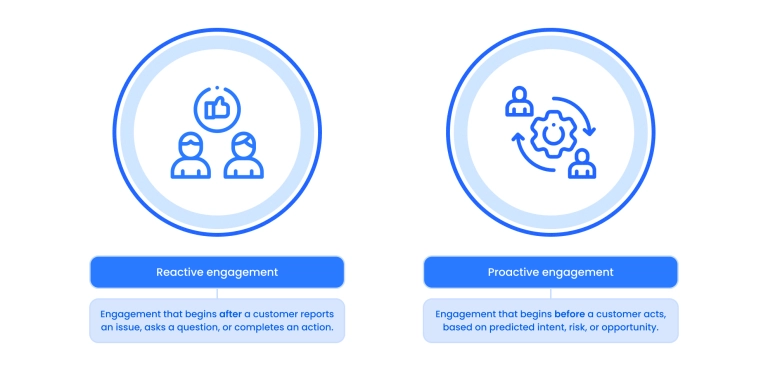
Proactive customer engagement is when a company initiates contact based on predicted customer intent before the customer explicitly asks, reports a problem, or completes a transaction. The company anticipates the customer's needs and predicts the exact moment when the value must be delivered.
Here are some of the examples based on different types of predictive engagement:
Proactive support (issue prevention): A logistics provider identifies a shipment delay risk, notifies the customer, and offers options to resolve the issue before the customer contacts support.
Proactive purchase facilitation: A sushi restaurant sees a regular customer who usually orders on Friday evenings and sends a limited-time set offer an hour before dinner time, before the time the customer usually opens the app.
Proactive retention & renewal: A streaming service sees a customer skipping recommended content and watching less each week, and sends a personalized re-engagement email with new releases and a pause option before the user cancels the subscription altogether.
Proactive expansion: An e-commerce seller's sales volume increases month over month, so the platform offers an upgraded analytics add-on before the seller looks for external tools.
The goal of proactive customer engagement is to influence customer decisions to increase positive business outcomes. The company uses proactive engagement to capture the value that would otherwise be missed.
The benefits of proactive customer engagement include:
Better customer experience
Personalized recommendations for the customer
Long-term customer trust and reduced churn, including higher customer lifetime value (CLV)
Less resources spent on support
Stronger brand perception
Higher revenue
More efficient use of data and insights
Stronger differentiation in competitive markets
Better feedback loops for product and service improvement
The gap between reactivity and proactivity
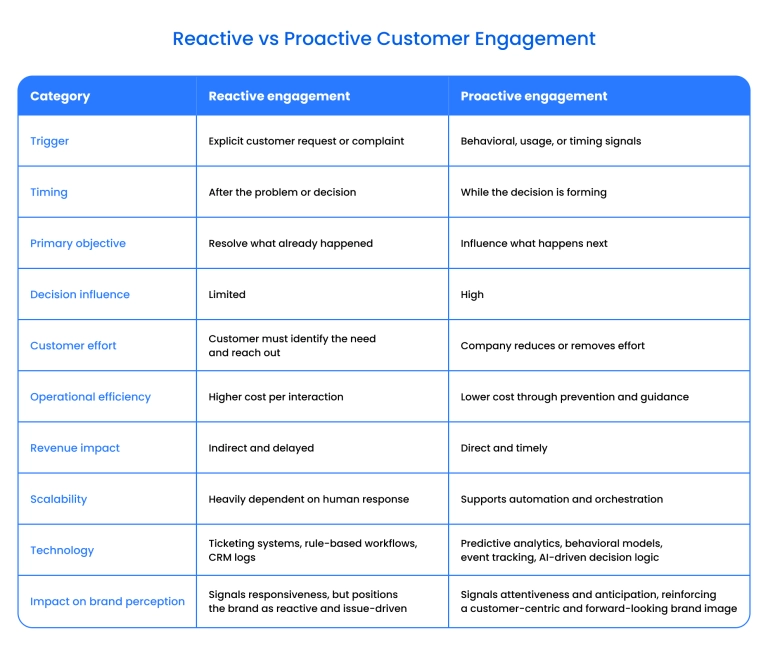
Unlike a proactive engagement model, a reactive model is one in which an organization responds to customer issues or needs only after they are explicitly reported or problems have already occurred, rather than anticipating them in advance.
In reactive models, customers form intent and make decisions independently because the company engages only after an action or complaint occurs. The company does not directly influence customer intent, which often leads to negative outcomes (e.g., abandoned purchases, subscription cancellations).
Reactivity is a losing strategy for overall customer satisfaction and customer experience because people want goods and accompanying services to be predictable and safe. They pay the businesses so that they don't have to think twice about products and services. Having to actively seek solutions and argue with support for something the company was supposed to cover creates frustration and kills trust.
When support is purely reactive, it activates only after friction or dissatisfaction has accumulated. At that point, the interaction shifts from guidance to damage control, making customer loss a predictable result rather than an isolated incident.
The customers would rather turn to competitors who did not cause them dissatisfaction. Preventing negative sentiment is an action that always yields a better outcome than dealing with the consequences of already-formed discontent.
In industries where the value of a single customer is high, such as insurance, cloud services, or healthcare software, losing even one client due to poor support is a direct loss of revenue and customer lifetime value. In the insurance customer journey, proactive engagement matters because key decisions unfold over extended phases, such as claims and renewals.
Deciphering behavioral signals: The foundation of prediction
In this section, we present a list of predictive analytics for proactive engagement. These generally cover the full decision context of the user – what the user is doing, what they are struggling with, which milestones the company overlooked, and what is happening commercially between the user and the company.
These are dynamic, meaning they are meant to reflect changes in behavior, such as a user's declining engagement with the platform. All behavior signals are quantifiable and suitable for both predictive analytics and ML techniques such as propensity modelling and survival analysis.
Each of the signals mentioned here invites a corresponding action. For example, if there is an indication of engagement decline, you can follow with a retention workflow.
In healthcare, if the patient is missing a clinical step, it is an excellent time for proactive outreach. Here is the comprehensive list of different behavioral signals tracked during proactive personalization marketing:
Usage patterns & activity trends
Frequency of platform logins or app usage
Time spent on specific features or modules
Declining engagement over time (e.g., last login how many days ago)
Abandoned processes (e.g., incomplete applications or forms)
These provide the information on whether the user is still actively engaged, the earliest and most universal signal of engagement health. Declining usage precedes any potential complaints.
Search & navigation behavior
Frequently searched topics or repeated queries
Time spent on help center or FAQ articles
Click patterns suggesting confusion or hesitation
Sudden interest in plan cancellation, plan downgrade, or refund pages
These factors point to exactly what the user is struggling with and the kinds of answers they want from you.
Communication & sentiment signals
Tone of emails and chats (sentiment analysis)
Increased support requests within a short timeframe
Non-response to outreach (e.g., ignored renewal reminders)
Negative NPS or satisfaction survey responses
Communication and sentiment signals explain how the user feels about your services.
One popular traditional communication metric is NPS, which stands for Net Promoter Score. It's a simple metric for measuring customer satisfaction and loyalty, based on the question: "How likely are you to recommend our product/service to a friend or colleague?"
The answer is on the scale from 0 to 10. NPS was a traditional measure of customer engagement before predictive analytics and proactive customer engagement became more widespread, but it lacks depth when used on its own. NPS, however, with predictive analytics, is an excellent communication system that integrates into a whole.
Insurance: lack of policy updates before renewal, delayed claims submissions
IT / SaaS: stalled onboarding steps, unconfigured features, repeated API errors
These industry-specific milestones indicate whether the user is progressing towards the critical steps in their user journey. For each industry, that progress looks different: predictive analytics for insurance has radically different milestones than healthcare.
Account or transactional signals
Unexpected drop in transaction volume or data usage
Spikes in billing questions or disputes
Repeated failed payments or an upcoming contract expiration
Early downgrades or pauses in service usage
These signals connect behavioral prediction to business outcomes, and they directly impact your revenue and potential financial risks.
Risk & churn indicators
Sudden decrease in user seats or licenses
Shift to negative sentiment after product or policy changes
Long response times from client teams in B2B environments
Lack of participation in training or feedback loops
These signals typically appear late in the journey, but they're critical for immediate intervention as they indicate that the customer is about to leave.
Contextual & temporal signals
Time-of-day and day-of-week engagement patterns
Seasonality (driven by factors such as renewal cycles or financial cycles).
Abrupt behavior changes relative to the user's historical baseline (e.g., a customer who always places an order at the beginning of the month suddenly stops for 3 months).
These signal the customer's intent and tell you what the best time for the outreach is.
Channel & responsiveness signals
Preferred communication channel (email, in-app, SMS, human outreach)
Response latency to previous messages
Click-through, dismissal, or ignore behavior on prior outreach
Notification opt-outs or muted channels
These indicate where and how the user wishes to be contacted.
Turn your data into a competitive advantage. Let's build your strategy.
Propensity models are a type of predictive analytics used to estimate the probability that an individual user will take a specific action within a defined time frame.
Instead of producing simple yes/no predictions, these models generate probability scores that reflect future intent. The probability score is based on the user's observable behaviour, historical patterns, and the interaction's context.
Predictive analytics is the broader discipline focused on forecasting future outcomes from data. Propensity models are a specialized application of predictive analytics that estimate the likelihood of user-level actions and support real-time decisioning frameworks such as Next-Best-Action (NBA).
In practice, propensity models answer questions such as:
How likely is this user to churn in the next 30 days?
What is the probability that a customer will upgrade to a higher plan this quarter?
How likely is a patient to miss their next appointment?
To use a propensity model, the organization first defines a target behavior, such as churn or no-show, with a clear prediction window. This transforms a business question into a measurable outcome that the model can learn from.
Next, user behavior is translated into structured signals. Some of the structured signals that can be used are engagement patterns, sentiment indicators, transaction events, etc. At this step, the activity is converted into an input that a model can evaluate.
The model is then trained on historical data using statistical or machine-learning techniques. During training, it learns which signal combinations have historically preceded the target action. Over time, it learns to recognize patterns that consistently indicate higher or lower likelihoods of that outcome.
Once trained, the model assigns each user a propensity score, a probability value (e.g., 0.75). It represents the estimated likelihood that the action will occur within the defined time frame. The prediction is automatically recalculated when behavior changes or new data arrives.
Propensity scores are not decisions on their own. They serve as inputs for prioritization and decision-making, enabling systems to determine where attention or intervention will have the greatest impact.
To better illustrate how propensity models work in predictive analytics with proactive engagement, let's look at an example of a customer planning to switch to a competitor.
Consider a SaaS customer who has been a stable, active user for over a year.
Over a short period, the system observes several behavioral changes: a decline in feature usage, repeated visits to pricing and plan comparison pages, and an overall slower response to the outreach. None of these signals alone confirms churn, but together they form a recognizable pattern that signals the customer is ready to abandon the service.
The propensity model compares this combination of behaviors against historical data and identifies a strong similarity to past users who later switched to competitors.
The customer has a high churn propensity score of 0.82, indicating a high likelihood of leaving in the next 30 days. This score feeds into a decisioning system, which triggers proactive outreach, such as an offer to review the current plan.
Next-best-action (NBA) framework
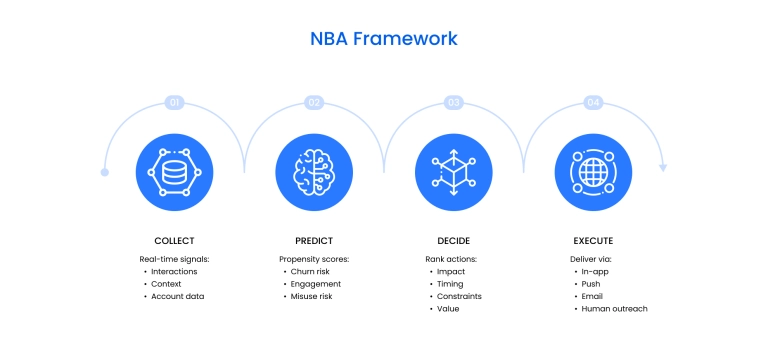
While propensity models estimate what a user is likely to do next, the Next-Best-Action (NBA) framework determines what the organization should do next in response. The NBA follows the prediction with the action.
Next-Best-Action (NBA) is an AI-driven decision-making framework that selects the most appropriate action for a specific user at a specific moment, based on:
predicted intent and risk (from propensity models)
current behavior and context
and business rules or objectives
Just as propensity models do, the NBA adjusts with the arrival of new data. Here is how the NBA framework works in real time:
1. Real-time signal collection
The system continuously captures live and historical inputs, including recent interactions, engagement patterns, contextual data (location, time of day, device type), and account information.
2. Predictive modeling & propensity scoring
Propensity models estimate the likelihood of key outcomes:
Is the user likely to churn?
Are they at risk of disengagement or misuse?
These probability scores quantify risk and opportunity, but do not yet determine what action to take.
3. Decision engine & action ranking
The NBA decision engine evaluates a set of possible actions, such as:
Recommend a feature
Offer an upgrade or an incentive
Schedule a check-in
Escalate to a human agent
Take no action
Each option is ranked based on:
predicted impact,
timing and context,
business constraints (compliance, cost, prioritization),
customer value and strategic goals.
The best option is selected based on the option with the best predicted outcome adjusted for time and context. It is important to note that "do nothing" is a valid NBA outcome when intervention would add no value.
The NBA is not always about taking an action; if the action serves no purpose, there is no need to take it. What matters is the outcome, not the action for its own sake.
4. Execution through the right channel
Once the optimal action is selected, it is delivered immediately through the most effective channel:
In-app message
Push notification
Email or SMS
Human outreach (support or account manager)
Dashboard alert
This entire loop signal → prediction → decision → action can occur within milliseconds.
Optimizing timing and channels for maximum impact
When it comes to proactive customer engagement strategies, propensity models, and NPS are not enough; the key is that they fit the proper context.
Even the most relevant recommendation will fall flat if delivered at the wrong time or through the wrong communication channel. The most likely outcome if the proper context is not met is that the customer will ignore your message. The response rate is higher if the message finds the customer at the right moment.
For example, sending a benefits explanation after a user completes onboarding will likely lead to high engagement. On the contrary, offering a new plan while the user is actively trying to do something on your website, or when they are frustrated with your actions, will only increase the risk of churn.
Event-triggered outreach usually reflects context better.
For example, in healthcare, follow-up reminders sent after missed logs convert better than generic reminders sent at random times, without regard to user behavior.
Timing also helps reduce overcommunication. Proper spacing based on user behavior avoids burnout and unsubscribes. There is no need to bombard your customers with notifications every hour.
Another factor that matters for context is that users engage differently across different channels, and the channel should match the appropriate context. As a rule:
Email is effective for detailed updates or documentation.
In-app or push notifications are ideal for urgent, immediate actions.
SMS is used for time-sensitive actions like appointments or payments
Human calls or agent outreach are still required for complex situations, such as when a patient misses multiple follow-up appointments after receiving test results. When a banking customer triggers a fraud alert, a call is essential for safety.
Customer preferences also play a significant role in channel selection. Some users prefer mobile-first engagement, while others are more responsive to email during business hours. A growing number of contemporary users oppose phone calls unless they are absolutely necessary, and calling for no urgent reason is seen as rude.
Key use cases for behavioral prediction
Churn prevention
Behavioral prediction helps identify users who are likely to leave before they explicitly cancel or churn.
Signals such as declining engagement, reduced responsiveness, negative sentiment, or increased interaction with cancellation-related content are compared against historical churn patterns to estimate churn probability. This allows organizations to intervene when the decision is still reversible.
Let's look into a real-world example of predictive customer service in SaaS.
A mid-sized company uses Slack daily, but over a few weeks, its workspace shows declining message volume and fewer active users. At the same time, admins stop opening product update emails. A churn propensity model flags the account as high risk.
Before the renewal date, the system triggers proactive outreach from a customer success manager who offers the company a cheaper plan before they start actively evaluating competitor profiles.
Upsell & cross-sell
Behavioral prediction identifies moments when a customer is most likely to benefit from and accept an additional feature or service. Models detect readiness signals (e.g., increased usage intensity and feature exploration) to make relevant offers.
Here is an example of this use case in cloud services. A startup running on AWS steadily increases compute usage and begins hitting performance limits during peak hours. Engineers repeatedly review documentation for auto-scaling and higher-tier services, so behavioral prediction indicates a high likelihood of upgrade readiness.
The system surfaces a contextual recommendation inside the console instead of just sending a generic e-mail. It suggests auto-scaling with projected cost estimates at the same time; when the low capacity becomes a real bottleneck for the team, they rightfully choose to upgrade.
Proactive support
Proactive support powered by predictive analytics in customer service prevents problems before users experience frustration or start using support themselves. Behavioral prediction identifies early warning signs such as repeated failed actions or stalled onboarding/ missed clinical steps.
Let's say that a patient using a remote monitoring app regularly logs blood pressure data but suddenly misses several entries after a medication change. No support ticket has been created yet, but the pattern deviates from the user's usual behavior.
The system recognizes this and triggers a proactive outreach: first a reminder, then a follow-up from a care coordinator. As a result, the patient does not miss their appointment and does not become frustrated with their application.
How Binariks can help
At Binariks, we design and implement AI/ML-powered behavioral prediction solutions that help organizations deliver smarter personalized customer engagement.
We ensure bidirectional data flow, so actions triggered by predictive models are automatically executed through the appropriate channels, such as email, SMS, app notifications, or agent platforms. We have proven expertise in delivering proactive customer engagement solutions in healthcare, insurance, and fintech.
Conclusion
The shift from reactive to proactive customer engagement marks a fundamental change in how modern organizations create and protect value.
In the modern business landscape, proactivity is a necessity for maintaining competitiveness, as clients expect it from businesses they will use more than once. The impact of predictive analytics on customer service lies in its ability to surface intent early and prevent friction before it escalates across the entire customer journey.
Organizations gain the ability to influence outcomes while decisions are still in motion.
By combining behavioral signals, propensity models, and Next-Best-Action frameworks, companies gain the ability to deliver the right intervention at the right moment through the right channel.
If proactive customer engagement is your priority – and in 2026, it should be – contact Binariks to start implementing it.
"I bridge cutting-edge technology with real business value, ensuring every solution addresses not just stated requirements, but the deeper challenges clients face."
"I bridge cutting-edge technology with real business value, ensuring every solution addresses not just stated requirements, but the deeper challenges clients face."
"I bridge cutting-edge technology with real business value, ensuring every solution addresses not just stated requirements, but the deeper challenges clients face."
"I bridge cutting-edge technology with real business value, ensuring every solution addresses not just stated requirements, but the deeper challenges clients face."
Share article
Let's Start Your Project
We'd love to hear about the project you're working on. Simply complete the form and we'll be in touch.
What happens next?
01
Our expert will reach out to understand your goals and challenges
02
If needed, we'll sign an NDA to ensure full confidentiality
03
You'll receive a tailored roadmap with solution suggestions, timelines, and budget estimates