


Cloud computing refers to delivering computing services – including servers, storage, databases, networking, software, analytics, and intelligence – over the internet (the cloud). This eliminates the need for physical infrastructure on-site, offering a more flexible and cost-effective way to manage IT resources.
Cloud computing is a dynamic, on-demand solution for businesses of all sizes. However, as cloud adoption soars, new terms emerge, leaving some people scratching their heads.
Our article cuts through the jargon and clarifies the difference between cloud-based, cloud-native, and cloud-enabled. By the end of this comprehensive guide, you'll be equipped to identify the perfect cloud solution for your specific needs and unlock the full potential of this transformative technology.
Understanding cloud-based technology & solutions
Cloud-based applications, often referred to as "Software as a Service" (SaaS), are designed to run on a cloud provider's infrastructure. They can be accessed over the internet using a web browser or a dedicated app, eliminating the need for users to install and maintain software on their own devices.
Here are just a few examples of how cloud-based applications are used in various industries:
- Email and collaboration: Cloud-based email services like Gmail and Microsoft 365 offer a convenient and accessible way to communicate and collaborate with colleagues, regardless of location.
- Accounting and finance: Cloud-based accounting software like QuickBooks and Xero simplifies bookkeeping tasks and financial management, accessible from anywhere with an internet connection.
- Human resource management (HRM): Cloud-based HR solutions streamline tasks like payroll, recruitment, and performance management, offering remote access and centralized data storage.
Advantages of cloud-based solutions
- Scalability: Cloud resources can be easily scaled up or down based on your needs. This eliminates the need for upfront investment in expensive hardware and allows you to adapt to changing workloads.
- Cost-effectiveness: Cloud-based solutions often come with a subscription fee, eliminating the upfront cost of purchasing and maintaining hardware and software licenses. Additionally, you only pay for the resources you use.
- Accessibility: Cloud-based applications can be accessed from anywhere with an internet connection, allowing for remote work and increased flexibility for employees.
- Security: Reputable cloud providers invest heavily in security measures to safeguard your data. Regular backups and disaster recovery plans ensure business continuity in case of unforeseen events. Some organizations prefer to keep their data in-house, so they opt for solutions that can be deployed on-premises, as the opposite of a cloud-based model.
Dive into cloud-native solutions
Unlike cloud-based applications that are simply ported to the cloud, cloud-native applications are designed from the ground up to leverage the inherent capabilities of cloud computing.
When choosing infrastructure, it's crucial to consider the distinction between cloud-native vs. cloud-based approaches. The latter is built with the following principles in mind:
- Microservices architecture: Cloud-native applications are decomposed into independent, modular services that communicate with each other via APIs. This modularity fosters agility and simplifies the development, deployment, and scaling of individual services.
- Containerization: Containerization packages an application and its dependencies into a lightweight, portable unit called a container. Containers ensure consistent application behavior across different environments and streamline deployment processes.
- DevOps practices: Cloud-native development embraces DevOps methodologies, emphasizing collaboration between development and operations teams. This fosters automation, continuous integration and delivery (CI/CD), and rapid iteration cycles.
Here are some examples of cloud-native architecture use cases:
- E-commerce applications: Microservices enable independent scaling of functionalities like product catalogs, shopping carts, and payment processing to handle peak traffic during sales events.
- Real-time analytics platforms: Cloud-native architecture facilitates the processing of large data streams in real-time, enabling businesses to gain insights from data as it's generated.
- Social networking applications: The modular nature of cloud-native applications allows for independent scaling of features like user feeds, messaging, and content delivery.
- Machine learning and AI applications: Cloud-native architecture facilitates the deployment and management of machine learning models, enabling them to scale and adapt to changing data sets.
Advantages of cloud-native architecture
Cloud-native vs. cloud-enabled distinction lies in scalability and flexibility. But here are several major advantages cloud-native applications can offer:
- Increased speed: Modular design and DevOps practices enable faster development cycles, allowing businesses to respond quickly to changing market demands.
- Enhanced fault tolerance: If one microservice encounters an issue, it can be isolated and repaired without impacting the entire application.
- Greater resilience: Cloud-native applications are designed for high availability and disaster recovery, ensuring minimal downtime in case of disruptions.
- Platform independence: Containerization ensures consistent application behavior across different cloud platforms, promoting portability and flexibility.
Exploring cloud-enabled solutions
Cloud-enabled applications bridge the gap between traditional on-premise deployments and the cloud. These applications are initially designed for local servers but can be modified or extended to leverage cloud services for specific functionalities.
Here are some examples of how cloud-enabled applications are utilized across various industries:
- Data warehousing and analytics: Businesses can migrate their existing data warehouses to the cloud for enhanced scalability and access to advanced analytics tools.
- Legacy application modernization: Cloud-enabled solutions can integrate cloud services like APIs and databases with legacy applications, extending their functionality and improving user experience.
- Disaster recovery and backup: Cloud storage provides a secure and reliable off-site backup solution for critical business data stored on local servers.
- High-performance computing (HPC): Companies can leverage cloud-based HPC resources for computationally intensive tasks like scientific simulations or financial modeling without investing in expensive on-premise infrastructure.
- Workload management: Cloud-enabled applications can utilize cloud services for tasks like workload balancing or auto-scaling, optimizing resource utilization, and improving application performance.
Cloud-enabled applications offer a blend of on-premise and cloud functionalities:
- Hybrid infrastructure: They often operate within a hybrid cloud environment, where some components reside on-premise and others leverage cloud services. This approach provides flexibility and allows businesses to gradually migrate functionalities to the cloud.
- Legacy system integration: Cloud-enabled solutions can integrate with existing legacy systems using APIs or connectors, enabling them to interact with cloud services and modern applications.
- Cloud-based APIs: These applications can leverage cloud-based APIs to access specific functionalities offered by cloud providers, extending their capabilities without a complete rewrite.
- Security and compliance: Cloud-enabled applications can benefit from the robust security measures offered by cloud providers, helping businesses meet compliance regulations.
- Pay-as-you-go model: Businesses typically pay for cloud services utilized by their cloud-enabled applications, offering a cost-effective way to scale resources as needed.
Benefits of cloud-enabled applications
Deciding between cloud-enabled vs. cloud-based solutions requires careful consideration: whether you require deployment flexibility or greater ease of use. Here are some more benefits:
- Reduced costs: Leveraging cloud services for specific functionalities can be more cost-effective than maintaining on-premise infrastructure for everything.
- Enhanced security: Cloud providers invest heavily in security, providing a potentially more secure environment for business data compared to some on-premise solutions.
- Preserving existing investments: Cloud-enabled solutions allow businesses to leverage their existing IT infrastructure while gradually migrating to the cloud at their own pace.
- Simplified management: Cloud services can handle tasks like software updates and infrastructure management, freeing internal IT resources for more strategic initiatives.
Key differences between cloud-based, cloud-native, and cloud-enabled solutions
Selecting the optimal cloud solution hinges on your specific needs and priorities. This table provides a detailed comparison of cloud-based, cloud-native, and cloud-enabled solutions across various key factors:
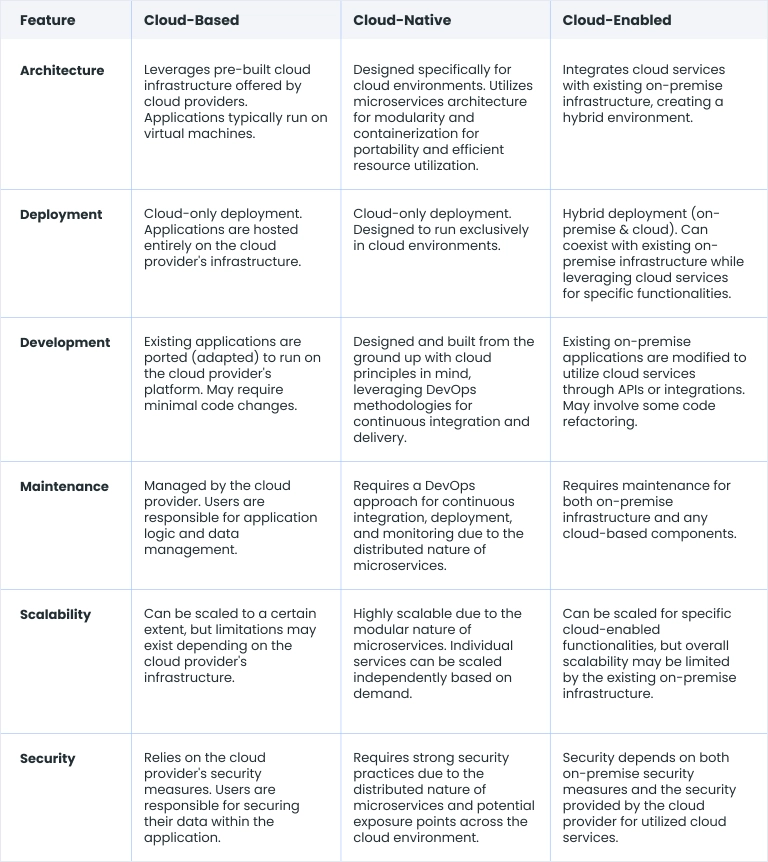
There is a whole spectrum between cloud-native and cloud-enabled solutions, offering maximum scalability and flexibility alongside on-premise deployment options for businesses with specific security or infrastructure requirements.
Use cases and examples
Cloud-based solution
Binariks has a list of great success stories to share. Once, we collaborated with eMotorWerks, a leading EV charging provider, to develop a cloud-based analytics dashboard for their JuiceNet platform. Facing tight deadlines and a shortage of local talent, eMotorWerks turned to Binariks for a remote software development team.
Our team delivered a solution that enables users to monitor electricity prices, predict optimal charging times, and access consumption statistics. With Agile methodologies and a cross-functional team, we ensured timely deployment and positive feedback from eMotorWerks and users.
Collaborating with Binariks means accessing a dedicated team of experts committed to delivering innovative solutions tailored to your needs. Whether you seek specialized talent, aim for scalable development, or need AWS or GCP consulting services , Binariks offers the flexibility and expertise required to meet your goals. Contact us and check it out yourself!
Cloud-native solution
The popular music streaming platform Spotify utilizes cloud services and container orchestration to manage its extensive music catalog, provide personalized recommendations, and support millions concurrent users across various devices.
Leveraging cloud-native technologies, Spotify can scale its services on-demand, optimize resource allocation, and continuously deliver new features and updates (Source ).
Cloud-enabled solution
Pfizer, the global pharmaceutical giant, revolutionized its supply chain by migrating it to the cloud and introducing a virtualized layer that facilitates seamless information sharing among stakeholders.
By virtualizing its supply chain, Pfizer streamlines operations, responds swiftly to market fluctuations, and ensures regulatory compliance, ultimately elevating its competitiveness in both patented and generic drug markets (Source ).
Factors to consider choosing the right cloud solution
Choosing the ideal cloud solution is akin to navigating uncharted territory – you need a compass to guide your way. Here, we'll explore critical factors to consider when selecting the cloud solution that perfectly aligns with your business needs and technical landscape:
- Budget considerations: Cloud-based solutions often follow a subscription fee, while cloud-native and cloud-enabled approaches may require upfront investment for DevOps practices or cloud service integrations. Carefully assess your budget and choose a model that aligns with your financial resources.
- Security and compliance: Research the cloud provider's security practices, certifications, and compliance with relevant industry regulations. Ensure the solution meets your data security and privacy requirements.
- Support and Service Level Agreements (SLAs): Evaluate the cloud provider's support options, response times, and service level agreements (SLAs) to ensure they meet your needs for uptime and performance guarantees.
By carefully considering these factors, you'll be well-equipped to make an informed decision and select the cloud solution that propels your business forward on its digital transformation journey.
Best practices for implementing cloud solutions
Collaborating with top cloud consulting firms allows access to the latest advancements and best practices in cloud technology. Here are some key ones to ensure a smooth and successful cloud implementation:
- Define a clear cloud strategy
Don't jump straight into migration. Develop a comprehensive cloud strategy that aligns with your business goals, considering both cloud-native and cloud-based solutions. This roadmap should identify which applications and functionalities are best suited for the cloud and outline a migration timeline.
- Start small and scale gradually
Avoid a "big bang" approach. Start with a pilot project to identify challenges and gain experience. Then, migrate additional applications or functionalities to the cloud.
- Embrace automation
Cloud platforms offer a wealth of automation tools. Utilize infrastructure as code (IaC) and configuration management tools to automate provisioning, configuration, and deployment processes, streamlining cloud management.
How to get started with cloud adoption
Whether cloud-based, cloud-native, or cloud-enabled solutions, understanding and leveraging the right cloud technologies can transform your operations, enhance agility, and significantly reduce costs.
Collaborating with professionals in cloud development services will help you choose the best option tailored to your unique needs and simplify complex cloud implementation.
At Binariks, we specialize in guiding businesses through their cloud journey, offering expert consulting and implementation services. Our team ensures a smooth transition to the cloud, enabling you to unlock the full potential of cloud technologies. Let Binariks empower your business to soar higher in the digital space and help you keep ahead of the competition. Reach out to us to harness the power of the cloud.