

Artificial intelligence and machine learning are transforming software development —but they also bring new challenges. Traditional approaches to the SDLC model may fall short of addressing these technologies' nuances, from the iterative nature of model training to the hurdles of deploying adaptive systems. AI-driven projects need a specialized approach that truly fits their dynamic and data-driven nature.
At Binariks, we insist that AI/ML development is all about ensuring high-quality data, rigorous model validation, and continuous monitoring to maintain top performance. Every phase of the SDLC, from initial planning to long-term maintenance, must be tailored to support AI's evolving needs. We're here to help you build AI solutions that are scalable, reliable, and future-proof.
In this article, you'll learn:
- Why AI/ML projects need a customized SDLC model in AI to succeed;
- The biggest challenges in scaling AI/ML solutions;
- Tools and frameworks that streamline the SDLC AI process;
- How adopting SDLC practices enhances the reliability of AI-driven products;
- Best practices for implementing SDLC in AI/ML projects.
Ready to transform your AI/ML projects with a tailored SDLC approach? Dive into the details to discover proven strategies and tools.
Why AI/ML projects need a tailored SDLC approach
Traditional software development lifecycle (SDLC) processes often fail to address the unique demands of AI/ML projects. As Forbes notes, "The main issue with traditional SDLC frameworks is that they are rigid and not designed for iterative processes, making it difficult to adapt to evolving needs like dynamic data and machine learning models." These limitations highlight the need for a more tailored approach to AI/ML project development (Source ).
AI/ML projects require SDLC phases that account for iterative model training, data preprocessing, and the continuous need for validation and monitoring.
Unlike static software systems, AI/ML models are affected by issues such as model drift and data distribution changes, which can degrade their performance over time. A customized SDLC for AI/ML projects ensures these complexities are managed effectively, allowing businesses to maintain model reliability and scalability.
Tailored solutions, such as those provided by Binariks, focus on integrating best practices at every stage of the AI SDLC. Their AI/ML development services help businesses navigate these challenges, ensuring efficient workflows and sustainable success.
Challenges in deploying AI/ML models at scale
Scaling AI/ML models is fraught with challenges that can undermine their performance, efficiency, and cost-effectiveness. "For AI/ML to make a sizable contribution to a company's bottom line, organizations must scale the technology across the organization, infusing it in core business processes, workflows, and customer journeys to optimize decision-making and operations in real time" (Source ).
Key technical challenges
- Performance optimization: Maintaining high performance as AI/ML models scale is complex. Models must process increasing data volumes and interactions without compromising speed or accuracy.
- Cost management: Scaling models often demands extensive computational resources, resulting in increased costs. Effective strategies for optimizing resource usage are essential to manage these expenses.
- System adaptability: AI/ML systems must adapt to a growing number of users while ensuring seamless scaling, robust functionality, and consistent user experience.
A structured approach to scaling AI/ML projects is vital. Incorporating a tailored software development life cycle AI process ensures the scalability and reliability of these systems while addressing performance and adaptability concerns.
Enhancing security
Increased scale often brings heightened risks, making security an essential aspect of AI/ML systems. Adopting an SSDLC embeds security protocols at every stage of development, safeguarding systems against vulnerabilities.
Moreover, AI/ML SDLC implementation provides a framework for systematically managing data processing, deployment, and model monitoring challenges. Businesses looking for guidance on implementing SDLC on AI can benefit from these structured methods to ensure success at scale.
By combining tailored SDLC strategies with robust security measures, organizations can address the challenges of scaling AI/ML models while delivering high performance, adaptability, and cost efficiency.
Key issues in AI/ML SDLC: From model drift to validation
Implementing an effective SDLC for AI/ML projects introduces unique challenges that differ from traditional software development models . These challenges stem from the iterative and data-driven nature of AI/ML systems, which require constant monitoring and adaptation. Without addressing these issues, the reliability and scalability of AI solutions can suffer.
Model drift
One of the most critical challenges is model drift, which occurs when the statistical properties of input data change over time. This can lead to reduced model performance and accuracy, making continuous monitoring and retraining essential components of any AI SDLC implementation. Failing to manage model drift can result in outdated predictions and poor decision-making.
Stale data
AI/ML models heavily depend on high-quality and up-to-date data. Training models on stale or irrelevant data can degrade performance, leading to biased or inaccurate outputs. Integrating robust data validation processes within the SDLC steps for AI projects ensures that only relevant, current datasets are used during training and updates.
Accuracy verification
Verifying the accuracy of AI models is another significant hurdle. Unlike traditional software, where testing often follows predictable patterns, AI/ML systems require dynamic validation methods to assess how well models generalize to real-world scenarios. A custom SDLC for AI solutions should include dedicated steps for model validation and testing to ensure reliability and consistency across deployments.
Organizations can effectively address these challenges by establishing a custom SDLC for AI solutions. Integrating best practices for monitoring, retraining, and validation into the SDLC mitigates risks and ensures sustainable performance over time.
Check out this article on the 11 most popular software development models for more insights into different lifecycle frameworks.
Essential tools and frameworks for AI/ML SDLC
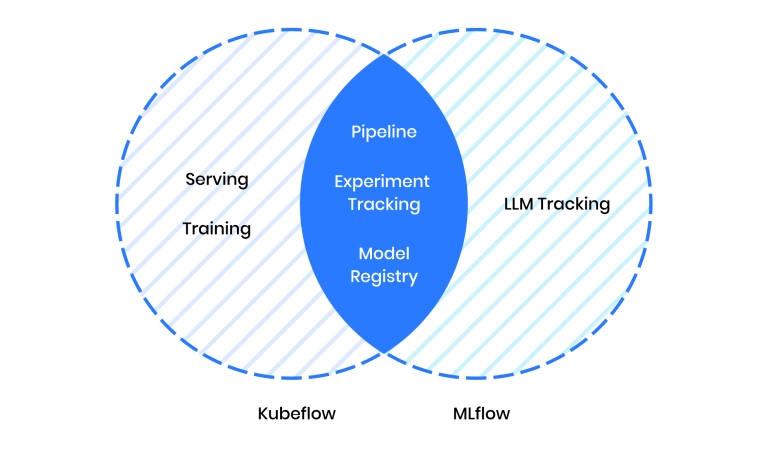
Implementing AI development and SDLC processes requires the right tools to streamline workflows and ensure efficiency. Popular frameworks like MLflow and Kubeflow are essential for managing the lifecycle of AI/ML models.
Key tools and frameworks:
- MLflow: This platform simplifies tracking experiments, packaging machine learning code, and managing model deployment. It ensures reproducibility and collaboration across teams during the entire development lifecycle.
- Kubeflow: Designed for Kubernetes, Kubeflow streamlines the deployment and scaling of machine learning workflows. It supports seamless integration of multiple pipelines, making it ideal for large-scale AI/ML projects.
- TensorBoard: A visualization toolkit for machine learning, TensorBoard provides insights into model training, performance metrics, and debugging workflows. It's particularly useful for tracking model improvements over time.
- Airflow: This workflow management tool automates complex scheduling and task execution for data pipelines. Airflow enables developers to easily create, monitor, and maintain dynamic workflows.
- DataRobot: A comprehensive platform for building and deploying AI models, DataRobot automates tasks like feature engineering and model tuning. It's ideal for teams looking for an end-to-end solution to accelerate AI projects.
These tools ensure an effective SDLC for AI models by addressing complexities like training, validation, and deployment. By implementing SDLC in AI/ML with these solutions, organizations can enhance scalability and maintain efficient workflows.
How SDLC for AI/ML enhances product reliability
A tailored SDLC for AI ensures the stability and durability of AI/ML-driven products by incorporating flexibility and iterative improvement. It enables systematic planning, rigorous testing, and continuous monitoring, addressing issues like model drift and data changes.
As highlighted in a recent study, "Traditional waterfall models are too rigid for AI/ML projects, where requirements and models often evolve during development. Iterative SDLC methodologies provide the flexibility needed to adapt and enhance product reliability" (Source ). By aligning development processes with evolving needs, businesses can maintain consistent performance and accuracy in AI solutions.
Best practices for implementing AI/ML SDLC
Implementing a robust SDLC for AI/ML projects requires the following best practices to ensure efficiency, reliability, and scalability:
- Define clear objectives: Establish measurable goals for the AI/ML project and align the SDLC processes to meet these objectives. This ensures clarity and consistency throughout the development lifecycle.
- Prioritize data quality: Incorporate robust data preprocessing, validation, and monitoring techniques to maintain model accuracy and reliability.
- Iterative development: Use agile or iterative methodologies to adapt to changes in data, requirements, or model performance during development.
- Automate testing and deployment: Implement automation tools for testing, validation, and deployment to reduce errors and accelerate development timelines.
- Monitor continuously: Post-deployment monitoring is essential to address model drift, data changes, and performance degradation, ensuring long-term stability.
By adhering to these practices, businesses can optimize the SDLC process for AI/ML, delivering scalable and reliable solutions that meet evolving demands.
Optimize AI development for long-term success
AI/ML projects come with unique challenges—from managing model drift to scaling deployments. A tailored SDLC is essential to ensure stability, scalability, and reliability at every stage.
Binariks offers expertise in designing and managing custom development lifecycles tailored to your project's needs. With proven experience in AI/ML development and delivering scalable and secure solutions, we help businesses streamline workflows, optimize performance, and maintain long-term reliability.
Whether you need to establish a structured AI/ML development process, ensure seamless model integration, or implement robust monitoring and validation frameworks, we're here to guide you. Ready to elevate your AI/ML projects? Partner with Binariks to implement a solid SDLC that drives results.